
AgentenCode News · October 18, 2026 · AI agents · work and governance
Anthropic study: AI agents reshape jobs and junior hiring
Anthropic's new study examines agent runtime, human reviews and junior technical hiring. What the six-to-one figure does and does not show.
In brief
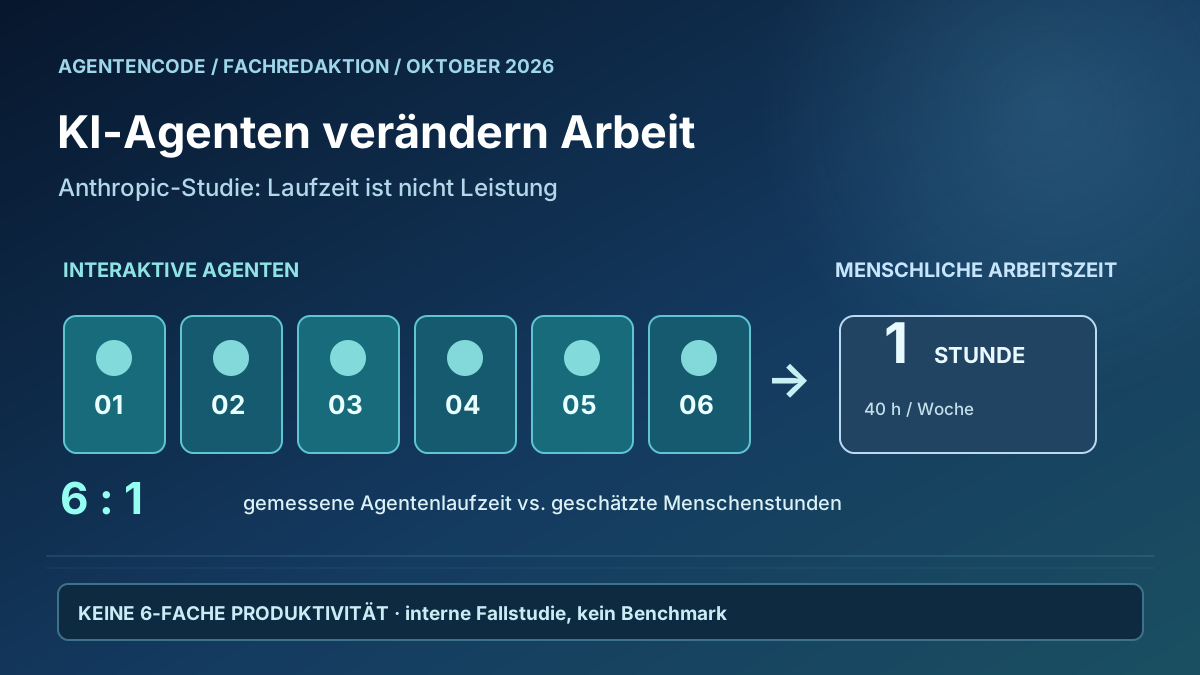
An Anthropic Institute report published October 16, 2026 describes changing work inside its own company. By August, measured interactive agent runtime reached roughly six times the assumed working hours of human operators. This is neither a sixfold productivity finding nor a representative statistic for other companies.
What the researchers actually studied
The Anthropic Institute published How employment is changing at Anthropic on October 16, 2026, authored by Nathan Wilmers, Regina Catipon, Maxim Massenkoff and Peter McCrory. The research combines internal usage records, employment and output indicators, calendars, staff surveys, communications and 17 interviews. It concerns a particularly AI-intensive company examining its own organization, not a representative independent survey of workforces across industries.
The six-to-one figure compares active interactive-agent runtime with estimated human working hours. For people, the analysis assumes 40 hours per week. Agent working time includes inference and active tool use, with long idle periods excluded. The resulting ratio is not the same as six times more useful work, six times better output, or a measured reduction in staff requirements.
Output increased, but attribution is difficult
The report documents more code commits per engineer and changes across sales and legal work. Researchers compare 192 engineers who adopted coding agents with 74 who had not adopted them during the observed period. Several code-quality proxies, including subsequent code removal and reverts, show no detectable difference between human and agent-authored code under the comparisons made.
These results do not prove that agent-generated code is always correct. The authors note that engineers who would later adopt agents were already on steeper output trajectories, and tool adoption was not randomized. Anthropic was also expanding quickly. Other organizations should evaluate their own tasks and quality controls rather than convert a correlation into a universal product claim.
Review work becomes a bottleneck
Anthropic estimates interactive Claude sessions spend roughly 80% of elapsed time awaiting human input. Converting model output to reading time under stated assumptions suggests that reviewing all agent text could consume more than half a week for some nontechnical employees. This is an estimated reading burden, not direct measurement of every employee's actual reading time.
Employees respond by building monitoring dashboards, authoring instructions and managing pipelines of other agents. The study calls some of this meta-work: activities required to manage the agents rather than directly finish the original task. Human context sharing, decision-making and approval remain important even with higher levels of automation.
Junior hiring shifts require careful interpretation
The share of junior staff in Anthropic's technical departments dropped from 21% to 14%, while junior hires' share of technical recruitment declined from 27% to 9% over the reported periods. Yet the business continued to grow and hire. These are composition changes within one company, not proof of economy-wide layoffs or a forecast of all entry-level careers.
The findings raise an organizational question: how will junior employees develop expertise when introductory implementation work is delegated to agents? The report discusses internal redeployment, but it does not establish a general solution for every employer.
How to apply the insight responsibly
Enterprise pilots should count not only automated completions but also review hours, corrections, escalations, errors and time until final human acceptance. High-impact actions need defined approval gates. Measuring the speed of the first generated answer without rework can overstate a workflow's benefit.
Our Claude Code profile gives related product context, not independent proof of public-product performance from this internal study. See Agentic Organizations for organizational design and AgentenFreigabe for questions about controlled actions.
AgentenCode · editorial perspective
My assessment: What the study means for businesses
My assessment: Six-to-one runtime attracts attention, but the more important development is the growing workload of review and orchestration. Companies should budget human attention and corrections as real operating costs in every pilot. Junior career development is equally important: if the introductory tasks that once trained experts disappear, employers need new ways to build expertise. This is editorial analysis, not independent research into Anthropic's workforce.
Personal editorial interpretation by Kai Schiller, not independent field research.
Four practical checks
- Never equate agent runtime with productivity
- Measure human review, errors and approval lead time
- Plan routes for junior employees to develop expertise
- Verify product-specific capability and availability separately
Vendor usage metrics do not establish features or plan availability of a specific agent profile. Capabilities and operating rights need their own evidence.
Frequently asked questions
Does the six-to-one ratio mean six times greater productivity?
No. It compares active agent runtime to assumed human working hours within Anthropic, not quality-adjusted output or business value.
Does the research establish agent-caused mass layoffs?
No. It reports a change in junior hiring shares while Anthropic's overall workforce grew.
Can other companies generalize these findings?
Not directly. The data come from one AI developer's own workplace; local pilots need their own measurements.
Original sources and methodology limits
The report was checked against the provider's original research. This is internal research or usage evidence, not an independent product benchmark or a guarantee for the linked AgentenCode profile.
Agent profile / related context
Claude Code – related product profile; check source and plan scope separately →
Coding-Agenten als Kategorie betrachten →
Agentic Organizations – organizational context →
Agent Fit: review requirements →
Author and transparency
Editorial assessment by Kai Schiller. Personal interpretation is separate from the first-party research. AgentenCode did not conduct independent product benchmarks.