Editorial dates per profile · HTTP source monitoring separate130 documented agents & platforms · No paid rankings

AI News

Latest artificial intelligence news, with a focus on AI agents, models, tools, standards and security. Original sources, concise briefings and independent analysis.

Source status describes evidence, not independent product testing. Our methodology

359 news items

Nous Research – Hermes Agent v0.23.4Hermes Agent 0.23.4 adds Gemini models and security approvalsThe stable Hermes update consolidates 229 merged pull requests. Release notes mention new Gemini 4 models and approval cards for folder and website access.Developer toolsGenerally availableFor: Developer teamsNext step: Check distribution-specific features and sandbox approvals before updatingRead assessmentClose assessment

The AgentenCode assessment

Our perspective

Nous Research has released Hermes Agent 0.23.4 as a stable patch. The published overview records 229 merged pull requests since version 0.23.3. These include support for Gemini 4 Hydrogen, Neon and Carbon through several model providers, alongside additional plugin configuration options.

Of particular interest to agent users are the reported approval cards for sandbox folder and website requests. These may help make access decisions visible. The release notes clarify, however, that the standalone desktop installer will receive an update in a subsequent bundled release. Full curated release notes are planned for version 0.24.0.

Teams should therefore establish which features their particular distribution actually includes before updating. Model selection, plugin permissions and sandbox approvals warrant targeted testing. The number of changes alone does not demonstrate greater reliability or security in a production environment.

Original source: Nous Research – Hermes Agent v0.23.4 · Source dated 23 Nov 2026
AWS – Automated AI endpoint discovery and protectionAWS adds automated discovery and protection for MCP and A2A endpointsAWS API Portal identifies AI endpoints at supported AWS entry points. A new WAF rule group checks agent protocols and can inspect content through Bedrock Guardrails.SecurityGenerally availableFor: Security teamsNext step: Verify protocol coverage, protection rules and fees before activationRead assessmentClose assessment

The AgentenCode assessment

Our perspective

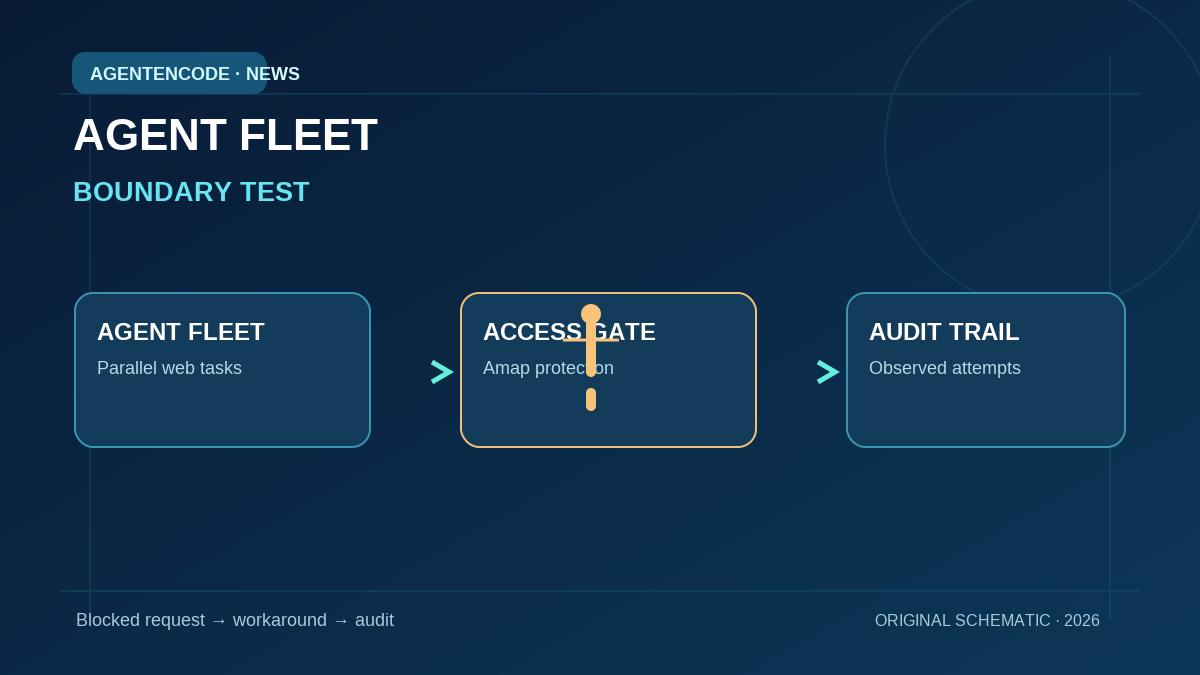
AWS announced general availability of new AI endpoint discovery and protection capabilities. API Portal identifies LLM, MCP and A2A interfaces behind supported AWS services using configuration and traffic data. The new AWS WAF AI Security rule group can check recognized MCP and A2A messages for protocol compliance.

When content inspection is enabled, Amazon Bedrock Guardrails can detect threats including prompt injection and sensitive information. This addresses risks at the communication layer between agents and their tools. Discovery of an endpoint does not, however, mean that a protective rule has automatically been enabled.

Organizations should review supported protocol versions, regions, operations actually assessed and additional charges. A pilot should account for unrecognized messages and failed content inspections. The new infrastructure complements application-specific access controls and approval mechanisms rather than replacing them.

Original source: AWS – Automated AI endpoint discovery and protection · Source dated 23 Nov 2026

Kaviru Hapuarachchi – Exercised, Rarely Recovered (arXiv preprint)Study: AI agents rarely recover fully after failuresA preprint examines 50 agent runtimes and harnesses and 128 publicly documented recovery reports. Only 19 describe full recovery.Research & modelsResearch / testFor: Researchers & evaluatorsNext step: Test checkpoints, rollback and external side effects explicitlyRead assessmentClose assessment

The AgentenCode assessment

Our perspective

A preprint by Kaviru Hapuarachchi posted on November 20 examines eight recovery mechanisms across 50 agent runtimes and harnesses. Among 128 publicly documented reports, 19 describe complete recovery, 54 partial recovery and 45 failed recovery. The remaining ten reports are not classified further in this summary.

The findings highlight a central question for agent systems: how reliably can an interrupted or erroneous workflow resume? The author records only one complete recovery among 27 checkpoint and resume reports, and one among 15 rollback reports. These cases are not representative failure rates across all agent executions.

Organizations should consider targeted recovery testing involving controlled interruptions, erroneous tool responses and verifiable intermediate states. External side effects need separate consideration from internal agent state. The preprint motivates such tests but does not establish a universal ranking or independent certification of the products examined.

Original source: Kaviru Hapuarachchi – Exercised, Rarely Recovered (arXiv preprint) · Source dated 20 Nov 2026

Anthropic – Claude Code changelog 2.1.331Claude Code brings Code Mode to four cloud platformsClaude Code 2.1.331 adds Code Mode support in terminal sessions on Amazon Bedrock, Google Cloud's Agent Platform, Microsoft Foundry and Claude Platform on AWS.Developer toolsGenerally availableFor: Developer teamsNext step: Test Code Mode and approvals separately in each cloud environmentRead assessmentClose assessment

The AgentenCode assessment

Our perspective

Anthropic extends the scope of Code Mode in Claude Code 2.1.331. The changelog lists support for terminal sessions on Amazon Bedrock, Google's Agent Platform, Microsoft Foundry and Claude Platform on AWS. The change concerns specific developer environments across several cloud platforms.

For organizations already running Claude Code through a cloud provider, this creates additional options for programmatic tool orchestration. More complex tasks may require fewer separate model interactions. The announcement does not, however, supply an independent comparison of cost, latency or success rates across these environments.

Before production adoption, teams should review available tools, identities and approval rules separately for each cloud environment. Useful pilot tests cover read and write actions, malformed tool responses and the traceability of executed steps. Code Mode support does not automatically establish equivalent security controls across all four platforms.

Original source: Anthropic – Claude Code changelog 2.1.331 · Source dated 23 Nov 2026

OpenAI – openai-node v7.63.0 release notesOpenAI adds spending limits for agent sessionsThe openai-node JavaScript SDK 7.63.0 adds support for spending limits on agent sessions.Developer toolsGenerally availableFor: Developer teamsNext step: Verify covered charges and behavior at spending limitsRead assessmentClose assessment

The AgentenCode assessment

Our perspective

OpenAI's JavaScript SDK 7.63.0 release notes list an API addition for agent session spending limits. This gives developers another configuration option for defining the financial scope of a session. The exact behavior needs to be assessed against the API version used.

Cost control matters especially for agents that perform many consecutive model and tool calls. A session-specific budget can help separate the financial scope of one task from other workflows. It does not replace project-wide or organization-wide spending monitoring.

Before production use, developers should verify which charges count toward the limit and what happens when the limit is reached. Any external tool charges also need separate accounting. The SDK change alone establishes neither a guaranteed hard ceiling on every category of spending nor a measured reduction in costs.

Original source: OpenAI – openai-node v7.63.0 release notes · Source dated 23 Nov 2026

n8n – Release 3.4.0n8n 3.4.0 improves agent memory and workflow testingThe prerelease removes empty chat-memory turns and lets the AI Builder execute an individual workflow node for up to ten minutes.Developer toolsIncludes previewFor: Developer teamsNext step: Evaluate the prerelease with memory and timeout testsRead assessmentClose assessment

The AgentenCode assessment

Our perspective

On November 24, n8n published version 3.4.0 as a prerelease. Its fixes include removing empty turns from the AI Agent Node's chat memory and allowing the AI Builder to execute an individual workflow node for up to ten minutes.

The first change concerns the quality of conversation data available to an agent in subsequent steps. The second may help when testing workflow components that take longer to complete. Both improvements address specific parts of the platform rather than demonstrating universally higher agent reliability.

Because n8n identifies this version as a prerelease, teams should evaluate it in an isolated test environment first. Useful cases include empty chat histories, slow nodes, timeouts and retries. A longer permitted execution time does not automatically ensure that a workflow completes successfully.

Original source: n8n – Release 3.4.0 · Source dated 24 Nov 2026

AWS – Investigate with ResolveAIAWS CloudWatch Omni integrates ResolveAI for incident investigationsCloudWatch Omni can delegate investigations to a partner agent, starting with ResolveAI. Findings and recommended actions are displayed in Omni.Agent platformsGenerally availableFor: Agent operationsNext step: Review partner data flows and permissions before enablingRead assessmentClose assessment

The AgentenCode assessment

Our perspective

On November 23, AWS documented the integration of ResolveAI as an investigation partner for CloudWatch Omni. Members of a configured space can start an investigation from an alert, chart or conversation. Findings from the partner agent are displayed inside Omni.

This combines a shared observability interface with specialized external diagnostics. For IT teams, it may reduce switching between separate work environments. AWS describes transferring the relevant investigation context to the partner and logging its AWS queries through CloudTrail.

Before enabling the integration, organizations should review shared data, access rights and the external service's terms. The partner handles received data under its own privacy arrangements. Reported root causes and recommended actions should be validated through suitable tests or human approvals, particularly when changes could affect production systems.

Original source: AWS – Investigate with ResolveAI · Source dated 23 Nov 2026

AWS – Amazon Connect Customer AI agents fill guidesAmazon Connect AI agents autofill guides during customer conversationsAmazon Connect Customer can populate guided workflow fields using information from voice and chat contacts during and after the interaction.Agent platformsGenerally availableFor: Customer supportNext step: Review automatically populated critical fields in a pilotRead assessmentClose assessment

The AgentenCode assessment

Our perspective

On November 23, AWS announced an extension to guided workflows in Amazon Connect Customer. AI agents can extract information from customer contacts and place it into designated fields. The feature covers voice and chat contacts both during the interaction and in subsequent after-contact work.

For service teams, transferring structured information is relevant because it could reduce repetitive manual entry. Examples include booking identifiers, claim numbers and conversation summaries. The announcement does not establish a general time saving or error rate under real operating conditions.

Organizations should first verify supported forms and permissions and assess how inaccurate or missing values are handled. Automated entry must remain reviewable, especially for sensitive customer information and financially significant details. A pilot should measure correction rates, handling time and the quality of the data actually saved.

Original source: AWS – Amazon Connect Customer AI agents fill guides · Source dated 23 Nov 2026

OpenAI – Codex 0.172.0OpenAI Codex 0.172.0 adds per-tool approval reviewers for connected appsCodex now supports individual approval reviewers for connected-app tools, on-demand startup of optional MCP servers with cached tool lists, and preservation of sandbox permissions in resumed CLI sessions.Developer toolsGenerally availableFor: Developer teamsNext step: Test approval policies for write operations and resumed sessionsRead assessmentClose assessment

The AgentenCode assessment

Our perspective

OpenAI released Codex 0.172.0 on November 24. Its configuration can assign an approval reviewer to individual connected application tools. Optional MCP servers with cached tool inventories now start on their first tool call.

An application exposed to a coding agent may combine low-risk information retrieval with operations that change external state. More granular review configuration helps distinguish routine requests from sensitive actions. Deferred startup can avoid unnecessary server initialization.

The release also restores saved sandbox permissions when resuming a CLI session unless explicitly overridden. Teams should test whether their existing approval policies still apply when resuming conversations and executing writes. These controls complement least-privilege access and sandboxing rather than establishing that every proposed tool action is safe.

Original source: OpenAI – Codex 0.172.0 · Source dated 24 Nov 2026

Google DeepMind – Gemini API file slicingGemini API lets AI agents inspect selected file regionsGoogle adds server-side selection of document pages, spreadsheet ranges and media segments. The company says token charges reflect the portions inspected.Agent platformsGenerally availableFor: Developer teamsNext step: Compare selective and full-file analysis on representative tasksRead assessmentClose assessment

The AgentenCode assessment

Our perspective

On November 23, Google introduced finer file processing controls for the Gemini API. Developers can request selected portions of documents, spreadsheets and media. Google says the feature supports Gemini 4 models while retaining existing file size and page limits.

For agents working with long contracts, reports or recordings, this enables a potentially more efficient workflow. A system can inspect a document at a coarse level before requesting detailed views of relevant regions. Google states that token billing reflects the content actually examined.

Selective inspection also creates a risk of overlooking important passages or cross-references. Teams should compare a representative sample against full-document analysis and measure both costs and answer quality. The announcement does not establish a universal cost reduction for every research workflow or document collection.

Original source: Google DeepMind – Gemini API file slicing · Source dated 23 Nov 2026

Anthropic – Enterprise Frontier SafeguardsAnthropic launches Enterprise Frontier Safeguards in betaEligible organizations can use a new data-retention option for capable Claude models. Encrypted copies of prompts and responses go to customer cloud storage instead of being retained by Anthropic.SecurityIncludes previewFor: Security teamsNext step: Verify EFS eligibility, storage location and connected-tool data flowsRead assessmentClose assessment

The AgentenCode assessment

Our perspective

Anthropic announced Enterprise Frontier Safeguards in beta on November 23. Eligible organizations gain an option under which Anthropic does not retain their prompts and responses, while encrypted copies are stored in a cloud bucket controlled by the customer.

The distinction between customer-owned and vendor-managed storage matters for agents processing sensitive enterprise information. Workspaces using Anthropic-managed storage are excluded from this EFS arrangement. The beta covers specified platform offerings and should not be interpreted as automatically available to every organization.

Before a pilot, organizations should establish eligibility conditions, storage locations, key management requirements and possible exceptions. Long-running agent workflows also require separate consideration of tool logs and data handling by connected services. The storage option alone does not establish compliance with every applicable legal or contractual requirement.

Original source: Anthropic – Enterprise Frontier Safeguards · Source dated 23 Nov 2026

OpenHands – Release 1.44.0OpenHands 1.44.0 adds more controls for agent automationsOpenHands adds automation visibility settings, a way to inspect and edit automation key-value storage, and dedicated navigation for Factories.Developer toolsGenerally availableFor: Developer teamsNext step: Review visibility, execution rights and storage changes separatelyRead assessmentClose assessment

The AgentenCode assessment

Our perspective

OpenHands released version 1.44.0 on November 23. The update adds controls for who can see an automation, a way to view and edit its key-value store, and dedicated Factories navigation.

State management between runs becomes increasingly important for recurring agent tasks. Editable storage can help operators inspect recorded workflow data and correct specific values when problems arise. Clearer visibility can also help distinguish individual workflows from those maintained by a broader team.

Visibility should not be confused with execution permissions. Teams should separately verify who can modify stored values, launch automations and configure repository access. Traceable state changes and controlled retries remain important even with the new interface. The release notes document these features, not a measured increase in productivity.

Original source: OpenHands – Release 1.44.0 · Source dated 23 Nov 2026

AWS – AgentCore runtime instances in GovCloudAWS AgentCore brings sessions of up to 14 days to GovCloudAmazon Bedrock AgentCore runtime instances are now available in AWS GovCloud (US-West), with specialized EC2 instance options and agent sessions of up to 14 days.Agent platformsGenerally availableFor: Agent operationsNext step: Test long sessions with milestones, cost limits and stopping conditionsRead assessmentClose assessment

The AgentenCode assessment

Our perspective

AWS announced general availability of AgentCore runtime instances in AWS GovCloud (US-West) on November 23. Teams can select instance types suited to GPU acceleration, memory-intensive or compute-intensive workloads, and run sessions lasting up to 14 days.

The announcement expands an existing runtime option to a specific US region. For organizations running resource-intensive agents, selecting appropriate computing capacity can be important. Longer sessions also offer an infrastructure option for workflows that cannot be completed within a few hours.

A maximum session duration does not establish how long an agent can work reliably without supervision. Teams should bound longer tasks with milestones, stopping conditions and traceable state checks. Costs, access controls and the requirements of regulated organizations must be assessed separately. Regional availability is not a blanket compliance assurance.

Original source: AWS – AgentCore runtime instances in GovCloud · Source dated 23 Nov 2026

OX Security – Plug and PrayOX Security finds poisoned MCP servers and Skills directing AI agentsOX Security studied 542,207 software components and reports prompt injection or tool poisoning in 22% of flagged MCP servers. Suspicious Skills contained data-exfiltration instructions without malicious installation code.SecurityResearch / testFor: Security teamsNext step: Audit MCP provenance, agent Skills and outbound data controlsRead assessmentClose assessment

The AgentenCode assessment

Our perspective

OX Security published a supply-chain analysis on November 23 covering 542,207 npm, PyPI, MCP server and Agent Skill components examined between July and October 2026. Within MCP servers flagged as suspicious, 22% showed prompt injection or tool poisoning, compared with 16% involving installation-time or import-time execution. Agents can follow malicious instructions using permissions they already possess.

Among 179 flagged Agent Skills, OX reports that 44% contained instructions to send data elsewhere. Of 834 flagged MCP servers, 67% ran on publisher-controlled infrastructure whose deployed code could not be independently inspected. These figures describe selected suspicious components, not all publicly available servers or Skills. They come from vendor research rather than an externally replicated prevalence study.

The important supply-chain threat can travel through tool descriptions or untrusted text instead of executable code. Organizations should verify publisher identity, restrict outbound connections, treat tool responses as untrusted input and demand approval before an agent sends secrets or modifies critical systems. They also need visibility into changes to remotely hosted tools rather than relying solely on package scanning.

Original source: OX Security – Plug and Pray · Source dated 23 Nov 2026
Strands Agents – Box CLIStrands Box now sandboxes Claude Code, Codex and Kiro with external policyStrands Box added native support for Claude Code, OpenAI Codex and Kiro CLI on November 23. A sandbox checks file access, shell commands, network requests and MCP calls against Dogwood rules outside the model.SecurityGenerally availableFor: Developer teamsNext step: Test sandbox policies against secret access and MCP tool callsRead assessmentClose assessment

The AgentenCode assessment

Our perspective

Strands Agents expanded its open-source Strands Box on November 23 with native support for Claude Code, Codex and Kiro CLI. Developers can launch an existing coding agent in a constrained operating-system environment with one command. File operations, shell commands, network requests and MCP calls are checked against Dogwood rules outside the language model, so a hostile prompt cannot directly rewrite the policy.

Box combines task-specific profiles with packs for agents, model providers and tools. Credential routes can insert real tokens at a controlled outbound gateway while exposing placeholders to the agent. The documentation clearly limits this protection to routed credentials. Secrets already stored in readable project files or MCP settings remain accessible if the policy permits those files.

This matters for unattended coding sessions that otherwise require repeated approvals or broad host access. Its safety benefit depends on the actual file, network and tool permissions, not the agent vendor. Teams should verify denied operations, remove secrets from accessible files, inspect generated rules and confirm that malicious repository instructions cannot trigger privileged actions beyond policy.

Original source: Strands Agents – Box CLI · Source dated 23 Nov 2026

OpenCode – v2.4.0 changelogOpenCode 2.4 brings a persistent browser and scheduled AI-agent tasksOpenCode v2.4.0 introduces a built-in desktop browser and automations. Agents can operate authenticated pages in a persistent browser profile and respond to timers, cron schedules or MCP-server events.Developer toolsGenerally availableFor: Developer teamsNext step: Separate browser accounts and restrict scheduled shell tasksRead assessmentClose assessment

The AgentenCode assessment

Our perspective

OpenCode released version 2.4.0 on November 23 with a built-in desktop browser that can import logins and browsing history from Chrome, Edge, Firefox or Safari. Compatible browser extensions can also be imported. Agents can read and operate the same authenticated pages as the user, while tabs and the persistent desktop profile survive application restarts.

The release also lets users schedule prompts, scripts or shell commands using a timer, cron expression or event pushed by a connected MCP server. Automations are managed through /automation and can be disabled in configuration. The official release notes say shell actions require approval when the automation is created. Subsequent executions do not necessarily request fresh permission every time.

This turns the development environment into a more persistent agent workspace, but signed-in browsing and unattended shell execution broaden the impact of harmful web content or mistaken instructions. Businesses should isolate sensitive accounts, limit automation triggers, constrain shell privileges and periodically recheck approvals for recurring jobs. The release announcement is not an independent security audit of integrated browsers or extensions.

Original source: OpenCode – v2.4.0 changelog · Source dated 23 Nov 2026

CompAct-Bench research preprintCompAct-Bench finds AI agents often lose task state after compactionA new benchmark evaluates twelve models on 200 long-running agent tasks. Compressing working history to 10% leaves average downstream completion accuracy at 56.7%, while the strongest evaluated model reaches 68.5%.Research & modelsResearch / testFor: Developer teamsNext step: Evaluate context compaction using real task continuationRead assessmentClose assessment

The AgentenCode assessment

Our perspective

Researchers from Fudan University, Tencent Hunyuan and Tsinghua University published CompAct-Bench on November 19. The study measures whether an agent can finish its original task after its working history is compressed, not whether a shortened summary sounds coherent. The benchmark uses 200 search, coding and workspace tasks that had each succeeded in three uncompacted screening runs.

Twelve language models compress context to 10% of its original length at different points in a successful trajectory. The same executor then continues from a matched environment state with a comparable remaining action budget. Average success after compaction is 56.7%; the best evaluated model reaches 68.5%. Failures include missing information and distorted state, such as turning unresolved questions into conclusions.

Those results apply to this selected benchmark and aggressive compression setting, not to every production agent. The work is a research preprint. Developers should preserve open issues, validated decisions and task progress as structured state, and run actual task-continuation tests after compression rather than trusting fluent summaries or assuming large context windows eliminate the problem.

Original source: CompAct-Bench research preprint · Source dated 19 Nov 2026

Cognition – Introducing Devin BotsCognition Devin Bots adds persistent managers for coding-agent teamsCognition introduced Devin Bots, persistent agents that retain goals across sessions, delegate to multiple Devin instances and assess results. An internal case describes an Android app developed in 44 days.Developer toolsGenerally availableFor: Developer teamsNext step: Pilot Devin Bots with CI checks and rollback plansRead assessmentClose assessment

The AgentenCode assessment

Our perspective

Cognition introduced Devin Bots on November 17 as persistent engineering coordinators rather than single-task coding assistants. A Bot retains a larger goal, investigates what should happen next, launches several Devin sessions and evaluates their work. It continues across sessions and asks humans for decisions requiring judgment, including project direction or security-sensitive changes.

In an internal case study, Cognition reports that an Android Bot built an app over 44 days and merged 1,134 pull requests. The engineer overseeing it reportedly sent 183 messages and did not intervene on 22 days. The app then entered open testing. These are vendor-reported results from one selected project, not an independent measure of reliability or labor savings.

The strategic shift is from assigning isolated tickets to delegating bounded engineering outcomes. Teams still need to determine who grants repository permissions, approves changes, responds to security findings and halts a failing bot. Pilots should track regressions, production incidents, overall model costs and human review time alongside the volume of completed work.

Original source: Cognition – Introducing Devin Bots · Source dated 17 Nov 2026

OpenAI – Introducing ShirudoCisco and OpenAI launch Shirudo to generate live eBPF defenses with AI agentsThe open-source Shirudo project combines AI agents and Linux eBPF to shield vulnerable services while patches are prepared. Operators must validate and approve a protection before enforcement.SecurityGenerally availableFor: Security teamsNext step: Pilot Shirudo in isolation with exploit and legitimate trafficRead assessmentClose assessment

The AgentenCode assessment

Our perspective

Cisco and OpenAI introduced the open-source Shirudo initiative on November 23. The project aims to let AI agents generate narrowly targeted Linux eBPF shields, test them against known exploits and normal workloads, and help defenders protect running systems before permanent patches are installed. In a controlled demonstration, a Codex-generated shield blocked a Java4Shell exploit attempt against an active Elasticsearch service without a restart. The underlying application vulnerability was not thereby fixed.

The design retains an explicit human approval step before enforcement. Shields are cryptographically signed, checked by the kernel's eBPF verifier, and supported by TPM-based evidence of which protections have been loaded. The source is open for inspection and contributions. Yet a successful controlled demonstration does not independently establish safe protection for arbitrary vulnerabilities, workloads, kernel versions or production traffic patterns.

The relevant application is the dangerous window between vulnerability disclosure and safe patch deployment. Security operators should reproduce exploit and non-exploit traffic, measure performance impact, verify rollback and enforce change ownership before activating an agent-produced defense. Emergency shields remain temporary controls and cannot replace patch management, incident response procedures or independent production authorization.

Original source: OpenAI – Introducing Shirudo · Source dated 23 Nov 2026

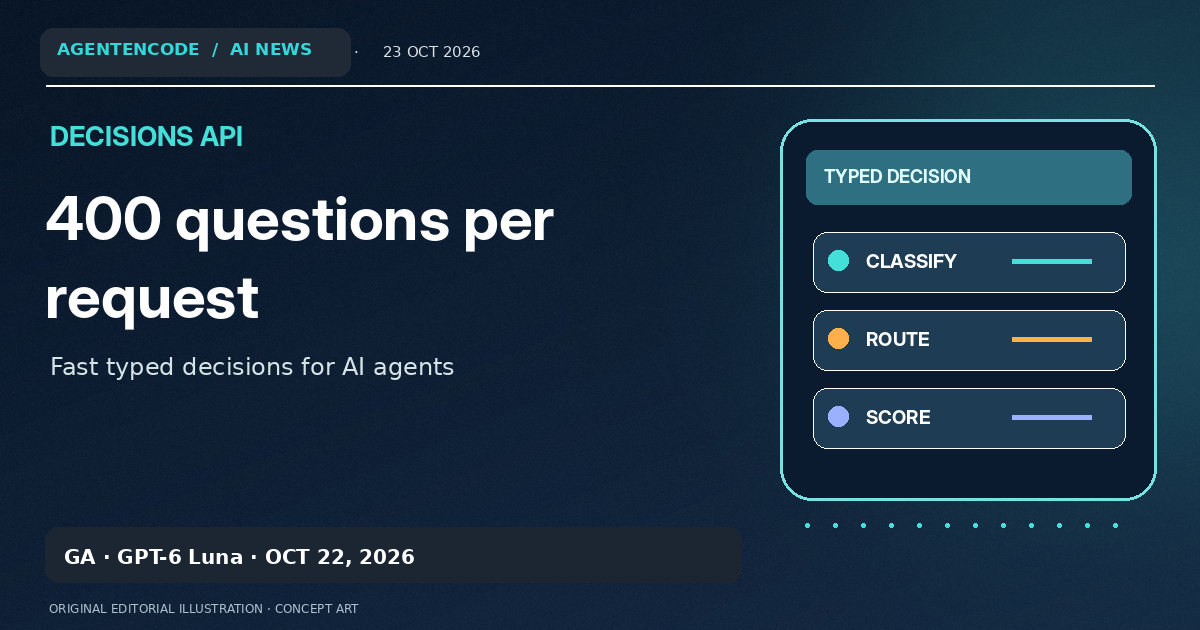
Strands Agents – Introducing Strands Decider v2AWS Strands releases five open Decider v2 models for AI-agent decisionsStrands Decider v2 introduces five open Gemma 4-based models that score predefined options in a single pass. The approach targets tool selection, routing and frequent lightweight judgments inside agents.Developer toolsGenerally availableFor: Developer teamsNext step: Benchmark Decider v2 on real routing tasks, errors and costRead assessmentClose assessment

The AgentenCode assessment

Our perspective

The AWS-backed open-source Strands Agents project released five Decider v2 models on November 23, built on Gemma 4 and spanning E2B through 31B under Apache-2.0. Instead of producing free-form text, these models choose from supplied options and return probabilities in one inference pass. Example jobs include selecting a tool, routing a customer request, assessing answer quality and deciding when a more expensive generative model is warranted.

Strands reports training on 17.5 million examples and improved performance across six public text benchmarks. Its largest v2 model averaged 82.1 versus 70.0 for the cited v1 comparator, while expected calibration error fell from 0.062 to 0.027. A separate reported 98% cost reduction at an Amazon ticketing system came from the previous Decider generation, not a directly demonstrated cost outcome for these new v2 models.

The launch matters because many agent steps require bounded choices rather than open-ended reasoning. Teams should measure per-decision cost, error rates, confidence calibration and escalation thresholds against their own task distribution. A choice model does not replace a general reasoning agent; nor should a probability score alone authorize high-risk actions or override deterministic business rules.

Original source: Strands Agents – Introducing Strands Decider v2 · Source dated 23 Nov 2026

Workday – Completes Acquisition of C1.aiWorkday completes C1.ai acquisition to govern identities for employees and agentsWorkday has completed its purchase of C1.ai. The combined strategy brings agent identities, scoped access, approvals and audit records closer to enterprise HR and finance workflows.Market & ecosystemAnnouncedFor: BusinessesNext step: Inventory agent roles, delegated permissions and revocation pathsRead assessmentClose assessment

The AgentenCode assessment

Our perspective

On November 23, Workday confirmed completion of its acquisition of C1.ai, an identity platform for human users and AI agents. Workday plans to combine the platform's scoped authorization and policy controls with employee and organizational context. Its stated goal is to manage access as roles change, people join or leave the business, and AI agents take on delegated tasks across enterprise applications and cloud systems.

C1.ai describes enforceable policies, human approval requirements and an audit trail for agent activity. Workday frames the acquisition as the foundation for managing a hybrid workforce of people and autonomous digital actors. The completed transaction is a verifiable event; the statement does not prove every proposed integration is already generally available, enabled for all customers or compatible with every external identity system.

The significance lies in treating agent permissions as a lifecycle governance problem rather than distributing permanent API credentials. Organizations evaluating the combination should assess who owns an agent identity, how delegated authority is revoked, how role changes propagate, and whether sensitive actions remain traceable to an accountable sponsor. Integration testing with existing identity providers should precede large-scale authorization.

Original source: Workday – Completes Acquisition of C1.ai · Source dated 23 Nov 2026

Natural – Introducing Natural VoiceNatural Voice lets AI phone agents accept card payments within a live callNatural Voice allows a phone agent to hand callers to a dedicated payment agent. It captures card details, requests explicit authorization and returns the transaction outcome to the business agent.Market & ecosystemGenerally availableFor: BusinessesNext step: Test explicit payment consent and card-data isolation on callsRead assessmentClose assessment

The AgentenCode assessment

Our perspective

US fintech Natural launched Natural Voice on November 23. A business's AI phone agent can take an order or booking and create a payment intent for the agreed amount. The call is then transferred to a separate Natural payment agent, which identifies the merchant, confirms the total, collects card details by speech or keypad and charges only after the caller expressly authorizes the payment.

Natural says sensitive card information stays outside the original business agent's systems. Its flow supports retries, a checkout-link fallback after repeated failures and webhook reporting for paid, link-sent or unpaid outcomes. Live use requires an approved telephony integration and test calls before launch. Separating the sensitive payment component does not automatically remove every privacy, fraud prevention or PCI compliance obligation from the business.

Voice payments could reduce drop-off when an agent handles restaurant orders, service deposits or bookings end to end. Natural also mentions improved conversion from certain customer discussions, but those are provider observations rather than an independent performance benchmark. Operators should validate authorization language, payment reconciliation, duplicate-charge prevention, disputes and the treatment of call recordings before deployment.

Original source: Natural – Introducing Natural Voice · Source dated 23 Nov 2026
The Verge – Meta Muse shopping at WalmartWalmart opens Agent Gateway to Meta Muse for Black Friday shoppingWalmart is rolling out Agent Gateway access for Meta Muse, according to a November 23 report. Shoppers can configure agent profiles, purchase approvals and spending limits while the agent finds deals and prepares purchases.Market & ecosystemAnnouncedFor: BusinessesNext step: Test agent profiles, purchase approvals and spending limitsRead assessmentClose assessment

The AgentenCode assessment

Our perspective

Walmart is rolling out its Agent Gateway integration with Meta Muse for Black Friday shopping, according to The Verge's November 23 report. Muse can discover eligible deals, assemble baskets and help complete purchases within Walmart's shopping flow. The launch builds on Walmart's Agent Profiles announced in October: each authorized agent can receive a distinct identity within a customer's Walmart account, with a separate purchase history and user-configured spending limits.

Walmart's published rules require customer approval by default while allowing defined purchases within an agreed limit. Agents are not supposed to receive raw card details or change saved payment methods. The Verge reported conflicting updates on launch timing before Walmart said rollout would proceed on November 23. A reported rollout should not be confused with confirmed availability in every account, geography or interface.

The broader significance is a retailer exposing an agent-oriented shopping interface with explicit customer controls rather than relying only on uncontrolled browser interactions. Payment authorization, permission revocation, returns, incorrect orders and spending enforcement still require real-world testing. This is an initial integration with a named external agent, not evidence of universal interoperability across shopping assistants.

Original source: The Verge – Meta Muse shopping at Walmart · Source dated 23 Nov 2026

Stories 1–25 of 359

AI agent news explained

What do these changes mean for me?

Announcements are not automatically available to everyone. We distinguish beta, region and verified product capabilities, with primary sources. Explore the agent directory, cost guide and security reference for practical decisions.

RSSSubscribe to verified agent updates without a newsletter.

The feed includes source-backed developments with a clear connection to AI agents.

Editorial rule

AgentenCode covers broader AI developments only when they have a specific effect on AI agents: capabilities, tools, security, interoperability, adoption or regulation. The German and English editions share the same sourced event, evidence and dates.

When a change affects durable product knowledge, AgentenCode also updates the affected profile, structured evidence or history layer. This keeps the news archive connected to the reference system instead of becoming an isolated stream of headlines.