
Can AI discover better drugs? MedChemBench exposes progress and limits
OpenAI's MedChemBench tests 99 medicinal-chemistry problems. Models show strong structural reasoning but important gaps in ranking compounds and predicting properties.
Drug discovery is harder than recognizing molecules
Impressive molecular illustrations and fluent chemical explanations are not the same as finding a useful medicine. A candidate must bind a biological target and still have acceptable absorption, stability and safety properties. Improving one feature can worsen another, which is why medicinal chemists work through repeated experiments and difficult trade-offs.
On November 20, 2026, OpenAI introduced MedChemBench to measure parts of this reasoning process. The evaluation draws on historical research rather than newly invented or clinically tested medicines. That distinction matters before treating a benchmark result as evidence of a scientific discovery.
Primary source: OpenAI – Can AI help scientists identify promising drug candidates? (20 Nov 2026)
What the 99-problem benchmark contains
The evaluation includes 99 questions based on 117 scientific papers and patents involving 761 distinct molecular structures. A model receives selected information from an earlier point in a research program, such as the disease-related target, known compounds and existing experimental findings.
Instead of rewarding familiar scientific vocabulary alone, the assessment asks whether a system can combine a molecular drawing with evidence and justify its next choice. Partial credit is possible, and the evaluation distinguishes different skills rather than collapsing every kind of performance into a single success rate.
Four scientific abilities are examined
MedChemBench evaluates molecular reconstruction, scientific explanation, compound ranking and selection, and numerical property predictions. These abilities are related but not interchangeable. A model may correctly interpret a molecule's structure while recommending a poor candidate for synthesis or further testing.
OpenAI illustrates the challenge with work on PRMT5 inhibitors. One compound might inhibit the target more effectively in cells, while another crosses cellular barriers more readily or breaks down more slowly. Selecting the next candidate requires weighing all those properties together.
Background reading: AI knowledge
How GPT-6.2 Astra performed
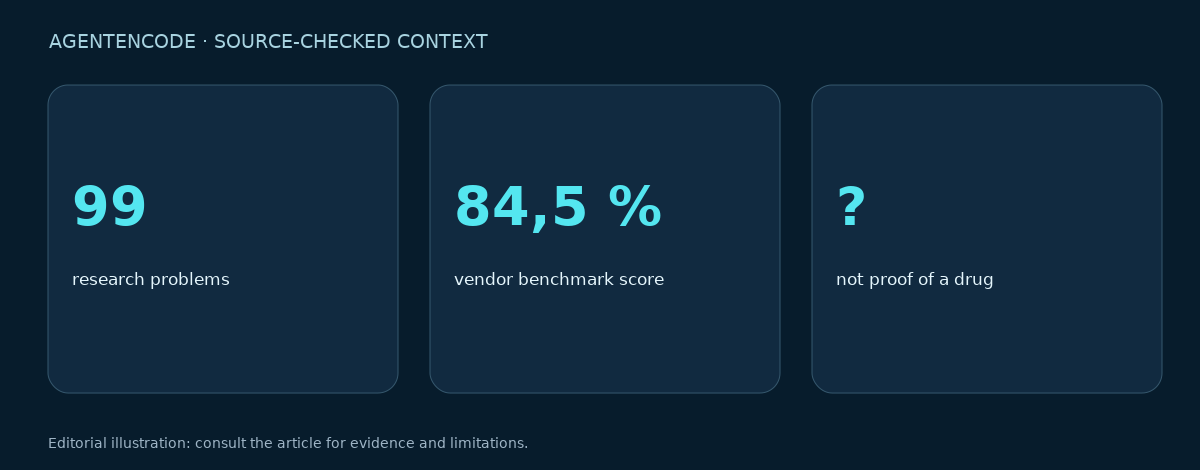
OpenAI reports that GPT-6.2 Astra received 84.5% of the available benchmark credit at the xhigh reasoning setting. The same announcement gives 83.3% for GPT-6 Astra and 82.0% for GPT-6.1 Sol. The figures come from the developer's own evaluation and are not independent evidence of clinical performance.
Most importantly, these percentages describe points awarded by the grading scheme. They do not mean that a model has an 84.5% chance of discovering a working drug. Higher reasoning effort and token consumption are relevant operational costs that the headline number alone does not capture.
The hardest mistakes occur at decision time
OpenAI's breakdown shows a gap between understanding structures and deciding what to test. Its earlier Astra model scored above 95% on structural reconstruction, while some compound-choice and numerical-prediction components awarded only about half the possible credit.
Those mistakes matter in real laboratories. A plausible but incorrect recommendation can consume scarce experiments, synthesis capacity and funding. The ability to produce a fluent chemical rationale is useful, but it should not become permission for an AI system to select expensive experiments without scientific review.
Why this is not a demonstration of drug discovery
The benchmark is retrospective, using research that has already appeared in published papers and patents. OpenAI acknowledges that prior exposure to some underlying information cannot be ruled out. The models also completed single attempts without using laboratory tools, obtaining new results or adapting to experimental feedback.
Consequently, MedChemBench cannot establish that AI will develop medicines independently or speed up regulatory approvals. It tests selected reasoning and interpretation tasks under controlled conditions. Prospective research on unseen problems would be needed to demonstrate real scientific productivity.
Practical implications for research groups
Medicinal-chemistry teams could use the benchmark to identify lower-risk supporting tasks, such as checking transcribed chemical structures, proposing alternative explanations for observations or spotting inconsistencies in experimental tables. Those workflows are easier to audit than automatically choosing compounds for synthesis.
Before deployment, teams should validate models on their own previously unseen projects, measure error severity and compare results against established expert processes. A marginal increase in benchmark credit is not sufficient justification for changing a laboratory's decision-making rules.
Our assessment: a useful measurement, not a cure
MedChemBench is valuable because it makes strong structural skills and weaker quantitative judgment visible at the same time. That is more informative than a leaderboard that suggests every aspect of scientific competence rises uniformly with model size.
The responsible conclusion is that advanced models may become useful research assistants while remaining unreliable judges of experimental priorities. We would look for independent, prospective laboratory trials before describing this as a breakthrough in autonomous medicine development.
Frequently asked questions
What is MedChemBench?
An OpenAI benchmark with 99 retrospective medicinal-chemistry problems testing molecular structures, scientific explanations, compound choices and property predictions.
Did AI discover a new drug in this research?
No. The evaluation uses published chemical-research material and does not demonstrate the discovery, synthesis or clinical success of a new medicine.
What does GPT-6.2 Astra's 84.5% score mean?
It is the share of available benchmark grading credit at a high reasoning setting, not an 84.5% probability of successful drug discovery.
Why do human chemists still need to review results?
Models can still rank compounds or predict properties incorrectly, and real-world chemical behavior requires experimentation and expert interpretation.
RESEARCH & CONTEXT
Sources for this article
This analysis relies on the original publications linked below, which readers can inspect directly.
Reviewed November 22, 2026. Vendor claims and research results are attributed; future real-world performance is not assumed.
Related agents, systems and context
Product links identify the subject of a report; ecosystem links provide context, not shared feature claims.
- Background guideWhat is an AI agent?