
AI agents are security-relevant because they can combine untrusted inputs with credentials, tools and autonomous action. Safe deployment requires least privilege, input isolation, human control, identity and auditability.
AGENTENCODE · ORIGINAL DATA / EDITORIAL ANALYSIS
What AgentenCode's own data adds
An expert reading of our source-linked registry — not an invented lab benchmark.
Our catalog currently contains 130 individual agent and platform profiles (registry snapshot: 2026-10-08). Those entries are documented products and frameworks, not independently scored performance tests.
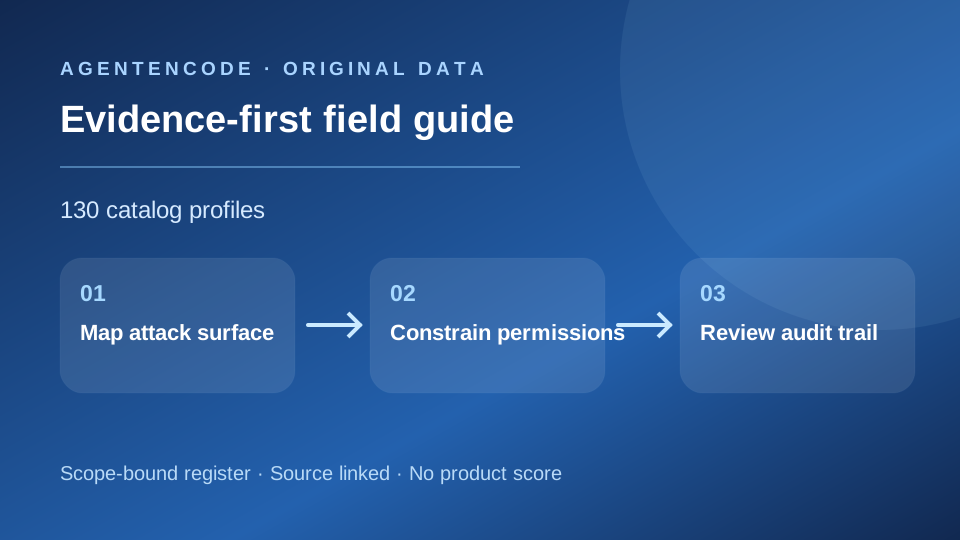
Three documented agent examples
These deliberately different profiles illustrate how application scope changes what the concept means:
OpenAI Codex OpenAI
AgentenCode records OpenAI Codex (OpenAI) in the Coding segment. Use the individual profile to check the exact product, plan and deployment limits rather than projecting another agent's abilities onto it.
Microsoft Copilot Studio Microsoft
AgentenCode records Microsoft Copilot Studio (Microsoft) in the Automation segment. Use the individual profile to check the exact product, plan and deployment limits rather than projecting another agent's abilities onto it.
Amazon Bedrock AgentCore AWS
AgentenCode records Amazon Bedrock AgentCore (AWS) in the Automation segment. Use the individual profile to check the exact product, plan and deployment limits rather than projecting another agent's abilities onto it.
Method: the named profiles come from the AgentenCode catalog (snapshot 2026-10-08). Protocol relations, where shown, come from the explicit AgentenGraph relation set (snapshot 2026-10-05). This is editorial interpretation of primary-source-backed records, not independent hands-on testing, formal certification, proof of production deployment or an exhaustive market census. Unknown does not mean false. Read methodology →.
Why agents are more security-sensitive than chatbots
A chatbot can produce a wrong answer. An agent with write permissions can produce a wrong answer and also execute an action. Repeated tool use can compound a mistake across systems.
That makes the agent runtime an application-security problem as much as an AI problem.
Least privilege
Give an agent only the permissions it needs for the current task. Separate read and write capabilities where possible, use scoped credentials and avoid broad shared accounts.
Permissions should be enforced by the external systems and tool layer, not left to model instructions.
Prompt injection
Webpages, emails and documents can contain instructions designed to manipulate an agent. If the agent treats those instructions as trusted policy, it may leak data or perform unintended actions.
Untrusted content should be clearly separated from system instructions. High-impact actions need independent validation and, where appropriate, human approval.
Human approval and action boundaries
Approval is especially useful before irreversible or externally consequential actions. The reviewer should see the target, effect and relevant context—not just a generic “approve” button.
Approval should complement permissions and logging rather than replace them.
Identity and credentials
Agent actions should be attributable to a clear identity. Dedicated workload or agent identities can make revocation, monitoring and policy easier than shared human credentials.
Secrets should be stored outside the model context where possible and exposed only to the tool that needs them.
Sensitive data
Check data access, retention, training use, hosting region and subprocessors separately. A provider may document one of these properties without documenting the others.
Memory adds another data surface because information can persist beyond the task in which it was originally supplied.
MCP, A2A and integrations
Standard protocols improve interoperability but do not automatically make integrations safe. MCP servers and A2A endpoints still require authentication, authorization, network controls and logging.
Each additional connector or agent relationship expands the trust graph and should have an owner.
Logging and observability
Logs should capture meaningful actions, tool calls, identities and outcomes. Tracing helps distinguish an incorrect model decision from a tool error or malicious input.
Without observability, incident response becomes guesswork.
Deployment checklist
1. Define the task and risk level.
2. Inventory data, tools and credentials.
3. Apply least privilege.
4. Add approval to consequential actions.
5. Treat external content as untrusted.
6. Log important actions and failures.
7. Test prompt injection and tool misuse.
8. Define stop, rollback and incident procedures.
Sources and further reading
- NIST – Identity and authority for software agents ↗
- OWASP AI Agent Security Cheat Sheet ↗
- Microsoft – Least privilege for AI agents ↗
- Microsoft – Manage agentic risk ↗
- OpenAI – Agent builder safety ↗
Frequently asked questions
What is the biggest AI-agent security risk?
There is no single risk, but excessive permissions combined with untrusted inputs can create especially large consequences.
Does using MCP make tools secure?
No. Protocol use does not replace authentication, authorization, validation or logging.
Should every action require human approval?
No. Approvals should focus on consequential actions to avoid approval fatigue.