
Claude Fable 5.2 and Mythos 5.2: what 1,000 AI agents actually prove
More than 1,000 agents, a machine-checked mathematical formalization and a bootable operating-system prototype: Anthropic is demonstrating what long-running agent teams can attempt. The difficult question is whether those demonstrations translate into dependable, economical production workflows.
Anthropic reports that Fable 5.2 coordinated more than 1,000 subagents over eight days on an operating-system prototype, while a separate 1,000-agent setup formalized Fermat's Last Theorem in Lean in 30 hours. Experimental scope, verification and access limits matter more than agent count alone.
Sources and evidence limits
Dated 2026-11-09: Anthropic original announcement. Product, test and availability statements originate with the vendor.
No hands-on deployment test, reproduced runtime benchmark or independent safety/efficacy audit. The decision framework is editorial inference.
What Anthropic introduced on November 9
On November 9, 2026, Anthropic announced Claude Fable 5.2 and Claude Mythos 5.2. The company says the two offerings share the same underlying model. Fable adds safeguards that limit high-risk cybersecurity and biology use; Mythos is offered under verification programs to eligible organizations in those fields. They are not interchangeable open-access products.
Anthropic reports improved coding, reasoning, vision and sustained technical work versus earlier versions. It also claims output can be up to 30% faster than the respective 5.1 releases. That is a vendor-reported comparison, not an AgentenCode speed measurement.
An operating-system prototype built with over 1,000 subagents
Anthropic describes a research project that began with an empty folder and a request to build a prototype operating system. Fable 5.2 reportedly coordinated more than 1,000 subagents over eight days of coding, testing and review. The company says the result boots on a laptop and includes storage, drivers, windows, login and installation functionality.
The relevant architectural advance is the combination of delegation, integration and verification over a long work period. But the number of subagents is not a production-quality metric. Without independently measured retries, compute budgets, reviewer interventions and reproducibility, this prototype cannot establish a general business case for massive agent teams.
Fermat's Last Theorem: formalization is not discovering a new theorem
Anthropic says approximately 1,000 Fable 5.2 agents formalized Fermat's Last Theorem in the Lean proof assistant in 30 hours, with minimal human guidance. Formalization translates an established proof into machine-checkable steps; it is not the discovery of an unsolved theorem. The agents received intermediate theorem statements to measure progress.
An earlier Anthropic attempt had taken eleven days with additional human guidance. In a single comparative run using the same 1,000-agent framework, Opus 5.5 reached 26% of the formalization in 18 hours and made little additional progress by hour 30. These are scoped research runs, not general success probabilities.
Reading coding benchmarks without overclaiming
Anthropic reports FrontierCode 2.0 scores of 49.1% for Fable 5.2 at Xhigh effort, 32.4% for Fable 5.1 and 45.5% for Opus 5.5. The benchmark examines proposed changes to open-source repositories; it is not a randomly sampled set of all real-world engineering work. Different harnesses, budgets and effort levels also change how such figures should be interpreted.
A trustworthy in-house evaluation would use identical repositories, task sets, permissions, failure thresholds and human review. A benchmark score of 49.1% is not evidence that 49.1% of arbitrary production tickets will be safely completed without assistance. Our original comparison graphic keeps these differences visible.
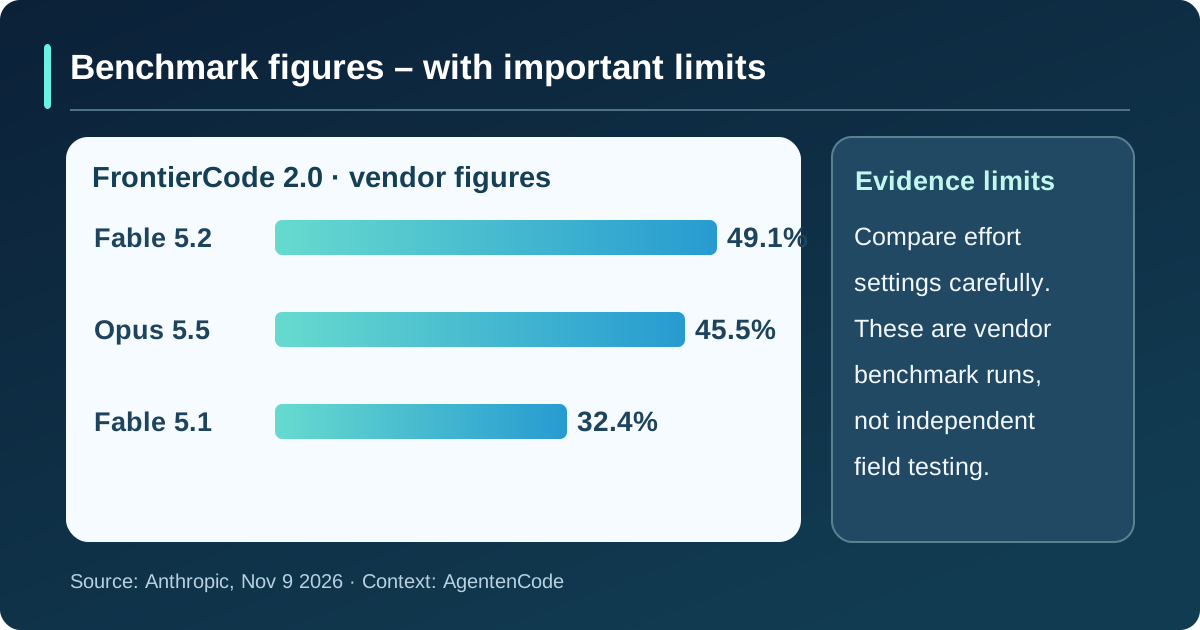
| Scope | Component/model | Value/function | Limit |
|---|---|---|---|
| FrontierCode 2.0 (Xhigh) | Fable 5.2 | 49.1% | Vendor benchmark |
| FrontierCode 2.0 (Xhigh) | Fable 5.1 | 32.4% | Vendor benchmark |
| FrontierCode 2.0 (best) | Opus 5.5 | 45.5% | Effort may differ |
Prices, speed and assigning the right work to the right model
The published prices are $8 per million input tokens and $40 per million output tokens for Fable 5.2 and Mythos 5.2. Optional fast mode is listed at $16 and $80 respectively, with up to 2.5 times faster token output. Actual project spending additionally depends on accumulated context, output length, retries, parallel agents and external tools.
Anthropic itself recommends starting ordinary coding and knowledge work on Opus 5.5, escalating only when the scope warrants Fable or Mythos. A sensible multi-agent architecture does not use the most expensive option for every subtasks: orchestration, routine execution and independent validation have distinct requirements.
Fable versus Mythos: scope of safeguards and access
According to Anthropic, Fable 5.2 applies safeguards to some high-risk cybersecurity and biology tasks; blocked requests may be handled by another model. Mythos 5.2 access is subject to verification programs for eligible organizations. Safeguards should not be read as blanket assurances about every tool-connected environment.
Anthropic also publishes behavioral audits, including sandbox-escape evaluations. Such tests offer useful visibility into model behavior but do not independently certify an organization's integration, credential management, network policies or data boundaries. Agents with write access need application-level controls regardless of benchmark performance.
AgentenCode decision matrix: when a large agent team makes sense
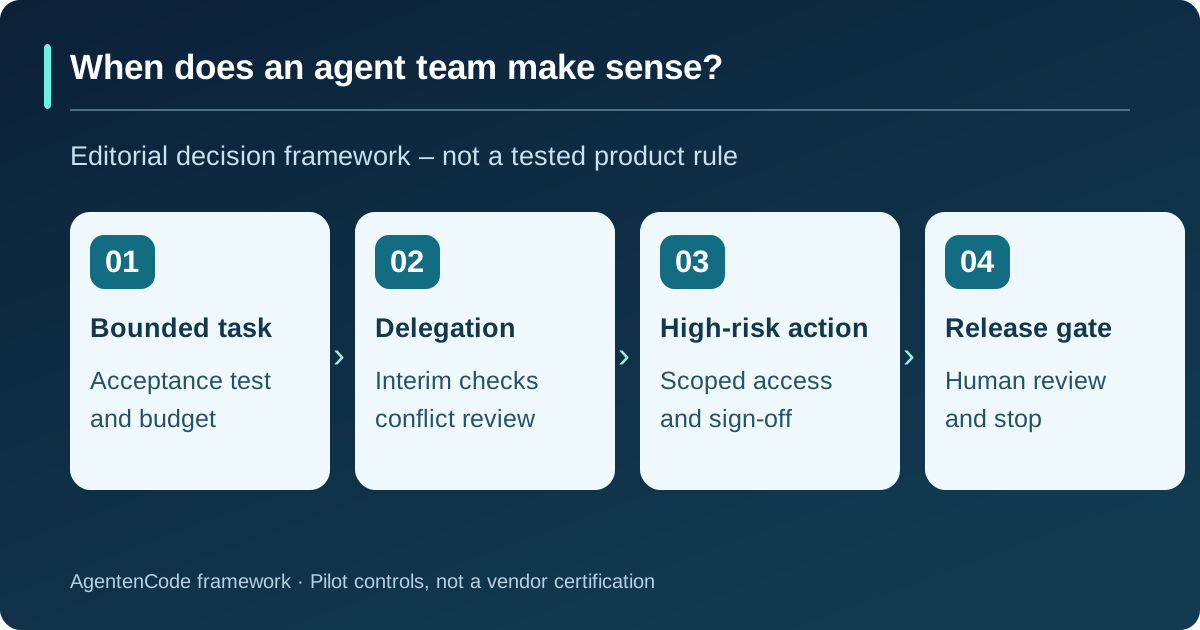
Our editorial framework separates bounded individual tasks, delegable long-running engineering projects and security-critical automation. The first needs reproducible acceptance tests and cost limits. The second needs task decomposition, independent integration tests and conflict handling. The third needs approvals, immutable evidence and a reversible stop path, regardless of model choice.
This matrix is an AgentenCode analytical inference from documented mechanisms and controls, not a measured ranking of vendors. Start with a small repeatable sample under explicit budgets before increasing concurrency. Delegation delivers little value when review and correction cannot keep up.
Practical rollout questions for development teams
A sound pilot defines a limited codebase, measurable tests, tool permissions, runtime and token budgets, and a mandatory human checkpoint before production changes. Include tasks with conflicting changes, unreliable documentation, incomplete requirements and deliberately planted defects to expose failure modes rather than showcasing only easy wins.
The new demonstrations justify serious evaluation of multi-agent orchestration for difficult, verifiable tasks. They do not prove that thousands of agents are economical or safe in every organization. See our guide to building AI agents and agent security guide for the surrounding governance decisions.
Related agent profiles: Claude Code and Claude Cowork are agent products, not interchangeable with the Fable 5.2 model.
Frequently asked questions
Are Fable 5.2 and Mythos 5.2 different base models?
Anthropic says they share a model foundation but differ in safeguards and access rules.
Did the agents discover a new proof of Fermat's Last Theorem?
No. They formalized a known proof into machine-checkable Lean code.
Is Mythos 5.2 open to everyone?
No. Access is restricted through verification programs for eligible organizations.
Is this an independent product benchmark?
No. We contextualize Anthropic's reported experiments and metrics but have not reproduced them ourselves.
Primary sources and methodology
Primary sources checked November 11, 2026. Vendor disclosures, editorial inference and unverified outcomes are distinguished. We did not run the published benchmarks.