
OpenAI launches Business Agents in ChatGPT: who owns the customer conversation?
Businesses can manage a profile in ChatGPT and, initially for eligible US ecommerce and online-service companies, offer a Business Agent. The practical issue is who controls those answers, who sees conversations and what remains independent.
A verified Business Hub profile does not automatically qualify for a Business Agent. Company-agent conversations are clearly separate, and OpenAI says private user chats are not shared with businesses.
What launched on November 10?
OpenAI introduced Businesses in ChatGPT in beta. Business Hub lets eligible organizations claim their profile and update details. A separate Business Agent can answer questions about the company's products or services when the business is approved.
This is a new business-facing conversation inside ChatGPT. It is neither a blanket global release for every company nor evidence that ChatGPT's independent answers now become the company's own advertising messages.
Who can create a Business Agent?
The initial Business Agent launch covers eligible US ecommerce and online-service businesses. Claiming a company profile through Business Hub may be available more broadly to eligible organizations where ChatGPT operates, but claiming is not the same authorization as publishing an agent.
OpenAI's policy states that successful business verification does not guarantee permission to publish an agent. Category, intended use and safety rules matter separately. There is no general European Business Agent release established by the November 10 announcement.
How does the company conversation begin?
When a business appears in ChatGPT's response, people can open its profile and, where supported, voluntarily start a distinct, clearly labeled Business Agent conversation. The agent can draw on information provided by that business and respond to follow-up product questions.
Such a conversation should not be mistaken for an independent comparison. Prices, claims and guarantees remain supplier statements, and the origin of an answer matters when evaluating an offer.
Business verification, feeds and privacy
Business Hub can keep company details and product feeds current. Eligible Shopify merchants have a path to connect their storefront. A claimed profile may display a verification marker but does not guarantee higher ranking in ChatGPT.
OpenAI describes aggregate metrics for mentions, website clicks and discovery topics. It states that private ChatGPT and Business Agent chats are not shared with companies. Precise thresholds, retention periods and every data-flow detail cannot be independently established from the launch post alone.
What the new policy actually requires
The Business Agents Policy requires accurate ownership and claims, clear identification as a company AI, and compliance with approved use boundaries. Fake prices, fabricated reviews and deceptive guarantees are prohibited, as are coercive sales prompts or unnecessary sensitive data requests.
Purchases, booking actions or the transfer of user information require explicit authorization through an approved feature. OpenAI may suspend or remove an agent. These are platform rules, not independent proof of perfect behavior in all deployments.
Advertising and independent ChatGPT answers
OpenAI also describes Business Agents as clearly labeled destinations for sponsored placements. The company-agent dialogue remains distinct from ChatGPT's independent answers. Agent creation does not guarantee greater placement or commercial results.
A sponsored entry point, a supplier's statement and an independent AI response carry different interests. Keeping that provenance visible is essential to informed user decisions and credible customer support.
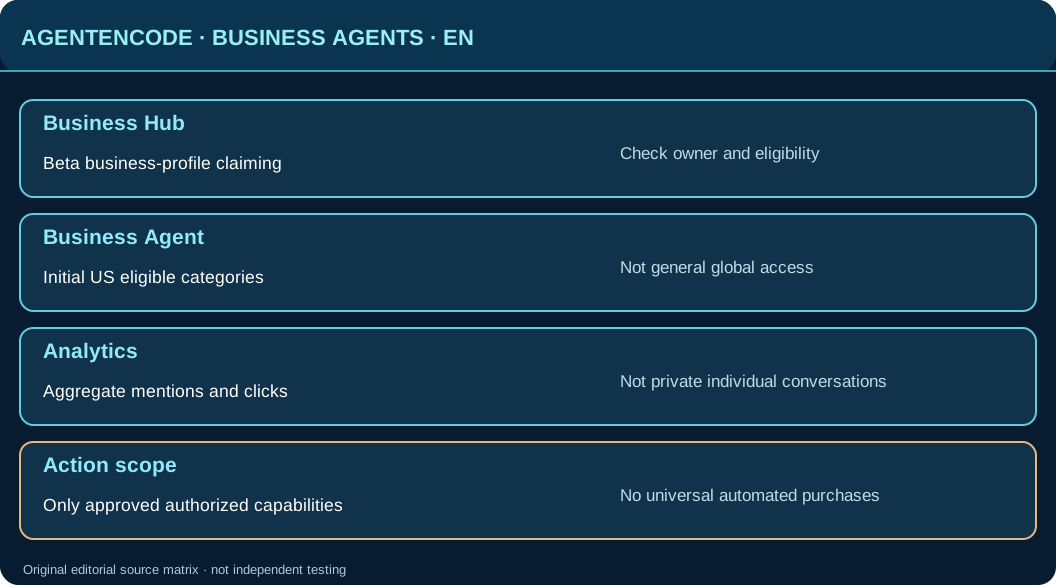
| Scope | Documented status | Verification need |
|---|---|---|
| Business Hub | Beta business-profile claiming | Check owner and eligibility |
| Business Agent | Initial US eligible categories | Not general global access |
| Analytics | Aggregate mentions and clicks | Not private individual conversations |
| Action scope | Only approved authorized capabilities | No universal automated purchases |
AgentenCode assessment: test accuracy before conversion
In a pilot, prioritize owner identity, current data and permission boundaries. Who updates prices and refunds? Can an agent notice conflicting offers? Will it hand an uncertain case to a person? Does it correctly stop trying to sell when a customer declines?
We recommend non-sensitive adversarial questions about unavailable items, hidden fees, competing offerings and data collection. This is an editorial test framework, not an independently performed AgentenCode deployment assessment.
Related dossiers and practical FAQ
ChatGPT Workspace Agents and Salesforce Agentforce Coworker address distinct workflows. See AI agents for businesses and agent security for organizational checks.
Available to all EU companies? No general launch has been substantiated. Can businesses see private chats? OpenAI says no, offering aggregated insights instead. Did we test a live Business Agent? No, this is a source-based editorial review of November 10 company announcements and policies.
Original sources and method
- OpenAI – Introducing Businesses in ChatGPT (10 Nov 2026)
- OpenAI – Business Agents Policy (10 Nov 2026)
- OpenAI – Businesses in ChatGPT: claim and eligibility
- OpenAI – Businesses in ChatGPT policy
Primary sources checked November 10, 2026. Vendor and benchmark statements are not misrepresented as AgentenCode testing or certification.