
Microsoft unveils seven MAI AI models to challenge rivals on coding, security and cost
Microsoft launches MAI Code 2, Cyber 2 Flash, Realtime 1 and other specialist AI models at Ignite 2026. What its striking cost claims actually cover.
Microsoft expands from reselling AI to building its own
At Microsoft Ignite on November 17, 2026, Microsoft AI announced a group of models covering agentic coding, cybersecurity, image editing, speech interaction, transcription and decision-making. The company describes a family of seven new models designed around a simple claim: different jobs should use specialized systems with better economics rather than the same expensive general model. The official overview puts price-performance at the center of the strategy.
This is a significant competitive shift. Microsoft still distributes third-party models through its platforms, but it increasingly operates its own MAI family. The key question for customers is not which vendor wins a public ranking but which model reliably completes their specific work within acceptable time, cost and risk constraints.
MAI Code 2 and Flash target practical development
MAI Code 2 is intended for debugging, multi-file changes, repository-wide reasoning and interface development. MAI Code 2 Flash targets frequent, smaller work such as code explanations and focused fixes. Microsoft says both are available through GitHub Copilot, with other routes subject to their own access conditions. Rather than optimizing for every research challenge, the models focus on routine enterprise engineering work.
That focus matters. A coding agent may propose edits and run tools, but a proposed patch is not equivalent to a safe production change. Reproducible tests, restricted repository permissions, security reviews and an accountable maintainer remain essential. Faster output without those controls may simply accelerate the creation of defects.
The 98 percent quality claim has a pricing footnote
Across four coding tests, Microsoft reports that MAI Code 2 reaches 98% of GPT-6.1 Sol's quality for 40% of the cost, and 96% of Claude Opus 5.5 performance for 5% of its cost. These are striking claims, but they measure defined benchmark sets, not every commercial development task.
The dedicated model post explains that some figures incorporate a 50% promotional price for MAI Code 2 and specific internal evaluation setups. The cost of code review, integration, retries and infrastructure is not automatically included. A rigorous buyer should compare accepted changes per total dollar rather than generalize from one chart.
Cyber 2 Flash focuses on vulnerability discovery
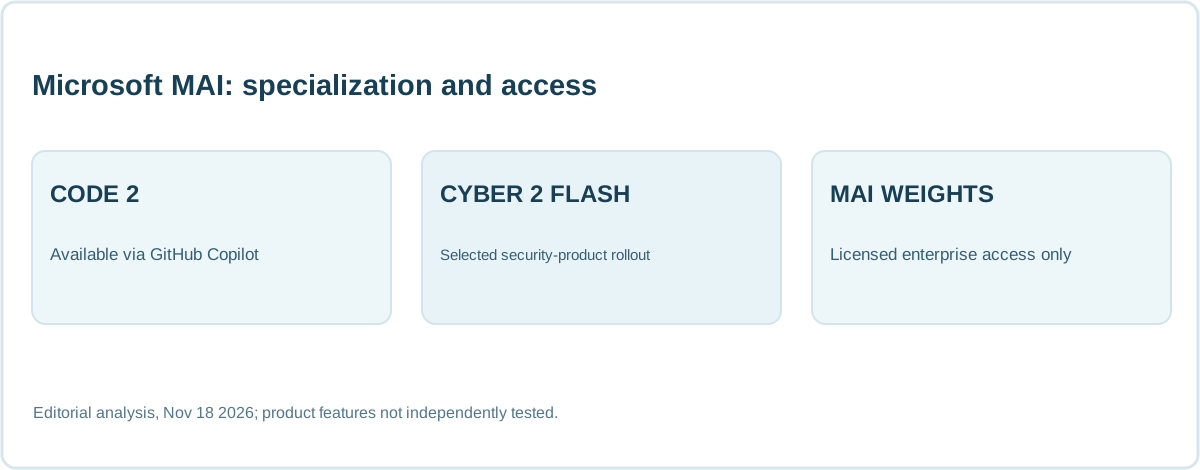
MAI Cyber 2 Flash is a specialized model for inspecting code, investigating vulnerabilities and recommending fixes. Microsoft reports a 92.3% success rate on CyberGym-E2E, versus 91.5% for GPT-6 Astra, at less than 2% of the measured per-task cost. The model also has a one-million-token context window, aiming to handle larger codebases and multistep investigations.
There is a material methodology note: Microsoft excluded 92 of 905 benchmark tasks after identifying overlap between their underlying public projects and parts of its training data. The reported result uses the remaining 813 tasks. The company plans to roll the model into eligible security products, including MDASH, starting in mid-December; that is not a universal public API or downloadable general release.
Speech and imagery broaden the MAI lineup
Beyond code and cybersecurity, Microsoft announced MAI Image 2.7, MAI Realtime 1 for direct spoken conversations, improved transcription technology and a new decision model for routing. It markets MAI Realtime 1 at a starting rate of $0.01 per audio minute, while positioning its image model for high-quality editing and generation.
The company also describes extensive use of its transcription models in Dragon Copilot for medical documentation. Those are vendor claims about deployments and evaluations, not proof that every spoken interaction or clinical document is error-free. Actual cost, latency, language support, consent and human review must be checked in the intended product.
Licensed model weights are not open weights
Microsoft introduced MAI Licensed Weights to let selected business customers customize and operate models in their own Azure environments. The stated benefit is greater enterprise control over proprietary data and model adaptation. It does not mean that the weights are freely published for anyone to download or redistribute.
Organizations should distinguish between ordinary hosted access, licensed access under private agreements and a genuine publicly distributed open-weight model. Those choices affect vendor dependence, regional controls, auditability and what can be modified or transferred. The term 'your weights' in marketing does not by itself define a permissive license.
Availability varies by model and product
Microsoft says the Code 2 family is available in GitHub Copilot. Code 2 Flash has a limited-access preview in Microsoft Foundry; MAI Realtime 1 has a trial or registration route; MAI Cyber 2 Flash is scheduled for introduction into selected security products. The broad Ignite announcement should not be interpreted as every one of the seven models being released everywhere on identical terms.
The wider Microsoft ecosystem also brings agent management, security monitoring and other capabilities with varying preview and general-availability statuses. Buyers need to confirm regional availability, quotas, terms, integration rights and pricing for the specific product. The official Ignite blog describes the overall direction, not a uniform release contract.
AgentenCode assessment: the economics of specialist AI
Microsoft's new family underlines a wider market move toward specialized models combined into workflows. A quick model may handle explanation and classification, a stronger one may develop code, and a cyber model may assess security findings. For high-volume business processes, matching the model to the step could materially lower total costs.
Whether Microsoft's advertised advantage holds in independent real-world tests remains to be seen. The company explicitly says Code 2 has not been optimized for fundamental science or extremely long agentic tasks. The sensible benchmark combines quality, accepted outputs, latency, oversight and total spending. Our AI agent evaluation guide discusses how to build that comparison.
Frequently asked questions
What did Microsoft launch at Ignite 2026?
Microsoft announced a seven-model MAI offensive spanning agentic coding, cybersecurity, image processing, speech, transcription and decision support.
Can developers use MAI Code 2 now?
Microsoft says Code 2 and Code 2 Flash are available in GitHub Copilot; other products may have limited previews or different rollout conditions.
Is the 95% cost saving universal?
No. The comparison with Claude Opus 5.5 is based on defined coding benchmarks and includes promotional price assumptions, not all real customer costs.
Are MAI Cyber 2 Flash or licensed MAI weights freely downloadable?
No general public download is established. Cyber 2 Flash is planned for eligible Microsoft security products, and licensed weights target selected enterprise customers.
RESEARCH & CONTEXT
Sources for this article
This analysis relies on the original publications linked below, which readers can inspect directly.
- Microsoft AI: Seven new world class models at scalable price-performance, 17 November 2026
- Microsoft AI: MAI Code 2 and Code 2 Flash—Everyday coding at scalable prices, 17 November 2026
- Microsoft AI: MAI Cyber 2 Flash—Leading security, lower cost, 17 November 2026
- Microsoft Official Blog: Ignite 2026—Building the frontier ecosystem, 17 November 2026
- Reuters: Microsoft unveils AI models for coding and cybersecurity, 17 November 2026
Checked November 18, 2026. Vendor statements, pilot scope and preview benchmarks have not been independently reproduced or certified.