
AI designs materials that scientists actually synthesize: the MOFGen study
A Nature Computational Science study reports four experimentally synthesized AI-designed materials using MOFGen. What it means for carbon capture and water harvesting.
From an AI proposal to a real material
The most important aspect of this study is not how many structures a model proposed but what happened in a laboratory. Using MOFGen, researchers designed new metal–organic frameworks and report experimentally synthesizing four of them. Their findings appeared in Nature Computational Science on November 20, 2026.
That crosses an important boundary. Generative systems can produce large numbers of theoretically plausible compounds without proving that they can actually be made. Recovering and characterizing physical crystals provides stronger evidence than an attractive computer rendering.
Primary source: Nature Computational Science – System of agentic AI for the discovery of metal–organic frameworks (20 Nov 2026)
What are metal–organic frameworks?
Metal–organic frameworks, or MOFs, are porous crystalline materials made of metal centers connected by organic linkers. Their networks contain cavities that can trap or selectively interact with molecules. Researchers are investigating these materials for carbon-dioxide separation and harvesting water from the air.
However, a promising structure is not yet an operational device. Real-world use requires reliable manufacturing, stability, repeatable behavior and suitable performance under practical conditions. The paper does not demonstrate that its four new materials already outperform commercial carbon-capture or water-harvesting systems.
A collection of models, not a single chatbot
MOFGen uses distinct computational components. A language-model agent proposes candidate chemical compositions, while a diffusion model generates crystal structures. Specialized stages evaluate geometry, energetics and whether chemists could plausibly synthesize a suggested combination.
Selected candidates eventually reach a high-throughput laboratory workflow where synthesis and structural characterization are attempted. The central innovation lies in connecting generative models with physical checks and experimental evidence. Suggestions are filtered and tested, rather than accepted merely because a model confidently produced them.
Background reading: AI knowledge
Hundreds of thousands of proposals, four verified syntheses
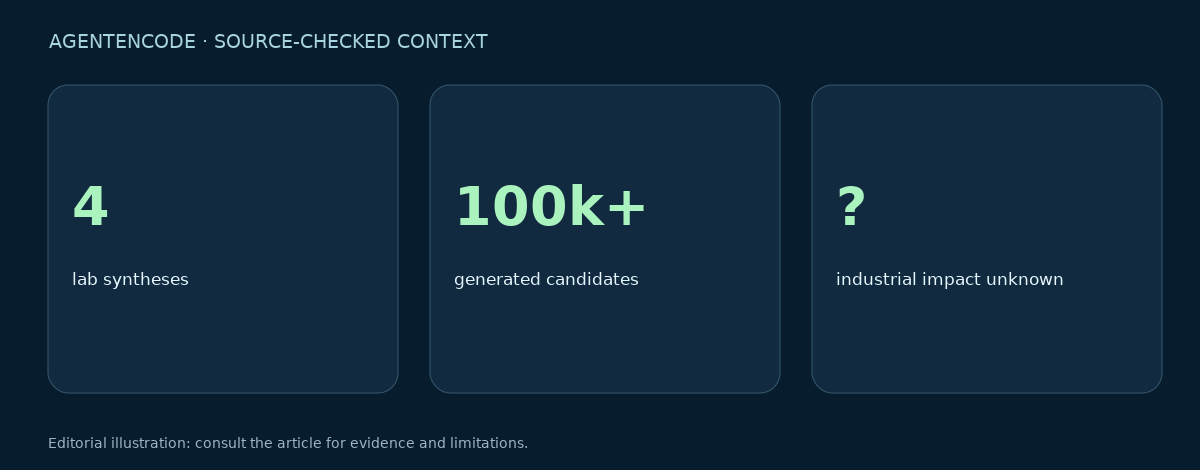
The authors report generating hundreds of thousands of candidate structures and organic linkers. Candidates were narrowed through computation and experimental screening, resulting in the synthesis of four AI-designed MOFs within weeks, sometimes in only days.
Those numbers represent very different outcomes. A generated design is not a synthesized material, and the four confirmed results do not establish a general success percentage for every proposal. The reliable milestone is the production of specific physical materials after a computational search.
Why synthesizability is the hard part
A structure that appears stable under simplified quantum-mechanical calculations may be exceptionally difficult or expensive to make. MOFs present additional challenges because their large networks can require specialized organic components and carefully controlled temperatures, concentrations and reaction steps.
MOFGen tries to address this gap through synthesis-feasibility screening and increasingly detailed modeling. Human chemistry knowledge is still part of the workflow. Instead of replacing experimentalists, the system aims to make their candidate selection more targeted and potentially less dependent on traditional trial and error.
Carbon capture is a goal, not a product claim
Porous frameworks are attractive for carbon capture, gas separation and atmospheric water collection. The paper highlights those applications as reasons to explore broader MOF chemistry, but it does not establish that the four specific synthesized materials are ready for deployment.
Commercial suitability would require measurements of capacity, selectivity, lifetime, manufacturing cost and scale-up behavior. Even a structure that has been reproduced in the laboratory can fail those later tests. This is research into discovery methods, not the announcement of a working climate-technology product.
Why the method could matter beyond MOFs
The general pattern is promising: propose candidates rapidly, discard implausible designs using physical constraints, then verify the survivors through experiments. Similar approaches might eventually help with catalysts or other advanced materials where reliable data and measurements are available.
The remaining constraints are substantial. Computation, high-quality training data, laboratory equipment and transferable chemical expertise all influence results. The meaningful economic metric is the cost per genuinely validated material candidate, not the number of structures a model can generate.
Our assessment: a narrower but meaningful breakthrough
Four successful syntheses make this more compelling than claims about generating millions of new molecules with no practical verification. The team has demonstrated a real route from AI-generated structures to laboratory chemistry, even if that result applies to a limited set of candidates.
It would still be premature to claim a solution to carbon emissions or water shortages. Reproduction by other laboratories, proven material properties and manufacturing economics will determine the eventual impact. Separating an experimentally supported milestone from an ambitious application forecast is essential.
Frequently asked questions
What is MOFGen?
A research system described in Nature Computational Science that combines LLMs, crystal-generation models, physical simulation and experimental materials synthesis.
Did scientists actually make the AI-designed materials?
Yes. The paper reports successful laboratory synthesis of four newly designed metal–organic framework structures.
Do these materials already remove carbon dioxide at scale?
No such commercial result is established by the paper. Carbon capture is a potential application area for MOFs, not a demonstrated industrial deployment of the four new structures.
Why are laboratory tests necessary?
Computer models cannot guarantee that a material can be produced efficiently or that it has useful real-world properties; experiments must check both.
RESEARCH & CONTEXT
Sources for this article
This analysis relies on the original publications linked below, which readers can inspect directly.
Reviewed November 22, 2026. Vendor claims and research results are attributed; future real-world performance is not assumed.
Related agents, systems and context
Product links identify the subject of a report; ecosystem links provide context, not shared feature claims.
- Background guideWhat is an AI agent?