
Cursor Live Apps: Agents now build and deploy complete web apps
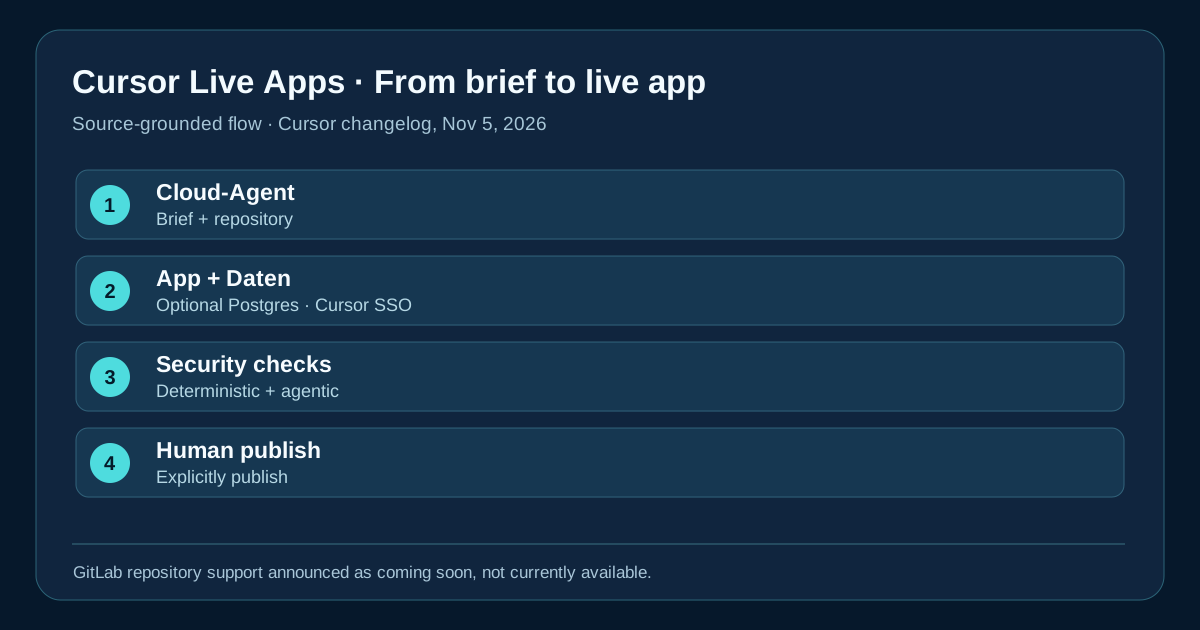
With Build Live Apps, Cursor moves its cloud agents beyond drafting source code. According to its November 5 changelog, an agent can scaffold a web application, provision Postgres if needed, configure sign-in through Cursor SSO, arrange hosting and prepare a live link. Security checks and an explicit human publish action remain in the loop. The bigger story is not another AI-generated user interface: it is the consolidation of application creation and operational responsibility into one workflow.

What actually changed on November 5
For many AI-built projects, shipping is harder than generating the first component. Real users need persistent data, sign-in, secrets, a domain, hosting and an owner who can take the app down. Cursor now combines these steps with the cloud-agent prompt: ask the agent explicitly to build an app, and it prepares the necessary infrastructure and a controlled publication flow.
This is particularly relevant for internal apps such as event registration, sales dashboards, customer presentations and engineering service portals. Cursor cites those examples from its own teams. They are product examples, not independently measured production success rates.
What the agent can do versus what an operator must verify
| Stage | Vendor-described capability | Independent operator question |
|---|---|---|
| Brief | Cloud agent builds the app | Are user needs and acceptance tests explicit? |
| Data | Optional Postgres provisioning | Who owns the data, backups and retention? |
| Identity | Cursor SSO authentication | Are authorization and group mappings correct? |
| Secrets | Agent requests integrations' credentials | Are tokens scoped, rotatable and logged? |
| Preflight | Deterministic and agentic security checks | Which checks actually ran and what did they miss? |
| Publish | Choose a domain, explicitly publish | Who approves, monitors and can roll back? |
The control questions are AgentenCode editorial analysis. SSO authentication does not prove that the app's internal API has correct authorization, and a deployed dashboard is not automatically ready for regulated production workloads.
The most important feature may be the stop button
Cursor says its publishing workflow runs deterministic and agentic security checks for common issues, including embedded secrets and exposed credentials. Failed checks are to be resolved before publication. Crucially, publishing also requires an explicit user action.
Team administrators can reportedly inventory apps and secrets, add their own security review rules, approve a blocked publication after review and unpublish an app. Those features make governance more plausible than a one-click deployment with no owner. However, the changelog does not demonstrate comprehensive detection of access-control failures, tenant isolation issues, unsafe dependencies or data-governance problems. It would be misleading to call the product's checks a universal security certification.
Availability is narrower than the headline suggests
The supported repository providers are Cursor Origin and GitHub; Cursor explicitly says GitLab integration is coming soon. The feature requires a paid plan with cloud agents enabled. The announcement does not provide an end-to-end pricing schedule for all storage, traffic, hosting or usage patterns.
Team apps can be shared with individuals, groups or the team behind Cursor sign-in. Cursor additionally describes public sharing for individual plans. Operators should verify their account's sharing and access controls rather than assume every Live App is public or that public access is available identically to organizations.
Original AgentenCode decision matrix
| Workload | Opportunity | Primary risk | Editorial recommendation |
|---|---|---|---|
| Internal non-sensitive team tool | Faster delivery | Orphaned apps with no maintainer | Small supervised pilot |
| Sales dashboard with limited data | Rapid feedback | Excessive secrets and permissions | Synthetic data and roles review |
| HR/legal application with personal data | Quick user workflow | Privacy, retention, location and access | Privacy and IT sign-off first |
| Public customer-facing service | Unified build-and-deploy | Abuse, authentication and availability | Dedicated security review |
| Regulated mission-critical workload | Lower initial build effort | Operational and evidentiary obligations | Architecture and approval gate |
These are our editorial recommendations, not Cursor guarantees or formal compliance conclusions.
An evaluation that measures outcomes instead of demo speed
Try two deliberately narrow applications in a test organization: a form backed by synthetic records and a simple dashboard. Set acceptance tests before prompting. Record time to preview, time to reviewed publication, actual spend, outstanding security findings, correct group access, secret handling and the steps needed to disable and export the result.
The relevant metric is time to a verifiably controlled, operable app, not the speed at which a beautiful page appears. A fast app with unknown ownership or overly powerful credentials may be worse than a slower conventional workflow.
Why this changes the agent market
When coding, infrastructure and publication converge, teams compete on the entire path from request to governed service. Non-engineering teams may create more software directly; platform and security teams must then make ownership, inventory, approval, backup and shutdown rules reusable. The decisive advantage will be reliable lifecycle control, not only code generation.
FAQ
Can Cursor now publish an app from a text instruction? The vendor describes a cloud agent that can prepare app, database, sign-in and hosting, but publication requires explicit action and a successful security gate.
Is Live Apps free? Cursor says paid plans with cloud agents enabled. All-in operating costs are not established by the announcement.
Does it already support GitLab repositories? No general support is announced. GitHub and Cursor Origin are listed; GitLab is coming.
Is a published team app public? The changelog describes authenticated team sharing and says individual plans can additionally share publicly.
Do the built-in checks prove the application is safe? No. They are useful prepublication checks, not comprehensive independent verification.
Conclusion: Deployment convenience comes with accountability
Cursor is automating the unglamorous last mile from generated source code to a reachable service. That could materially improve internal-tool development. But the gains are durable only when human approval, scoped secrets, ownership, data-handling controls and an exit path are built into the workflow from the start.
Sources and method
- Cursor, “Build Live Apps in Cursor,” official changelog, November 5, 2026.
- Vendor claims are separated from original AgentenCode analysis. No independent end-to-end deployment, price measurement or security certification. Reviewed November 8, 2026.
Sources and limitations
Independent editorial interpretation of cited sources. No independent product/security/cost test or unverified claim about current patch or feature status.