
NVIDIA Cosmos 3: New tools bring world models closer to robotics
Cosmos 3 expands beyond a world-model release with simulation checkpoints, multisensor pipelines and open training tools, but physical-world transfer still needs validation.
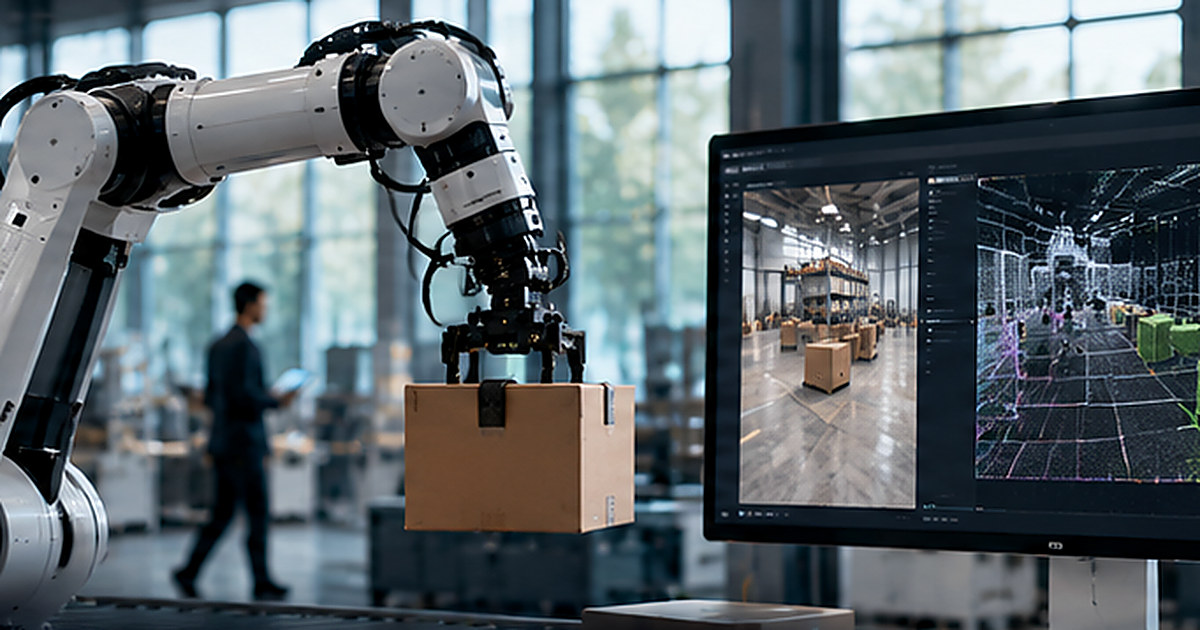
On October 21, 2026, NVIDIA announced additional Cosmos 3 components: simulation checkpoints, multisensory data pipelines and open recipes for training, optimizing and deploying world models. They are tools for building and assessing physical-AI systems, not proof that robots can safely operate in any environment without further testing.
CLAIM-LEVEL EVIDENCE
What is sourced and what remains open
Primary sources, vendor claims, discrepancies and open questions separated.
- Primary source
October 21 expansion announced
NVIDIA documents new Cosmos Data Factory recipes, simulation checkpoints and framework tools.
- Primary source
Open training and simulation recipes
NVIDIA's developer announcement identifies four Nano example checkpoints and supported post-training methods.
Evidence: NVIDIA Developer Forums – Cosmos simulation checkpoints and training ↗
- Vendor claim
Up to 2× faster NIM inference
The figure covers validated configurations only and is not a universal independent performance result.
- Open question
Sim-to-real reliability remains unproven
The announcements do not establish safe physical operation across arbitrary robotics environments.
Announcements are not independent effectiveness tests. Methodology →
What a world-model toolchain adds beyond a model launch
A robot needs more than fluent text generation. It must anticipate how objects will move, how sensors can fail and whether a planned action remains safe when the real environment changes. World models aim to support those predictions and provide synthetic experiences for training or testing. At GTC Berlin on October 21, NVIDIA expanded its Cosmos 3 ecosystem with new simulation checkpoints, data-processing pipelines and model customization tools. The announcement is interesting because it attempts to connect the full engineering workflow, from camera recordings through world-model training to constrained deployment, rather than selling a single new general-purpose AI model.
The training-data layer deserves attention first. Cosmos Data Factory gains blueprints for autonomous driving, defect detection and video augmentation, while Cosmos Curator is described as handling richer multimodal, multisensory material. Developers could use these tools to create examples of rare factory or road events that are expensive or unsafe to stage physically. But a visually plausible synthetic sample is not necessarily physically accurate. A serious evaluation separates training data from real held-out test sets and probes unusual lighting, object properties, camera placement and motion. Otherwise the simulation can accidentally reward behavior that does not transfer.
NVIDIA also outlines an open Cosmos Framework for fine-tuning, reinforcement learning, quantization, distillation and supported inference back ends. Its developer announcement describes four new Cosmos 3 Nano example checkpoints for multiview and multisensory simulation. This provides a more accessible starting point for research teams that want to modify existing models rather than build every component from scratch. The word open still needs scope: source code, weights, datasets, licenses and runtime dependencies are distinct, and a supported recipe is not proof that every GPU, model family or robotic platform works interchangeably.
The performance claims are useful precisely when interpreted narrowly. NVIDIA says updated Cosmos 3 NIM microservices can deliver up to twice the inference speed without quality loss in validated configurations. It also describes video-stream efficiency improvements for a related Metropolis blueprint. Those are manufacturer measurements with specific workloads and conditions, not independently replicated guarantees for production robots. Meaningful comparison requires the same hardware, quantization, image resolution, latency budget, quality metric and complete infrastructure cost. Larger throughput alone says little about robustness when a physical actuator is involved.
The best pilot connects simulation to a real controlled benchmark. Teams should measure failures on previously unseen situations, human intervention rates, emergency-stop behavior, detection of out-of-distribution observations and the cost of creating each extra reliable training sample. Document licenses, safety responsibilities and reproducible evaluation datasets. The broader opportunity is faster iteration between observation, simulated testing and action planning. Whether that is sufficient for a warehouse, factory line or public road remains an application-specific question that no conference-stage announcement can resolve.
Original sources and editorial context
- NVIDIA – New Cosmos tools at GTC Berlin ↗
- NVIDIA Developer Forums – Cosmos simulation checkpoints and training ↗
- NVIDIA Technical Blog – Cosmos 3 architecture ↗
Source scope and maturity were editorially reviewed at publication; product details can change.
Frequently asked questions
What did NVIDIA add to Cosmos 3?
New simulation checkpoints, synthetic data pipelines and training and deployment tools were announced October 21.
Is Cosmos 3 a finished autonomous robot?
No. It is a collection of models and tools; control, integration, safety and deployment remain separate responsibilities.
Are its speed claims independently verified?
The quoted gains are NVIDIA results for specified setups, not independently reproduced measurements in this article.