
Why we added Honeycomb AI SRE Agents despite Early Access
Honeycomb's Personal and Team AI SRE Agents remain in Early Access. We added them because trace-backed investigation, persistent team goals and explicit authority boundaries make a distinctive agent category worth documenting now.

General availability is not a prerequisite for a factual directory entry. Honeycomb qualified because Personal and Team Agents have distinct responsibilities, findings can link to traces and goals can have bounded permissions. We explicitly label Early Access and do not imply proven performance.
Documented facts and limits
- Primary evidence
Vendor sources dated November 3, 2026: Honeycomb.
- Editorial selection, not a test
AgentenCode documents its inclusion criteria. No independent agent runs, privacy audits or security certifications were performed.
Why an Early Access agent can still merit a reference
Honeycomb introduced its Personal and Team AI SRE Agents on November 3, 2026 and explicitly designated both Early Access. A directory that only lists generally available products could ignore an important emerging operating model. But listing an experimental product without an availability warning would mislead buyers. We chose a source-scoped profile that makes its status and uncertainty prominent.
Our existing launch analysis explains the announced feature set. This editorial note serves a different purpose: to make clear why the trace-centric, continuous-goal model is relevant enough to track and why the listing is not an endorsement or a claim of successful independent use.
Criterion one: Personal and Team Agents do distinct work
Honeycomb distinguishes the Personal Agent, which supports an individual investigation, from Team Agents, which pursue defined shared objectives. The latter are described as running on triggers, schedules or SLOs to monitor a release, surface instrumentation gaps or carry findings into team knowledge. These are distinct responsibilities, not interchangeable labels.
We maintain one catalog profile for the two forms because the announcement presents them within one underlying Honeycomb agent environment. Separate thin entries would overstate their product independence. The page still distinguishes the personal and shared contexts and the authorization boundaries each implies.
Criterion two: findings should link to observable evidence
Our strongest editorial reason for inclusion is the intended evidence chain: a finding should link to the query, distributed trace, deployment or ticket underlying it. Honeycomb also says an agent can identify a confirmed observation versus a hypothesis. That creates a useful framework for evaluating agentic SRE claims with inspectable evidence rather than fluent prose.
A trace can support a correlation without proving root cause. Sparse instrumentation, biased sampling and missing system boundaries can make a plausible conclusion wrong. The presence of links is therefore a verification opportunity, not a guarantee of correctness. Teams should use AgentenCheck to consider access, data quality and privacy before delegating analysis.
Criterion three: a team goal is not a blanket write permission
Team Agents are described as pursuing goals such as watching deployments or improving service instrumentation. Honeycomb mentions action paths including tickets, paging and drafting changes. These have very different consequences; a goal description is not a valid authorization to write to production or bypass review.
Our listing is driven by the testability of repeated, evidence-backed investigations with bounded actions, not by a claim that Honeycomb autonomously prevents outages. That distinction gives buyers a meaningful pilot design: begin with read-only monitoring and trace validation, then consider narrowly scoped write actions only when the actual account permissions have been verified.
Five criteria behind the Honeycomb listing
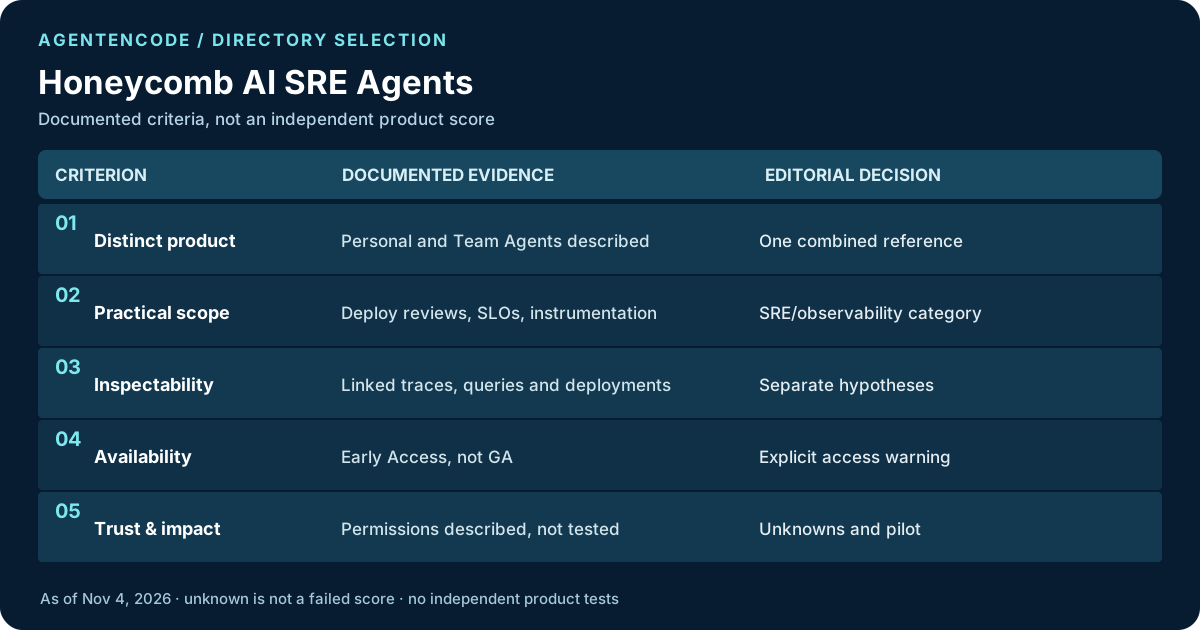
The decision matrix asks whether the product has a distinct agent role, clear operating tasks, inspectable supporting evidence, a truthful access label and visible governance or privacy unknowns. Honeycomb's public documentation supports an editorial reference for those questions, even while availability is limited to Early Access.
Those criteria are not a Trust score. We have no basis to certify a tenant's authorization enforcement, processing regions, retention or incident outcomes. Where product-specific facts have not been independently verified, the relevant fields remain unknown in the AgentenCode catalog.
| Criterion | Source evidence | Editorial decision |
|---|---|---|
| Distinct product | Personal and Team Agents described | One combined reference |
| Practical scope | Deploy reviews, SLOs, instrumentation | SRE/observability category |
| Inspectability | Linked traces, queries and deployments | Separate hypotheses |
| Availability | Early Access, not GA | Explicit access warning |
| Trust & impact | Permissions described, not tested | Unknowns and pilot |
How to compare it with PagerDuty Paige and AWS
For incident and on-call orchestration, PagerDuty Paige is a relevant comparator and was announced GA on November 3. Honeycomb starts from observability, distributed traces and ongoing team goals. AWS DevOps Agent adds a cloud and infrastructure investigation perspective. Similar SRE terminology should not disguise different entry points or maturity levels.
The Honeycomb reference, AgentenFit and Agent Comparison now give readers a structured way to compare these cases. The responsible choice depends on actual data coverage, the deployed stack, action permissions and access terms—not an unmeasured autonomy ranking.
The important questions still awaiting evidence
AgentenCode has not used a Honeycomb Early Access tenant or executed real goal-based investigations, caught a production regression, measured user savings or independently audited permission enforcement. Privacy claims about personal chats and shared team memory remain vendor descriptions until their contract and runtime boundaries can be examined.
Our editorial decision is therefore to include the product with a conspicuous Early Access label and explicit untested scope. As Honeycomb publishes GA, pricing, role-specific documentation or handling of trace data, the profile should be updated. The directory's value is to preserve an honest comparison and documented unknowns, not to recommend an untested product.
Primary sources
- Honeycomb – AI SRE Agents announcement (2026-11-03)
- Honeycomb – Team Agents product page (2026-11-03)
- Honeycomb – AI Ecosystem background, September 29 (2026-09-29)
Frequently asked questions
Why do you list Early Access agents?
A clearly marked source-based profile can be useful when the tasks and product limits are concrete. Listing does not turn Early Access into GA.
Why do Personal and Team Agents share one entry?
They belong to the same Honeycomb agent offering and integration context; we document their different authority boundaries within that reference.
Has AgentenCode independently tested Honeycomb?
No. This is a source-scoped editorial decision with an original criteria matrix, not a live Early Access performance or security evaluation.