

Agent profile · SRE & automation
PagerDuty Paige SRE Agent
Provider: PagerDuty
Paige is PagerDuty's generally available SRE agent for incident investigation and governed remediation. General availability does not mean every autonomous feature is available.
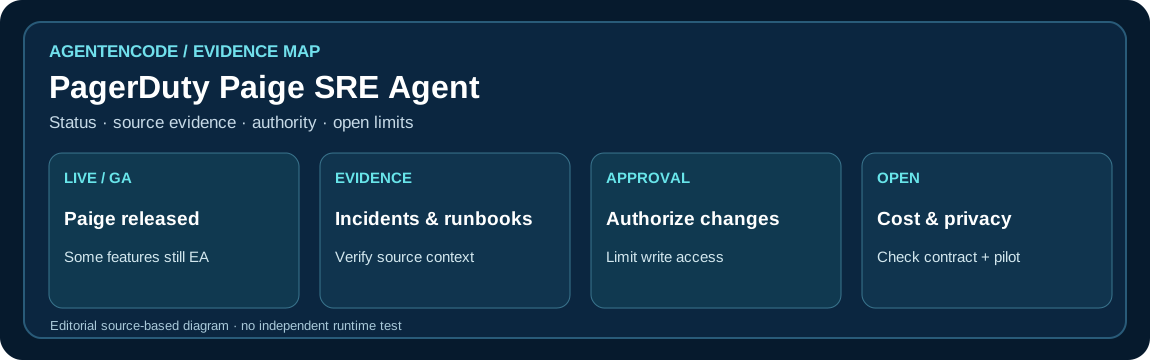
Original source-based decision map
PagerDuty Paige SRE Agent — scope and approval decisions
Availability, evidence, permissions and next checks at a glance.
Overview & Direct Answer
Direct answer: PagerDuty Paige SRE Agent
Paige is a specialized site reliability engineering agent embedded in PagerDuty's incident-response ecosystem. The vendor announced general availability on November 3, 2026. It is intended to connect operational signals, historical incidents, runbooks and diagnostic context so responders can investigate incidents and consider governed remediation. AgentenCode reviewed official sources, not a working customer deployment.
The essential selection criterion is not whether the product calls itself autonomous. Teams need to distinguish a diagnostic suggestion, a proposed runbook, an approved production action and truly unattended remediation. Those steps create different operational risks, audit needs and permissions. A GA product announcement alone cannot establish that every related research capability or integration is in general release.
Features & Operating Model
PagerDuty describes Paige reading incident signals, logs, runbooks and connected development and operations systems. The agent can surface likely causes, coordinate responders and recommend diagnostic and remediation steps. The vendor lists Slack and Microsoft Teams as collaboration surfaces, and tools, skills, APIs and MCP-based integrations for supported installations.
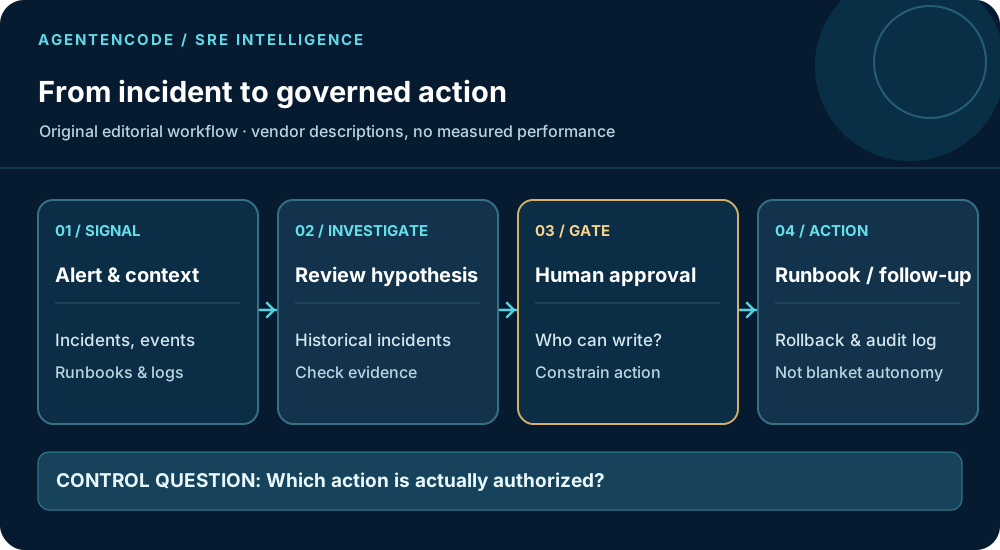
A representative workflow begins with an alert. Paige draws context from authorized sources, links relevant incident history and presents a potential investigation path. A responder can assess the evidence before any risky action. The PD Reliability Console adds an interface for incidents and agent activity, subject to platform availability and account entitlements.
PagerDuty also describes shared memory from resolved incidents. This is a vendor-described capability, not an independently measured improvement in accuracy. Teams should verify which sensitive incident details are retained and where they may reappear in subsequent investigations.
Use Cases & Pilot Design
A restrained pilot should start with a known service, reliable alerts, a maintained runbook and a clear on-call escalation path. Paige can then be evaluated as a read-first triage assistant before introducing production write privileges. Useful outcomes include whether hypotheses cite the right evidence and whether responders can reject unsafe suggestions.
For a high-severity outage, accountability should remain unambiguous: who controls the incident, who can authorize changes and how to roll back a faulty fix. A plausible root-cause hypothesis based on incomplete logs is not a verified diagnosis. Post-incident summaries can support documentation, but require review before being recorded as facts.
Teams can measure their own pilot against incident reproducibility, source coverage, proposal quality, action approval friction and actual AI Actions consumption. AgentenCode has not run such a benchmark and does not award a relative performance ranking.
Appropriate tasks
- Triage incidents
- Review runbook actions
- Collect escalation context
- Prepare post-incident reviews
Access, Pricing & Limitations
General availability covers Paige and the PD Reliability Platform as announced on November 3, 2026. PagerDuty documents adding Paige as a virtual responder through Incident Workflows as Early Access. PD Labs previews, research capabilities and future autonomous functionality must be treated separately from current production entitlements.
PagerDuty documentation states that certain requests and nudge actions consume four AI Actions. AI usage allowances, licensing and any incremental price depend on the account and product plan. Buyers should seek written confirmation of applicable plans, supported surfaces, quotas and connected services instead of assuming a fixed universal price.
A technical detail matters for incident completeness: PagerDuty's SRE Agent documentation states that only the first 2,000 characters of some custom details and notes are analyzed. Missing context outside that boundary can change a diagnosis, and should be surfaced to the responder rather than treated as absent evidence.
Access at review date: Paige GA since Nov 3, 2026; availability and features depend on PagerDuty AI, the PD Reliability Platform, plan and surface.
Privacy, Security & Trust
Production remediation crosses several permission boundaries: the PagerDuty account, Incident Workflows, observability integrations, deployment tools and runbook execution systems. PagerDuty's approval model is relevant, but does not by itself certify customer IAM configuration, end-to-end event logging or data residency.
A defensible pilot should separate read permissions, diagnostic access, ticket or pager notifications and production writes. For risky remediation, require accountable human approval, a recorded action scope, event timestamps and a rollback procedure. The presence of vendor documentation is not proof that an arbitrary customer setup enforces these controls.
Retention of incident memory, processing regions, contractual privacy guarantees and the exact executing identity require account-specific product documentation and contract review. Where product-specific evidence is not established, AgentenCode reports the field as unknown rather than false or compliant.
Comparisons & Selection
Editorial selection: Why AgentenCode added this agent – our documented criteria, availability scope and remaining evidence gaps.
Paige and AWS DevOps Agent both target operational reliability, but their documented centers of gravity differ. PagerDuty focuses on incident workflows, escalation and connecting the on-call response. AWS DevOps Agent has a stronger documented emphasis on cloud and infrastructure investigation. The right fit depends on the deployed stack and authority boundaries.
Honeycomb AI SRE Agents offer another operating model: the vendor emphasizes trace-driven insights and continuous deployment or instrumentation goals. Personal and Team Agents were only in Early Access at the review date. Feature lists from different vendors do not establish a common real-world effectiveness benchmark.
The practical selection question is whether the team needs an incident coordinator with carefully approved remediation or a continuous, trace-centric release observer. Existing tools, data quality and the cost of operational mistakes should drive a scoped evaluation rather than an unqualified top-agent ranking.
Related profiles: AWS DevOps Agent, Honeycomb AI SRE Agents. Current expert analysis: Read AgentenCode news.
In-depth Analysis
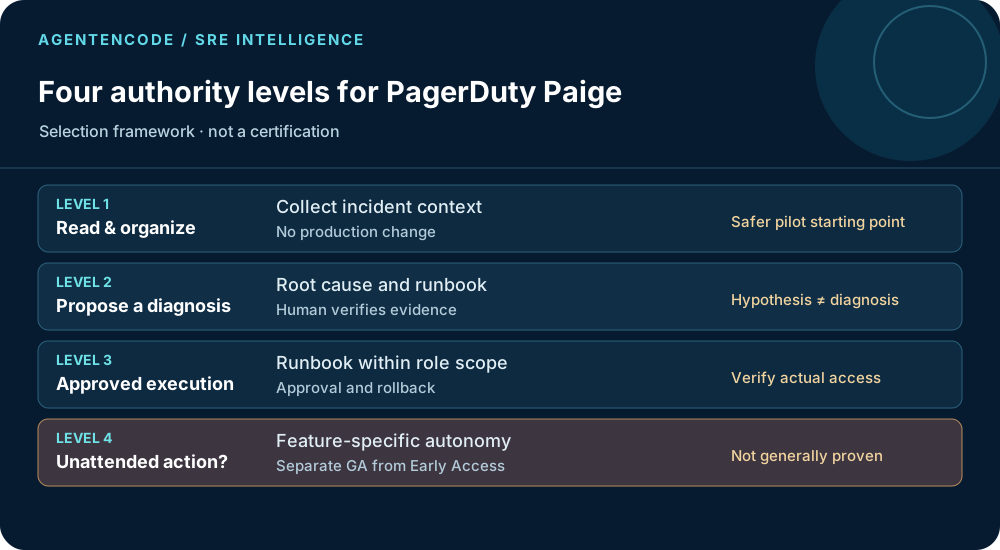
AgentenCode's key observation is the governance shift from AI summaries to AI-proposed and AI-executed production operations. Evidence collection, decision support, approved automation and unattended action are distinct authority layers. Each requires its own access control, monitoring and rollback considerations.
A three-stage introduction is defensible. Start by replaying resolved incidents with read-only context and comparing hypotheses with the known result. Next evaluate approved actions in a low-risk environment. Only then consider limited autonomy after documenting failures, side effects, AI Actions consumption and rollback performance.
Vendor assertions about learned incident memory or forthcoming autonomous capabilities do not substitute for measured customer outcomes. Open questions include end-to-end access scope, regional privacy terms, latency, error handling and alert-to-action reliability. Each should become an explicit acceptance test, not an invented marketing conclusion.
Pre-adoption checklist
- Separate read access from production writes
- Check plan and AI Actions usage
- Distinguish virtual responder Early Access
Frequently Asked Questions
Do not confuse the generally available agent with every surrounding experiment, integration or entitlement. Vendor launch statements and feature-specific documentation may carry different status labels; the narrower status governs the feature in question.
The answers below summarize official PagerDuty materials reviewed November 4, 2026. This is a source-scoped editorial examination, not a purchasing guarantee, security certification or runtime product test.
Is PagerDuty Paige generally available?
PagerDuty announced Paige and its PD Reliability Platform as generally available on November 3, 2026. Specific integrations and virtual-responder workflows may still have Early Access limits.
Can Paige fix production incidents without approval?
PagerDuty describes approval-first remediation and configurable autonomy for bounded scenarios. Every customer must validate permissions, runbooks and approval policies before enabling production actions.
What does Paige cost?
A universal flat subscription fee is not established by the reviewed sources. Eligibility varies by platform and plan; the documentation describes four AI Actions for some Paige requests or nudges.
Primary Sources & Changes
Primary sources include PagerDuty's November 3 launch release, the Paige product description and administrative documentation. The profile distinguishes vendor claims from AgentenCode's own derived assessment and from unverified operating behavior.
Created November 4, 2026. No Paige customer account was accessed, no real incident was remediated, and no independent performance benchmark was conducted. Verify current access, costs, regions and policy enforcement with the provider.
Official primary sources
- PagerDuty launch release — https://www.pagerduty.com/newsroom/pagerduty-2026-fall-launch/
- Paige product page — https://www.pagerduty.com/platform/ai-agents/sre/
- PagerDuty SRE Agent documentation — https://docs.pagerduty.com/ai-automation/advance/sre-agent
- Paige Virtual Responder Early Access — https://docs.pagerduty.com/ai-automation/advance/add-paige-as-virtual-responder
- PagerDuty Paige introduction — https://www.pagerduty.com/blog/ai/meet-paige-sre-agent/
Editorial record: 2026-11-04 · source-scoped review; no runtime, security or privacy audit.