
Why PagerDuty Paige earned a place in the AgentenCode directory
We added PagerDuty Paige as a distinct SRE agent because it addresses an identifiable incident workflow, documents approval boundaries and occupies a different niche from AWS DevOps Agent and Honeycomb—not because a product calls itself autonomous.

Our directory is not a list of every AI launch. Paige qualified as a source-documented, generally available operational agent with a bounded workflow and a meaningful approval distinction. Its inclusion is a transparent editorial categorization, not an independently tested endorsement.
Documented facts and limits
- Primary evidence
Vendor sources dated November 3, 2026: PagerDuty.
- Editorial selection, not a test
AgentenCode documents its inclusion criteria. No independent agent runs, privacy audits or security certifications were performed.
Why not every AI announcement becomes a profile
AgentenCode adds an agent profile when a product has a distinct agent role in a real task category and sufficiently specific primary-source documentation to explain it responsibly. As of November 4, 2026, Paige passes that editorial threshold. Readers looking into incident orchestration and authorized remediation now have a dedicated reference rather than another loosely categorized AI announcement.
Our separate launch analysis already covers what PagerDuty announced. This editorial note explains the catalog decision, its evidence, the scope of its comparisons and the limits we are not willing to hide.
Criterion one: a concrete job and a defined audience
PagerDuty describes Paige as an SRE agent linking incident signals, prior incidents, team context and operational runbooks. Its target users are on-call engineers, infrastructure operators and reliability teams. This is a different operating problem from a coding agent that prepares a pull request or a research agent that composes a report.
That difference matters because production operations introduce authority boundaries: who receives the alert, who owns the service, who can recommend a remedy and who can approve a change. We believe readers benefit from a dedicated SRE category and sources addressing these questions rather than an unstructured list of vendor claims.
Criterion two: governed actions rather than a vague autonomy claim
Paige's documented workflow separates triage and investigation from a proposed remediation and human-approved execution. That distinction makes it possible to examine permissions on a step-by-step basis. It does not prove that the product is secure in a particular customer deployment, nor does a promotional interface constitute an independent runtime test.
The critical line is the move from observation to mutation. A mistaken incident summary can be corrected; an unsafe restart or configuration change can make an outage worse. Our AgentenCheck therefore remains a more useful next step than treating the word autonomous as a purchase criterion.
Criterion three: general availability is feature-specific
PagerDuty announced general availability for Paige and its reliability platform on November 3, 2026. That is not universal evidence that each lab experiment or future hands-free action is currently released. Feature-level preview and roadmap labels still matter, especially when procurement teams expect operational privileges.
The distinction is deliberate. Paige's agent-level status is GA; selected investigative and autonomy features remain separate. In contrast, Honeycomb's newly introduced Personal and Team Agents are Early Access. That makes comparing them interesting without pretending their distribution or maturity is identical.
Five criteria behind the directory decision
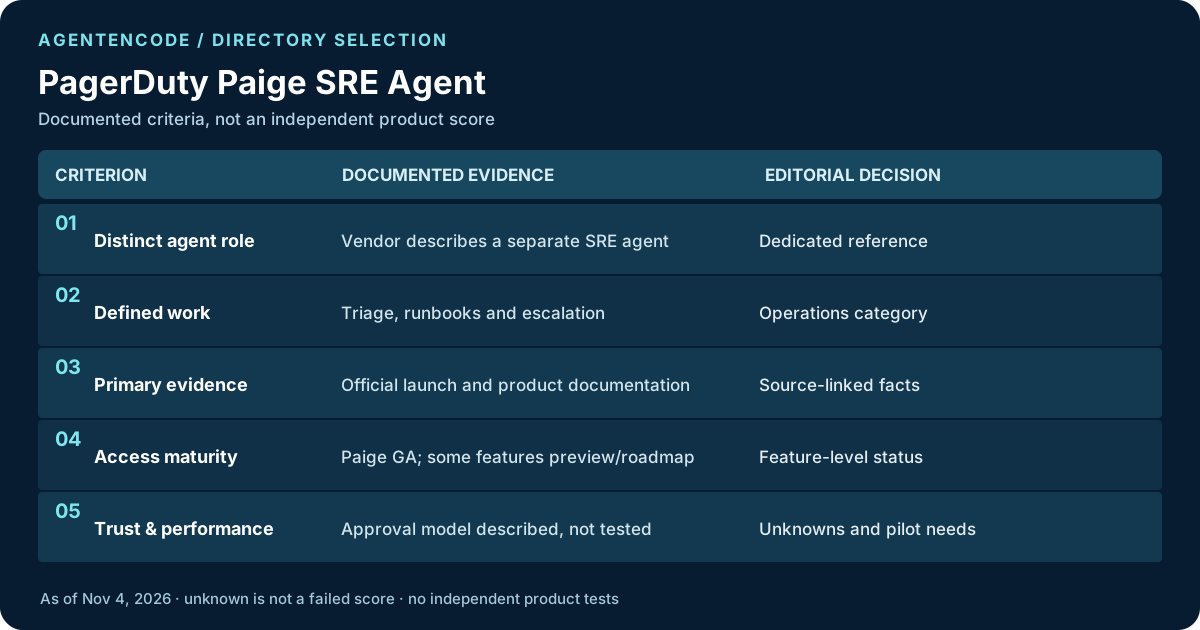
Our five selection checks cover product identity, a defined task, official sources, availability scope and explicit evidence or governance limits. Paige has vendor-documented support for the first four. The fifth is not a positive safety score: it is where missing customer-specific information and untested access enforcement are visibly left open.
The table below explains an editorial inclusion, not an automated ranking. A real product can belong in a factual directory even when its measurable field performance and detailed contractual safeguards have not been verified. Hiding those gaps would be less helpful than publishing them.
| Criterion | Source evidence | Editorial decision |
|---|---|---|
| Distinct agent role | Vendor describes a separate SRE agent | Dedicated reference |
| Defined work | Triage, runbooks and escalation | Operations category |
| Primary evidence | Official launch and product documentation | Source-linked facts |
| Access maturity | Paige GA; some features preview/roadmap | Feature-level status |
| Trust & performance | Approval model described, not tested | Unknowns and pilot needs |
How to use the new Paige reference responsibly
The Paige agent reference now connects task descriptions, approval questions, sources and original editorial decision diagrams. Teams should first describe the incident task they want to delegate, then use AgentenFit and Agent Comparison to test fit rather than buying from a launch headline.
For infrastructure diagnosis, AWS DevOps Agent is a relevant alternative to evaluate. For trace-centric release observation, Honeycomb AI SRE Agents offer another model, currently with Early Access constraints. We have not executed a comparable test suite, so we do not proclaim a winner.
What remains unknown and when this profile will change
Open questions include real-world error rates, account-level access, incident-memory retention, data processing regions, AI Actions billing and the effectiveness of approval controls. AgentenCode has not executed Paige or independently benchmarked incident recovery. The reference is labeled as a source-scoped editorial review for that reason.
Our long-term quality goal is to keep the record accurate when meaningful releases change access, pricing or operational boundaries. We will update scoped fields when original evidence justifies the change and avoid turning missing data into inferred Trust controls. A directory profile is a maintained reference, not a one-time marketing endorsement.
Primary sources
- PagerDuty – Meet Paige SRE Agent (2026-11-03)
- PagerDuty – Reliability in the AI era (2026-11-03)
- PagerDuty – Paige product page (2026-11-03)
Frequently asked questions
Does inclusion mean AgentenCode recommends buying Paige?
No. It means the product merits a source-based reference and clearly stated limits, not that we ran an independent evaluation.
Why treat Paige as an agent rather than just a PagerDuty feature?
The vendor documents a distinct SRE operating role across incident data, investigation and controlled actions. Feature-specific eligibility remains important.
Is Paige independently benchmarked against other agents here?
No. Our links to AWS DevOps Agent and Honeycomb are source-scoped comparisons, not controlled performance measurements.