
PagerDuty Paige is GA: An AI SRE agent can run fixes—but only within defined limits
PagerDuty has made Paige and the PD Reliability Platform generally available. Paige can prioritize incidents, suggest runbooks and execute approved remediations. Crucially, fixing well-understood incidents without waking the on-call team is still a future capability, and Deep Investigation remains a PD Labs experiment. This analysis maps those different availability and approval levels.

PagerDuty has made Paige and the PD Reliability Platform generally available. Paige can prioritize incidents, suggest runbooks and execute approved remediations. Crucially, fixing well-understood incidents without waking the on-call team is still a future capability, and Deep Investigation remains a PD Labs experiment. This analysis maps those different availability and approval levels.
Source-backed facts and limitations
- Primary sources
Official documentation and announcement: PagerDuty (2026-11-03).
- Not independently tested
Availability, feature and performance claims derive from vendor originals. AgentenCode has not executed product workflows, fault scenarios or benchmark replications.
Why Paige is more than an alert summarizer
PagerDuty introduced Paige with the generally available PD Reliability Platform on November 3, 2026. The platform brings Signal Intelligence, Incident Management and Automation together. Paige is intended to use alarms, prior incident context, service topology and runbooks to help the human on-call team decide what to do next.
The architectural change is more significant than a chat interface. A plausible diagnosis is not yet an established root cause. A useful SRE agent should be able to connect a signal, a change timestamp, an affected service, the responsible owner and a permissible remediation into an inspectable decision trail.
What is available versus experimental
PagerDuty explicitly lists Paige and the PD Reliability Platform as generally available. The broader announcement also discusses capabilities at different maturity levels. Handling familiar incidents autonomously without waking on-call staff is described as «coming soon», rather than a feature that teams can already assume is enabled.
Topology, Deep Investigation and SRE Workbench initially belong to PD Labs. Deep Investigation is described as testing multiple root-cause hypotheses and explaining what it ruled out. Those are intriguing capabilities, but a PD Labs experiment is not a general-availability commitment, and purchasing decisions should not collapse the two.
The real boundary: propose, approve, execute
According to the product description, Paige can suggest and run existing operational runbooks. An authorized responder can approve a proposed resolution such as a service restart. What matters is that a human remains able to choose whether to investigate further, apply the fix or take another route. Organizations define permissions for each group.
Our operational conclusion is that approval is only meaningful when attached to a particular runbook action, service scope and short-lived identity. A broad approval covering unknown future mutations is not the same kind of control. Neither an automatically drafted post-incident review nor accumulated incident memory proves that an intervention was safe.
Where PagerDuty and Honeycomb differ
Honeycomb announced its own Personal and Team SRE Agents on the same date, but they entered early access. Their emphasis is high-cardinality traces and persistent engineering objectives such as deployment regression detection. PagerDuty approaches the problem from incident orchestration, escalation, response collaboration and runnable remediation. Paige itself reached general availability.
This does not imply a universal winner. A team without good telemetry cannot assume any agent will infer reliable root causes. A team with strong traces but poor handoffs may benefit more from controlled incident workflow. The two approaches overlap but have different entry points; production outcomes, coverage and actual cost need customer-side measurement.
A five-case incident approval matrix
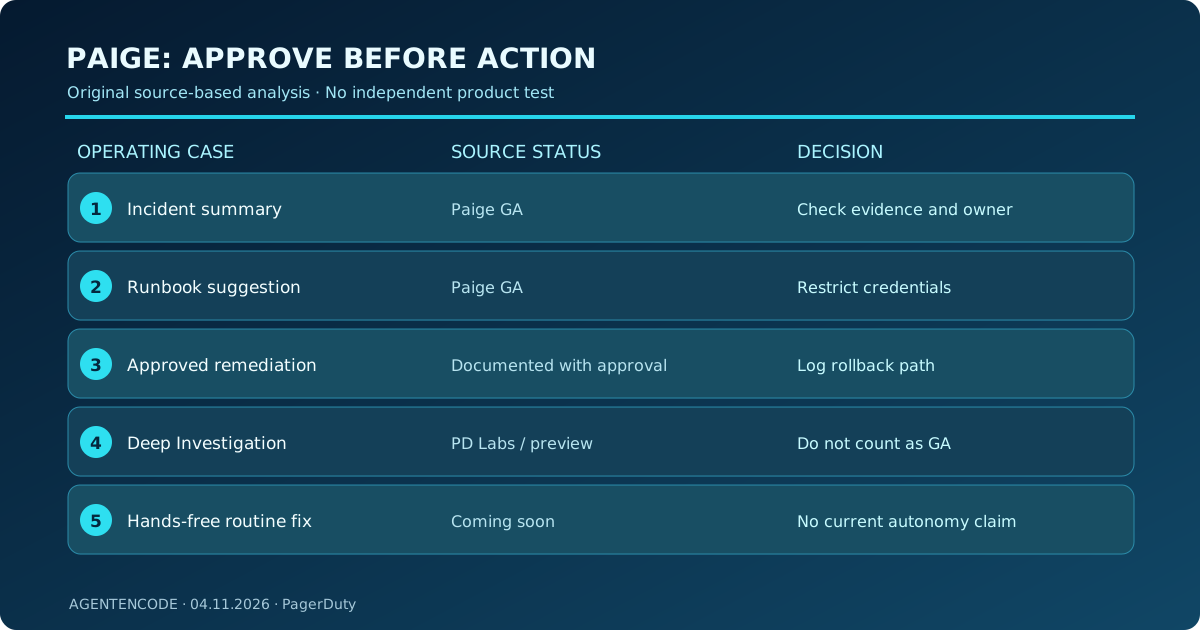
The five-case matrix translates PagerDuty's dated announcements into operational decision points. It is original editorial synthesis, not an independent deployment or penetration test. In particular, PD Labs previews must be called out in each acceptance checklist rather than silently included in a GA promise.
The key shift is from observation to mutation. A generated incident summary is easy to revise; a Kubernetes restart, service configuration change or escalated credential may not be. Without ownership and a rollback plan, production write access should remain restricted even when the suggested diagnosis sounds convincing.
| Case | Sourced status | Decision |
|---|---|---|
| Incident summary | Paige GA | Check evidence and owner |
| Runbook suggestion | Paige GA | Restrict credentials |
| Approved remediation | Documented with approval | Log rollback path |
| Deep Investigation | PD Labs / preview | Do not count as GA |
| Hands-free routine fix | Coming soon | No current autonomy claim |
A pilot that can challenge vendor claims
Start with a staged fault in a non-production service. Log when the alert fired, which services Paige associated with it, the evidence cited, the runbook proposed, the approving identity and the actual system outcome. Repeat with one harmless false positive and one case where the initial hypothesis is misleading.
Candidate metrics are time to actionable diagnosis, evidence gaps, false-positive escalations, successful versus failed runbook actions, recovery time and the quality of the generated postmortem. AgentenCode has not run these experiments or reproduced vendor benchmarks; this is a proposed acceptance test, not observed product performance.
Conclusion: autonomy must be earned
Paige represents a concrete move from incident commentary to controlled operational assistance. The generally available product is real, but hands-free resolution and some advanced investigative interfaces sit at different points on the roadmap.
A responsible enterprise decision should optimize for a defensible sequence of diagnose, authorize, execute and verify—not for the largest number of autonomous steps. That is the test Paige and its alternatives must pass with actual workloads before teams delegate irreversible production changes.
Primary sources
- PagerDuty: Meet Paige, SRE Agent (2026-11-03)
- PagerDuty: AI that works the incident with you (2026-11-03)
- PagerDuty 2026 Fall Launch / availability (2026-11-03)
Frequently asked questions
Is Paige generally available as of November 3, 2026?
Yes. PagerDuty states that Paige and the PD Reliability Platform are generally available, but that does not include every PD Labs experiment.
Can Paige autonomously fix production incidents today?
Approved runbooks and remediation are described. Hands-free resolution of defined familiar incidents is still presented as coming soon.
How does it differ from Honeycomb Team Agents?
Paige focuses on incident orchestration and approved remediation; Honeycomb's newly announced agents focus on trace-based investigation and are in early access.