
Honeycomb's new AI SRE agents watch deployments—but who verifies their conclusions?
Honeycomb's November 3 launch proposes AI SRE agents that watch releases, investigate regressions and improve instrumentation before an incident escalates. The notable feature is a trail from each finding back to a trace or query, with actions governed by permissions. Yet the Personal and Team Agents are both early-access products, not generally available services.

Honeycomb's November 3 launch proposes AI SRE agents that watch releases, investigate regressions and improve instrumentation before an incident escalates. The notable feature is a trail from each finding back to a trace or query, with actions governed by permissions. Yet the Personal and Team Agents are both early-access products, not generally available services.
Sources and limitations
- Dated primary source
Original announcement dated November 3, 2026: Honeycomb – Read original.
- No independent field test
Vendor claims and editorial inferences are separate. No independent agent run, pricing test, security evaluation or performance benchmark has been performed.
The production bottleneck created by faster AI coding
Coding agents can generate changes faster than operations teams can assess their effect on real customers. Honeycomb targets that bottleneck with Personal and Team SRE Agents designed not just to explain incidents after an alert, but to check deployments, latency, error rates and instrumentation continuously. The proposed shift is from reactive incident triage toward an explicit ongoing reliability objective.
This is a vendor announcement dated November 3, 2026, not a controlled validation of production outcomes. Honeycomb also cites figures from its own forthcoming survey. Without transparent sampling and methodology we cannot turn those claims into independent industry success rates, and they do not establish that these specific agents already prevent outages.
A personal assistant and a team worker are different controls
The Personal Agent is described as a collaborator for an individual engineer. It investigates questions, provides evidence for recommendations and takes actions only when explicitly instructed, while keeping the conversation private according to Honeycomb. That is a narrower trust boundary than a shared automated worker operating continuously for an engineering team.
Team Agents pursue defined goals: for example checking a checkout release for the first 30 minutes after deployment or finding instrumentation gaps. They can run on schedules, triggers and service-level objectives. Both products are explicitly labeled early access, so broader production readiness and customer-level results should not be inferred from their ambitious design.
Why an inspectable trace matters more than a confident answer
Honeycomb says its agents use high-cardinality distributed tracing data, attaching findings to the exact query, trace, deployment or ticket behind them. The vendor describes distinguishing confirmed observations from hypotheses. If implemented accurately, this creates a useful path from a natural-language explanation back to the original telemetry instead of requiring the reader to trust a free-form AI assertion.
But a trace is not the entire truth. Incomplete instrumentation, sampling, missing external systems and correlation errors can all mislead an investigation. AgentenCode therefore recommends a reproducible evidence gate: an incident finding should show its time window, the comparison baseline, query links and which parts of the explanation remain hypotheses.
Tickets, paging and fixes are different degrees of autonomy
The platform describes connectors for tools including GitHub and LaunchDarkly. Team Agents can turn findings into tickets, notify on-call responders or draft fixes, depending on the permission level chosen for each goal and action. A patch draft should not be confused with an automatically approved production deployment; the latter requires its own authorization boundary.
Teams should treat those permissions separately. A false positive can interrupt responders, a false negative can hide degradation and a write action can cause a new incident. A control design needs scoped credentials, auditable approvals and a human fallback, not just the vendor promise that the agent is “proactive”.
Our five-case release and evidence matrix
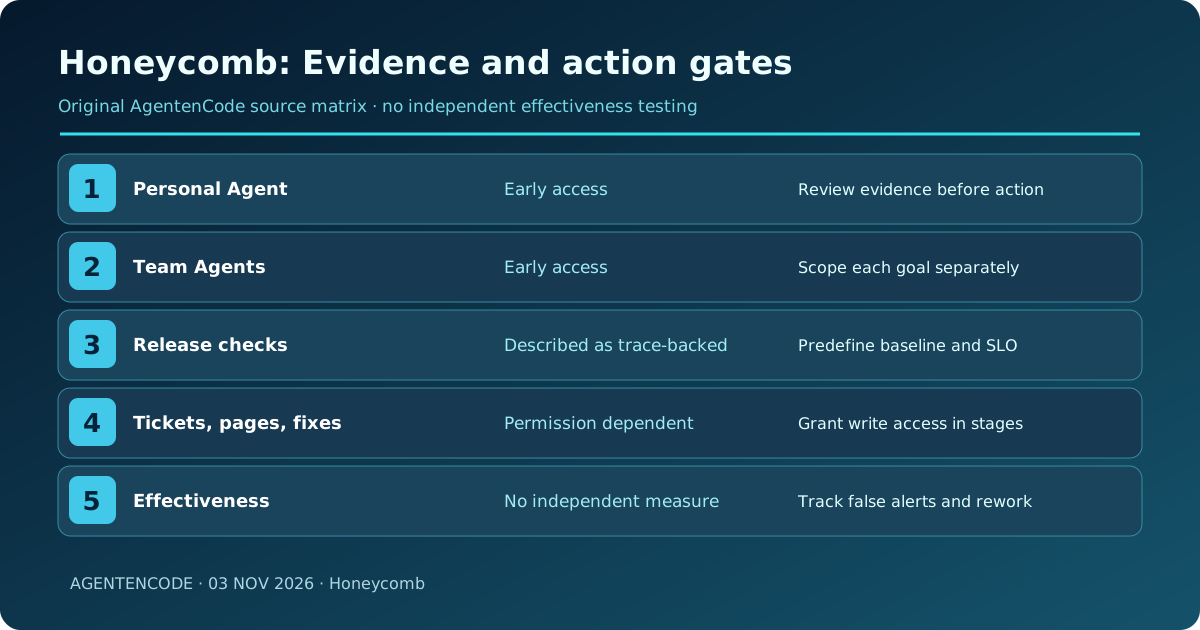
The original AgentenCode matrix below maps personal assistance, scheduled goals, evidence quality, write privileges and product maturity to operational acceptance decisions. It interprets Honeycomb’s public documentation; it is not the result of an independent deployment benchmark.
Unlike an agent that merely reacts to a page, a continuous goal needs a measurable definition such as “no new checkout regression within 30 minutes of deployment.” The success condition requires a known baseline, an agreed SLO and someone accountable for accepting the result. Otherwise “we found the issue earlier” is a slogan rather than a testable outcome.
| Case | Source status | Acceptance gate |
|---|---|---|
| Personal Agent | Early access | Review evidence before action |
| Team Agents | Early access | Scope each goal separately |
| Release checks | Described as trace-backed | Predefine baseline and SLO |
| Tickets, pages, fixes | Permission dependent | Grant write access in stages |
| Effectiveness | No independent measure | Track false alerts and rework |
A pilot that can fail safely and teach something
We would start with a noncritical service and reliable distributed tracing. Let the Team Agent observe two known deployments, produce latency and error comparisons, and include query links—but prohibit automatic paging, ticket writes or patch application. Engineers independently check whether the claimed changes are visible in the source telemetry under predefined review criteria.
The next step is to measure reproducibility, false alarms, cost of added telemetry and human verification time. Only then should a limited ticket-writing permission be considered; production fixes and on-call paging need stronger proof. AgentenCode has not run this test and makes no independent claim about effectiveness or savings.
Verdict: the evidence chain is more important than the autonomous label
Honeycomb’s proposal addresses a genuine weakness in AI-assisted operations: a model can produce a plausible root cause while the actual service behaves differently. Linking findings to distributed traces, giving agents ongoing goals and controlling their tools is a valuable direction for teams deploying AI-generated code.
However, these are early-access products. Our conclusion is that the architecture deserves attention, not that outage prevention or cost reduction has been independently demonstrated. Real adoption hinges on the scope of measured telemetry, false-positive rates, clarity of hypotheses and the action boundaries teams enforce.
Original sources
Frequently asked questions
Are Honeycomb Team Agents generally available?
No. Honeycomb labels both Personal and Team Agents as early access as of November 3, 2026.
Do trace links prove that every agent conclusion is correct?
No. They support verification, but trace coverage, instrumentation completeness and causal interpretation still require review.
Can the new agents make production changes automatically?
Honeycomb describes permission-controlled actions such as creating tickets, paging responders or drafting fixes. Actual write scope and deployment approval must be checked for each integration.