

Agent profile · SRE & automation
Honeycomb AI SRE Agents
Provider: Honeycomb
Honeycomb's Personal and Team AI SRE Agents aim to investigate releases and production signals with trace-backed findings. Both remain in Early Access as of November 4, 2026.
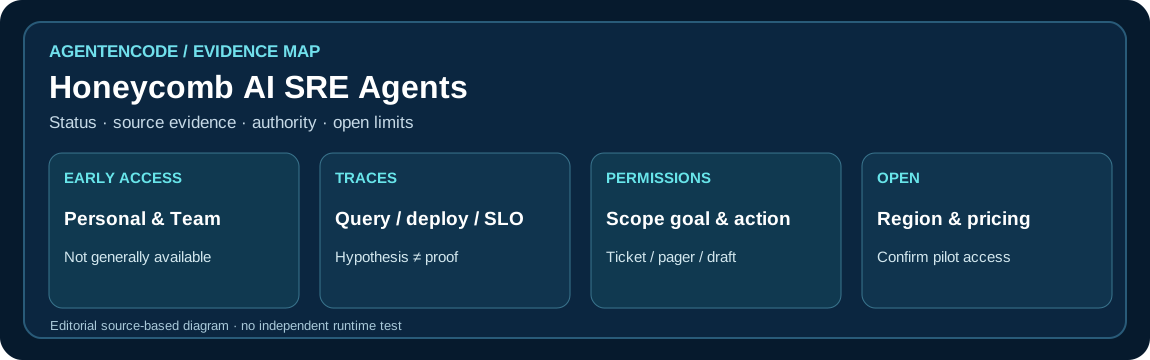
Original source-based decision map
Honeycomb AI SRE Agents — scope and approval decisions
Availability, evidence, permissions and next checks at a glance.
Overview & Direct Answer
Direct answer: Honeycomb AI SRE Agents
Honeycomb introduced two related forms of AI site reliability agent: a Personal Agent for individual investigations and Team Agents for goals shared across an engineering team. The vendor emphasizes high-cardinality traces, queries, deployments and external context. Both product forms entered Early Access on November 3, 2026, rather than general availability.
The important product distinction is that trace-based evidence and an autonomous production repair system are not synonymous. Honeycomb describes investigations that link their findings to underlying telemetry. Teams should first establish whether they have sufficient distributed tracing and real access to the Early Access features before making claims about their operating value.
Features & Operating Model
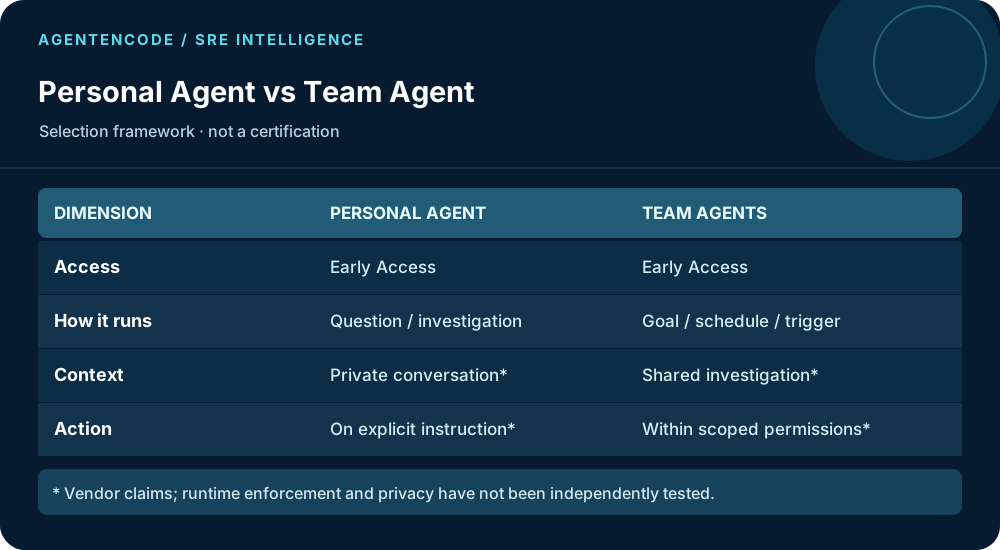
The Personal Agent is positioned as an investigation partner that can answer questions about production behavior and link its conclusions to the relevant data. Honeycomb says personal chats remain private and proposed actions require an explicit human instruction. The product statement does not replace review of the customer's actual privacy and access contract.
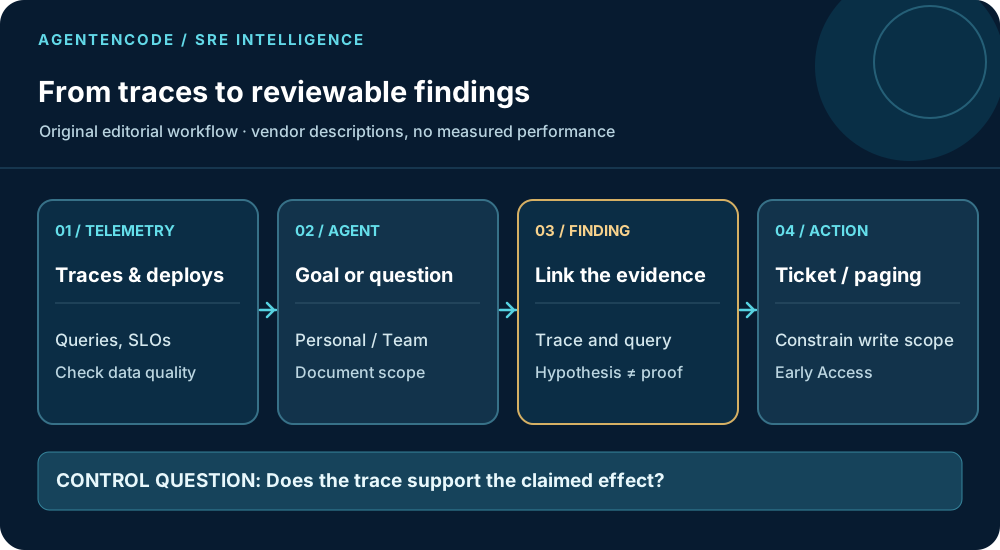
Team Agents pursue goals that the team defines, such as checking a deployment, improving instrumentation, monitoring SLOs or maintaining knowledge documents. Goals can run on a schedule, trigger or service-level objective. The platform aims to associate findings with the query, trace, deployment or ticket that supports them, so investigators can review the chain of evidence.
Honeycomb also describes a shared memory across team investigations. A measured finding should remain distinguishable from an unverified hypothesis. Integrations can read context and may optionally prepare tickets, page responders or draft changes, with authority varying by goal and action permissions.
Use Cases & Pilot Design
A practical first trial is to monitor a single well-instrumented service after a known deployment. Define the release window, relevant error and latency signals, evidence quality and the escalation route before the agent runs. The acceptance criteria should be externally checkable: trace links that exist, detectable regressions and clear treatment of uncertainty.
Another relevant use case is instrumentation quality. Sparse or incorrectly sampled traces cannot support a confident root-cause conclusion. A team agent can propose missing attributes or spans, but engineers need to assess whether the resulting telemetry is representative and safe to collect. This is especially important when traces include sensitive user or customer identifiers.
AI applications add a third scenario: connecting conversations, tool calls and evaluations after prompt or model changes. Honeycomb advertises connectors that can enrich the diagnosis. Whether they are enabled for a specific tenant, and whether they improve production outcomes, remains a test question rather than an observed fact in this profile.
Appropriate tasks
- Detect release regressions
- Link findings to traces
- Monitor SLO goals
- Find instrumentation gaps
Access, Pricing & Limitations
At the time of writing, Personal and Team Agents are explicitly Early Access. Prospective users need to confirm plan eligibility, geography, support conditions and any later GA milestones with Honeycomb. The reviewed public announcement does not establish one clear universal price for these new agents, so we do not publish a guessed subscription figure.
A trace supports investigation but does not prove causality on its own. An apparent correlation between a deployment and degraded latency may have alternative causes. Missing instrumentation, incorrect sampling and underdefined service-level objectives can all weaken the agent's recommendations. Each output needs a route back to evidence and a visible uncertainty label.
Honeycomb discusses actions such as filing a ticket, paging a responder and drafting a possible fix. These do not establish that every Early Access installation may autonomously roll back code or change production infrastructure. Each permitted operation must be verified per connector, team policy and target environment.
Access at review date: Personal and Team Agents Early Access as of Nov 3, 2026; no general availability or universally verified pricing.
Privacy, Security & Trust
Personal investigations and shared team automations cross different privacy boundaries. Honeycomb describes private Personal Agent chats and shared Team Agent memories. Before exposing sensitive trace attributes, organizations must check role visibility, retention, deletion, data sharing and the exact sources incorporated in persistent findings.
The advertised goal-scoped permission model can support controlled operations, but AgentenCode has not independently verified its runtime enforcement, audit trail or processing region. A prudent rollout starts with read-only goals and separate identities, then introduces explicitly approved write actions after review.
A clickable trace is useful evidence for the engineering decision, not a general security certification. We do not award positive Trust control flags solely on the basis of product marketing. Properties without sufficiently specific and verifiable product sources stay unknown in the AgentenCode evidence register.
Comparisons & Selection
Editorial selection: Why AgentenCode added this agent – our documented criteria, availability scope and remaining evidence gaps.
Honeycomb Team Agents and PagerDuty Paige approach operations from different entry points. Honeycomb emphasizes trace-centric, continuous release observation and shared engineering goals. PagerDuty emphasizes on-call incident orchestration and governed remediation. Availability also differs: Paige reached GA in early November 2026, while these new Honeycomb agents remained Early Access.
AWS DevOps Agent provides another point of comparison for cloud and SRE investigation. These tools have different data environments, access models and possible write scopes. Vendor features should not be turned into a competitive benchmark without the same well-defined tests and independent measurement.
Honeycomb is worth evaluating when a team already relies on rich traces and wants recurring release and instrumentation checks. Teams focused on escalation and incident remediation may prefer to evaluate PagerDuty or AWS workflows. No single provider is the default winner across all operational contexts.
Related profiles: AWS DevOps Agent, PagerDuty Paige SRE Agent. Current expert analysis: Read AgentenCode news.
In-depth Analysis
AgentenCode's editorial observation is that a measurable team goal, linked to reviewable production data, offers a more defensible model than a vague promise of autonomous SRE. Every goal should identify its trigger, data scope, success condition, authorized actions and escalation path. Without those elements, an apparently useful automation remains hard to audit.
A controlled adoption sequence starts with read-only release observations and linked evidence. Next, permit creation of a reviewed ticket with a clearly scoped payload. Only after tests and access review should teams consider additional operations. The current public sources do not justify presenting autonomous production fixes as a proven feature.
Independent operating results, geography, pricing by goal, real Early Access behavior and the handling of sensitive trace fields remain open. This profile is an evidence-scoped editorial review dated November 4, 2026, not an account-based software test.
Pre-adoption checklist
- Confirm Early Access eligibility and regions
- Scope write actions per goal
- Validate trace evidence and hypotheses
Frequently Asked Questions
A useful pilot discussion should separate public product commitments from the capabilities actually exposed to an invited Early Access customer. Permission controls matter more than the word autonomous because issuing a ticket, paging someone and changing a production system create very different risks.
The answers below rely on the November 3 announcement and official Honeycomb product information. Unverified pricing, data residency, availability by account and precise execution controls remain explicitly unresolved.
Are Honeycomb AI SRE Agents generally available?
No. Honeycomb explicitly described both Personal and Team Agents as Early Access in its November 3, 2026 announcement.
How do Personal and Team Agents differ?
The Personal Agent helps an individual investigate and acts on explicit instruction. Team Agents pursue defined team goals via schedules, triggers or SLOs and share investigative context.
Can Team Agents automatically roll back production releases?
The reviewed sources do not establish a universal autonomous rollback feature. Honeycomb describes permissions for ticket creation, paging and drafting fixes, which require separate action-level validation.
Primary Sources & Changes
The core sources are Honeycomb's vendor-issued November 3 press release and the official Team Agents product description. These establish the advertised scope and Early Access status, not independently measured effectiveness.
Created November 4, 2026 without a Honeycomb Early Access account. We did not run the agent, detect a real regression or execute any production write operation.
Official primary sources
- Honeycomb AI SRE Agents announcement — https://www.prnewswire.com/news-releases/honeycomb-introduces-ai-sre-agents-that-go-beyond-incident-chasing-with-goal-oriented-continuous-improvement-302926929.html
- Honeycomb Team Agents product page — https://www.honeycomb.io/platform/team-agents
- Honeycomb platform overview — https://www.honeycomb.io/platform
Editorial record: 2026-11-04 · source-scoped review; no runtime, security or privacy audit.