
GitHub tested 5,000 coding agents in one repo—what its new Git layer cannot solve
Rubicon is a storage scaling story: 5,000 agents and 7,200 pushes/s are internal test figures, not evidence of safe merges, lower CI bills or GA availability.

GitHub’s Rubicon architecture promises a different scale of concurrent Git writes. The hard operational questions about permissions, review capacity and cost remain separate.
Source and availability status
- Primary source
- Release scope
Limited private preview, with a broader rollout targeted for early 2027; not generally available.
- Evidence limit
Source-first analysis of GitHub’s November 5, 2026 engineering post. We did not run the private preview, replicate the benchmarks or certify security and pricing claims.
Why GitHub is rebuilding its Git layer
As coding agents work around the clock, a busy repository no longer receives only intermittent human pushes. Independent agent sessions create branches, publish objects and fetch each other’s work, triggering a growing wave of downstream reads.
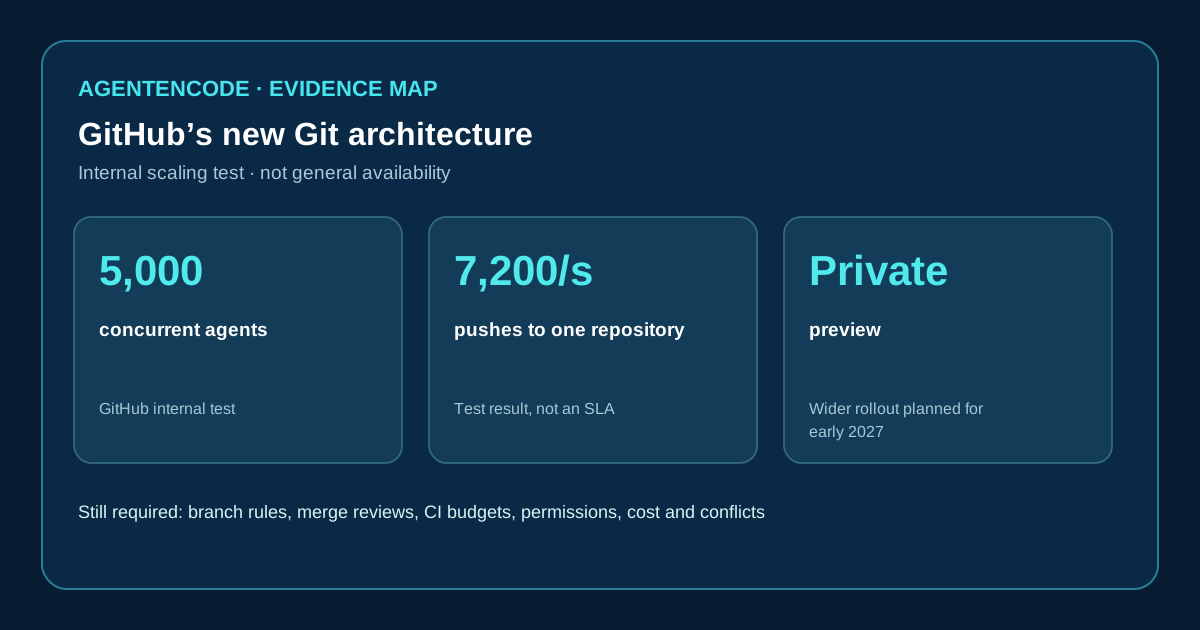
In its November 5 technical announcement, GitHub reports internal tests with 5,000 concurrent agents and 7,200 pushes per second to a single repository. These are vendor test results, not an independently replicated capacity guarantee for an ordinary customer repository.
How Rubicon separates Git object writes from reference updates
Git object storage is content-addressed and largely immutable, allowing objects to arrive in parallel. Updating a branch reference, by contrast, needs ordering and consistency. GitHub separates these concerns through a Ref-CAS service, blob-backed durable storage and independently scalable virtual replicas.
Pack compaction and garbage collection move to background workers. The design reduces unnecessary coordination while preserving reference correctness. Faster storage does not remove the possibility that two agents produce incompatible changes.
The private preview matters more than the headline
GitHub says the system is presently in a limited private preview, with broader availability planned for early next year. No public text establishes a universal customer SLA of 7,200 pushes/s or a guaranteed schedule for every paid plan.
Nor does the announced number measure accepted pull requests, deployment success or software quality. Teams should not convert a storage benchmark into a promised productivity multiple.
AgentenCode decision matrix: four independent bottlenecks
Our framework separates the Git write path, authorization and branch policy, CI capacity, and engineering acceptance. Rubicon targets the first bottleneck; the others depend on organizational architecture and approval rules.
A sound pilot needs agent-scoped credentials, protected branches, explicit merge gates and attributable audit trails. The evidence graphic maps GitHub’s measured throughput against the current limited release scope.
| Control | Evidence / status | Editorial limit |
|---|---|---|
| Git data path | 5,000 agents / 7,200 pushes/s in tests | Vendor test, not customer SLA |
| Rollout | Limited private preview | Broader rollout planned, not GA |
| Authorization | Branch and token policies remain | Fast writes do not imply permission |
| Engineering outcome | CI and merge review still gate changes | Measure accepted work, not pushes |
The budget question GitHub’s test cannot answer
Higher push throughput can shorten a blocking wait, but it can also generate more CI runs, review events, dependency downloads and deployments. A faster Git backend does not establish a lower total cost per accepted change.
Measure CI minutes per merged pull request, rebase failures, rate-limit incidents, secrets exposure attempts and human review effort before scaling a fleet. These are recommended operational metrics, not results GitHub claimed to measure in the announcement.
How to evaluate an agent-scale repository responsibly
Start with a small number of agents working on isolated branches against representative workloads. Establish branch ownership, least-privilege tokens and stable human review criteria. Increase concurrency only when conflict rate and test throughput remain acceptable.
If your organization cannot access the private preview, the architecture can be assessed conceptually but cannot be independently benchmarked in your own tenant yet. That is a legitimate outcome for procurement planning.
Bottom line: throughput is not governance
Rubicon is meaningful infrastructure work for AI-assisted development, and the internal stress figures are notable. But a repository that accepts thousands of pushes still needs systems to decide which changes should be merged.
The real operating advantage is proof of who changed what, under whose authorization, at what cost and with which independently verifiable checks.
Frequently asked questions
Can any GitHub customer achieve 7,200 pushes/s today?
No. GitHub reports an internal test of its limited-preview architecture.
Is Rubicon generally available?
No. GitHub describes a limited private preview and a broader rollout targeted for early 2027.
Do thousands of agents eliminate pull-request reviews?
No. Git throughput and code acceptance are different operational controls.
Does GitHub promise lower CI bills?
The announcement does not establish savings across downstream CI or review workflows.
Primary sources and methodology
Methodology: Source-first analysis of GitHub’s November 5, 2026 engineering post. We did not run the private preview, replicate the benchmarks or certify security and pricing claims.