
OpenAI's 500 persistent OpenClaw agents: how the controls work
OpenAI reports more than 500 internal persistent agents. We examine Codex sandboxing, agent identity, auto-review, audit logs and OCE's pilot status.

The risk changes when an agent keeps working
A typical coding assistant completes a defined task and stops. Persistent agents can remain active, react to new events and initiate work with no new user prompt. That creates a different risk profile: long-running access must be controlled even when an individual output looks harmless.
In a November 12, 2026 engineering post, OpenAI describes its internal OpenClaw deployment. The company says more than 500 proactive agents now handle work such as opening pull requests after product feedback and running continuous experiments. This is a vendor-reported internal deployment, not an independent assessment of safety or productivity.
A trusted control plane for untrusted execution
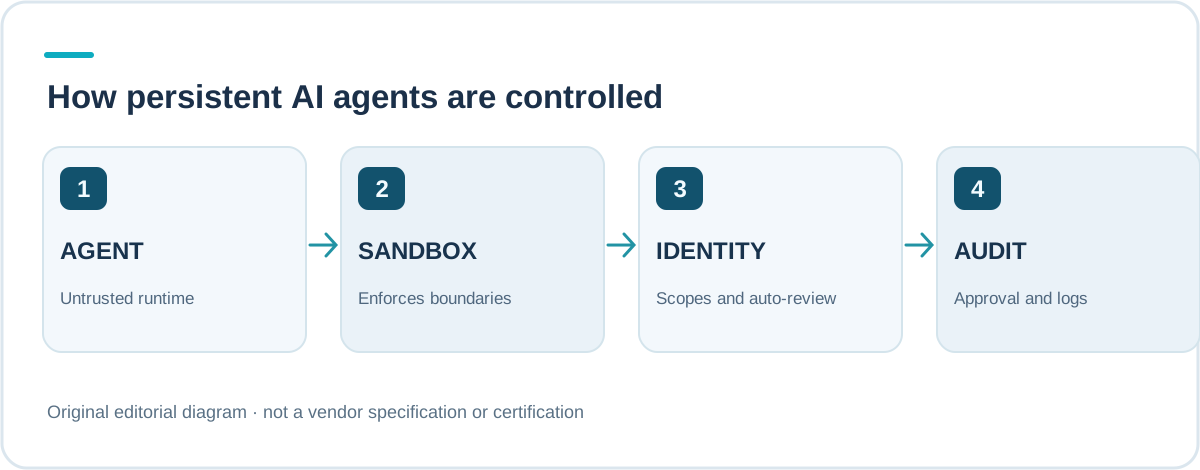
OpenAI's central design decision is to separate deterministic infrastructure from the agent runtime. Networking, credentials, identity and sandbox policy live in trusted components; the model, its tools and its generated code are treated as untrusted workloads.
The implementation splits OpenClaw Gateway and the remote agent harness into separate execution environments. A long-running agent should not be able to enlarge its permissions simply by rewriting a local setting.
Bound the workspace, network and secrets
The described Codex sandbox restricts process access, file writes and network destinations. OpenAI uses managed allowlists and explicit denials for sensitive endpoints. A credential broker provides access without exposing raw secrets to the agent's working context.
Its shared configuration examples exclude unrestricted danger-full-access mode and enforce tighter sandbox options. The fact that a configuration exists is not proof of perfect enforcement: isolation must be tested against the actual workload, runtime version and threat model. OpenAI's sandbox security documentation explains isolation boundaries in more detail.
Auto-review and separate agent identities
OpenAI says every agent action goes through auto-review. A second model filters routine operations, reserving human attention for higher-value decisions. This may reduce repetitive approval prompts, but model-based review can itself fail or be misled and should not become the only control on irreversible actions.
Each agent also has a distinct identity associated with a ChatGPT Service Account. Actions can be audited separately from the human owner, inference access can be revoked and connected services can apply their own policies. This distinction between agent identity and user delegation matters as systems become more autonomous.
Availability and evidence limits
The article introduces OpenClaw Enterprise (OCE) as an open-source, vendor-neutral agent control plane. OpenAI explicitly calls the project a pilot and says it aims for a 1.0 release by the end of 2026. It would be premature to describe OCE as a fully mature enterprise deployment standard.
Observability is also a trade-off. Recording all agent turns and control-plane changes helps investigators, but those traces may contain sensitive content. OpenAI describes restricted access to internal logs. Customers must make their own decisions about data retention, disclosure and the scope of inspection.
AgentenCode assessment: prove boundaries before scaling
Begin with reversible tasks and minimal tools. Check which directories and endpoints are reachable, what happens when an identity is revoked and which changes require an accountable human approver. Test prompt injection, unauthorized writes, failed review steps and emergency shutdown. Our AgentenTrust framework also examines permissions, traceability and human approvals.
This is useful evidence of architectural practice, not a transferable security certification. The durable advantage comes from enforced boundaries and verifiable audit trails, not from the raw count of agents. See our AgentenTrust framework and security guide.
Frequently asked questions
Are the 500 OpenClaw agents offered to customers?
No. OpenAI's count describes its own internal deployment, not publicly available customer agent instances.
Does auto-review eliminate human approval?
No. Model-based review helps prioritize decisions, while high-risk or irreversible actions need appropriate human controls.
Is OpenClaw Enterprise generally available?
OpenAI describes OCE as a pilot in November 2026 and targets a 1.0 release by year-end.
RESEARCH & CONTEXT
Sources for this article
This analysis relies on the original publications linked below, which readers can inspect directly.
- OpenAI Developers – Securing persistent agents like OpenClaw (12.11.2026)
- OpenAI Developers – Sandbox Security
Checked November 13, 2026. Vendor statements are identified as such; we conducted no independent product benchmark or security certification.