
llm-d 1.0: Why cheaper AI agents need more than a model
The AI industry keeps comparing foundation models. A new open-source release addresses the layer beneath them: how thousands of agent steps can reuse context, share infrastructure and remain responsive under unpredictable load.
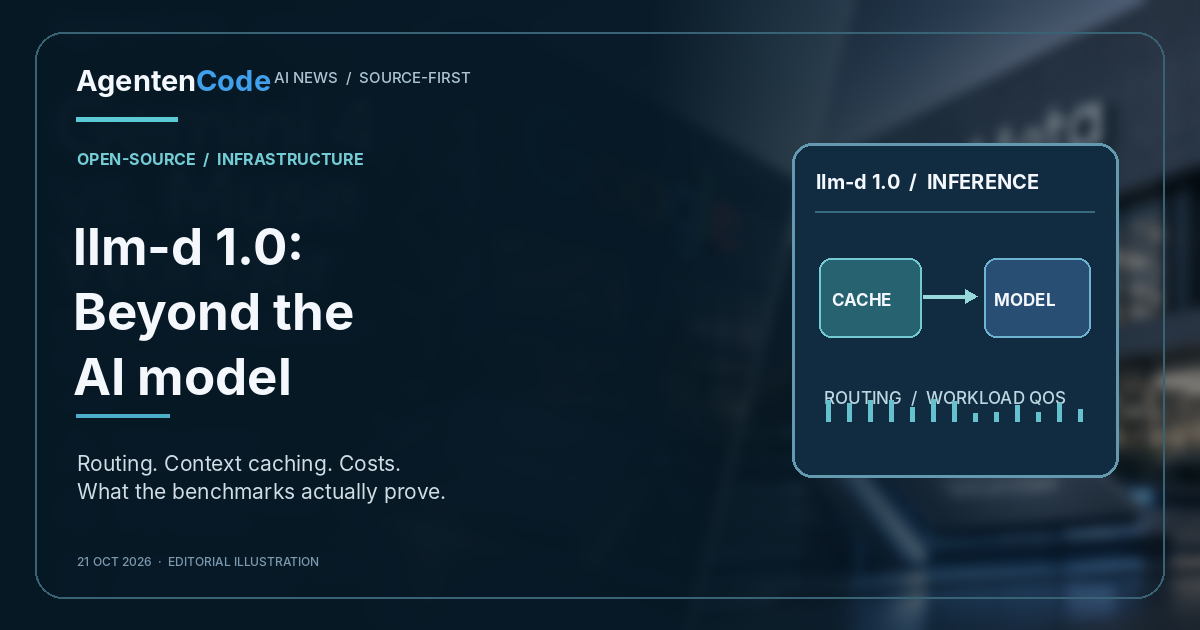
On October 20, 2026, llm-d contributors announced version 1.0 of an open Kubernetes-native inference platform. It coordinates model servers with routing, caching and operational controls. IBM cites large efficiency improvements in selected demonstrations; they are not guaranteed savings for every deployment.
Most AI comparisons focus on a model's benchmark score or the cost of a single API request.
For agent fleets, cache reuse, workload priorities, utilization and service reliability may be just as important.
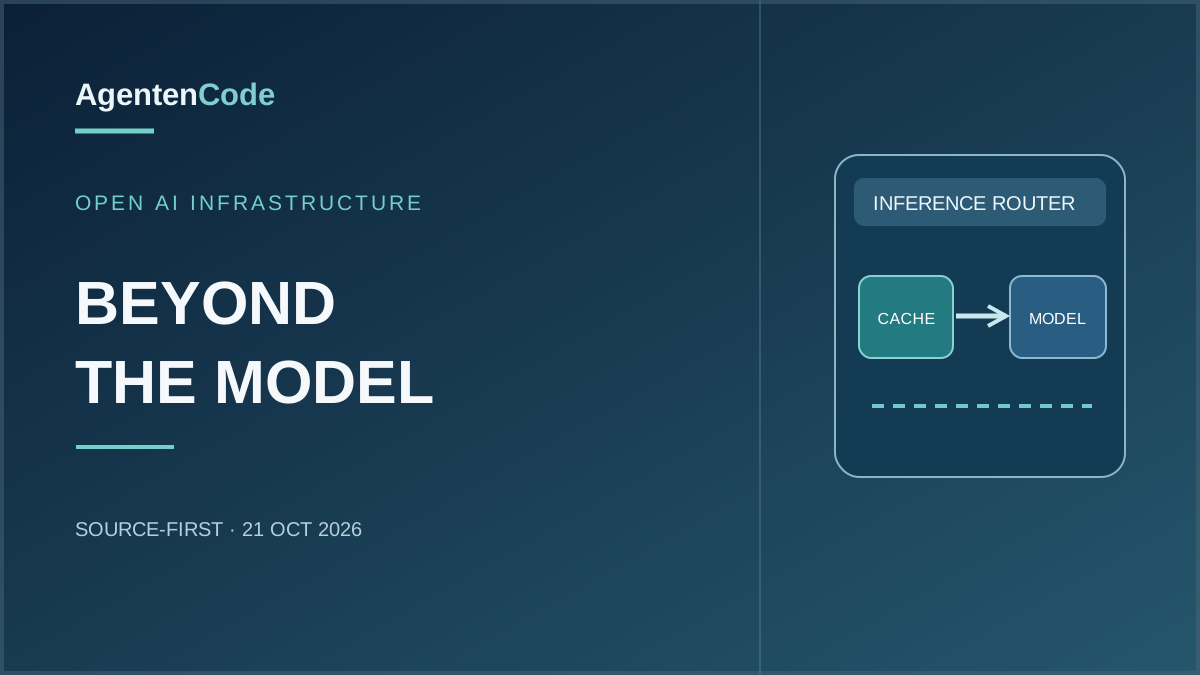
View the technical explanatory graphic
CLAIM-LEVEL EVIDENCE
What the evidence supports
Original documents, vendor claims, unresolved questions and our interpretation are separated.
- Primary source
Version 1.0 announced
The maintainers and IBM document the October 20 release.
Evidence: llm-d maintainers: Version 1.0 technical release ↗ · IBM: llm-d 1.0 release ↗
- Primary source
Operational controls described
The technical release covers tenant priorities, session affinity and upgrade mechanisms.
Evidence: llm-d maintainers: Version 1.0 technical release ↗
- Vendor claim
Savings are benchmark claims
IBM cites cost benefits under selected traffic and hardware conditions.
Evidence: IBM: llm-d 1.0 release ↗
- Open question
Total cost varies by deployment
These sources do not establish a vendor-neutral universal total-cost advantage.
Evidence: llm-d maintainers: Version 1.0 technical release ↗ · IBM: llm-d 1.0 release ↗ · IBM Research: llm-d for production inference ↗
Vendor sources are not independent tests. Methodology →
Why a great model is not enough
AI agents often call models repeatedly: they plan, use tools, inspect outputs and delegate smaller tasks. Many turns carry forward a substantial amount of previously seen context. If follow-up requests are sent to arbitrary servers, some of that context must be computed again. Parallel agents also create irregular bursts of traffic that compete with interactive requests. llm-d addresses the serving layer rather than building a new language model. It coordinates established engines such as vLLM and SGLang with a routing and scheduling system. In other words, it shifts part of the problem from model quality to the economics of operating that model.
What version 1.0 adds
The project's maintainers describe multi-tenant flow control with priorities and fairness, router high availability with failover and coordinated updates for separately operated prefill and decode components. A stable configuration interface is intended to make longer-term operations more predictable. When different workloads share a fleet, the router can protect latency-sensitive traffic instead of blindly dispatching every request to busy servers. These capabilities are documented in first-party release material. They do not independently prove zero downtime under every failure, or the same performance on every accelerator and cloud.
Why session-aware routing matters for agents
A model server's key-value cache holds computations associated with earlier tokens. When a follow-up request reaches a replica with compatible cached state, part of that computation can be reused. llm-d 1.0 adds session-aware routing, prioritization of active agent turns and stateful Responses API handling. These are relevant for long-running coding and research agents, where the same context may be revisited many times. Actual gains depend on session length, traffic patterns, cache capacity, model architecture and how well sessions fit within the available fleet. Short, independent calls can have very different economics.
What IBM's cost figures do – and do not – prove
IBM describes a benchmark deployment serving up to 3,000 concurrent coding agents and more than 6.6 million output tokens per minute at peak. On selected context-heavy workloads it reports five- to tenfold lower cost per token versus certain commercial API prices. Another IBM research case cites an 11.5-fold advantage against a proprietary configuration. These numbers come from project participants using specific benchmarks, hardware and price assumptions. They do not constitute a vendor-neutral independent total-cost study. GPU rental or purchase, power, reliability engineering, staffing and utilization may alter the result substantially.
When self-hosting is worth considering
Small companies may save time and risk by using a hosted API rather than operating their own Kubernetes and GPU fleet. Larger organizations with sustained demand, long agent sessions or special infrastructure requirements have stronger reasons to test an open serving stack. The right comparison measures cost per successfully completed workflow, answer quality, tail latency and operational overhead under representative traffic. llm-d 1.0 makes the technical option more mature, but a production pilot remains essential before claiming business savings.
EDITORIAL ASSESSMENT · NO INDEPENDENT TEST
AgentenCode assessment
Agent economics are increasingly about more than the price of one token. The relevant levers are context reuse, retries, traffic isolation and completed work per unit of cost. Open infrastructure can offer flexibility and bargaining power. But an impressive benchmark does not replace a complete accounting of equipment, people, energy and deployment risk.
Primary documents and reporting
Links document what the sources say; they do not imply an independent AgentenCode product test.
Frequently asked questions
What is llm-d 1.0?
An open Kubernetes-native serving layer connecting routing and scheduling to inference engines like vLLM and SGLang.
Does llm-d automatically reduce agent costs?
No. Benefits depend on traffic, caching, hardware utilization and operating expenses.
Who should consider self-hosted inference?
Teams with sustained high-volume workloads and the capacity to operate a GPU and Kubernetes fleet.