
GitHub restricts privileged PR workflows: What coding agents must fix before November 9
GitHub will block privileged pull_request_target workflows in public repositories by default in December. Coding-agent teams should review their event policies, fork handling and secrets before the first November brownout.
GitHub will block privileged pull_request_target workflows in public repositories by default in December. Coding-agent teams should review their event policies, fork handling and secrets before the first November brownout.
Sources and limitations
- Primary source
Official dated announcement: GitHub, 2026-11-02.
- Not independently verified
Vendor claims and editorial analysis are separated; no independent product, security or billing tests.
The trust boundary behind pull_request_target
GitHub says pull_request_target executes in the base repository's context and may have access to sensitive credentials. Executing code checked out from an external fork in that privileged context crosses a serious trust boundary.
An AI coding agent cannot eliminate that risk simply by being instructed to spot malicious content. The security of the event context and credentials must be enforced independently of the model, especially when the workflow can write to repositories, invoke tools or reach production systems.
The precise rollout and brownout dates
The official notice dated November 2, 2026, postpones the planned enforcement until December 2. Before that permanent date, the rule remains in evaluate mode except during two temporary enforcement windows.
The brownouts are scheduled for November 9 and 16 from 16:00 to 18:00 UTC. Affected runs fail with annotations during those windows, letting maintainers see actual disruption. These are temporary tests, not a claim that the whole month will be blocked.
Which repositories and events are covered
The change covers public repositories on GitHub Free, Team and Enterprise Cloud. GitHub explicitly excludes private and internal repositories, and Enterprise Server. The event is specific: this is not a blanket retirement of GitHub Actions.
GitHub permits applicable Actions event policies to allow particular workflows that legitimately need the trigger. An allow decision needs clear scope and ownership; it does not by itself make untrusted pull-request code safe to run with privileged tokens.
Why coding agents increase the stakes
GitHub Agentic Workflows reached GA in October and uses GitHub Actions as its execution foundation. Agent instructions and model routing do not bypass repository policies or alter the security boundary of Actions triggers.
A risky chain combines a third-party fork, executable checkout, powerful secrets and an agent allowed to act on results. AgentenCode's recommendation is to separate read-only analysis from privileged writes and require deliberate authorization where further actions affect protected resources.
AgentenCode's five-case risk matrix
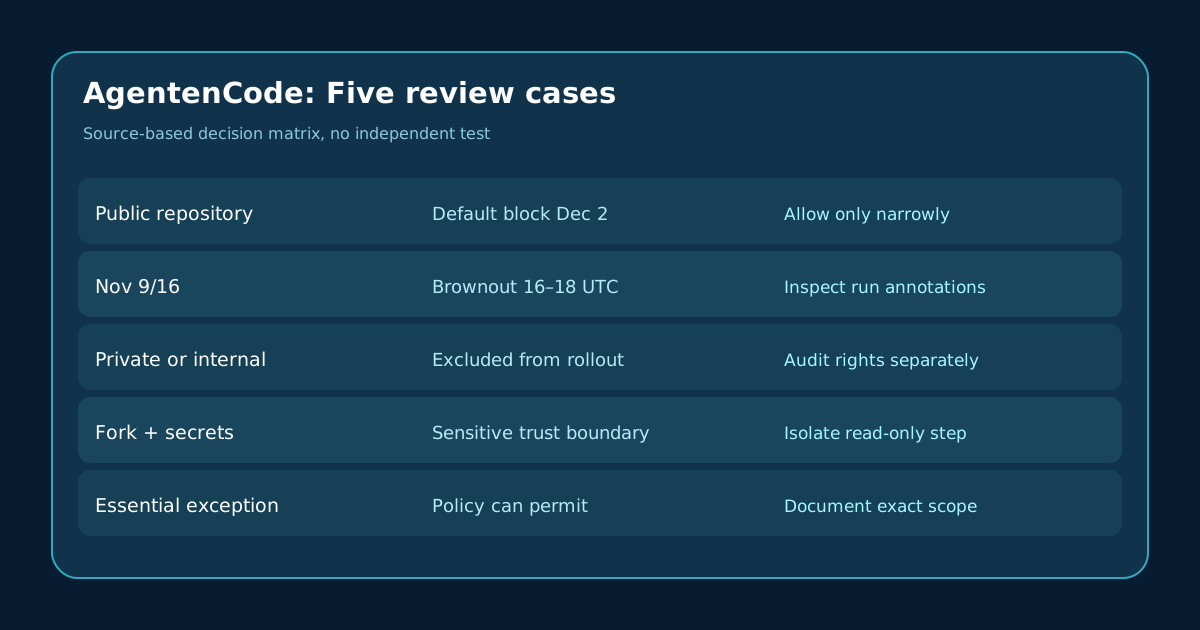
Our five-case table distinguishes policy coverage, exceptions and review priorities. It is a source-based AgentenCode analysis of GitHub's dated announcement, not an independent security assessment.
The decisive dimension is not which model the workflow uses but whether untrusted inputs share a context with a token capable of changing protected state. An allowed job can still be misconfigured.
| Case | Status | Review action |
|---|---|---|
| Public repository | Default block Dec 2 | Allow only narrowly |
| Nov 9/16 | Brownout 16–18 UTC | Inspect run annotations |
| Private or internal | Excluded from rollout | Audit rights separately |
| Fork + secrets | Sensitive trust boundary | Isolate read-only step |
| Essential exception | Policy can permit | Document exact scope |
A practical plan before November 9
Inventory workflow YAML files and event policies for pull_request_target. Classify each match by repository visibility, fork checkout behavior, write permissions, secrets and business need. Use GitHub Insights and evaluate-mode signals to identify likely blocked workflows.
Where technically possible, move untrusted checks to a read-only pull_request path and keep privileged updates behind a separate approval. Exercise a harmless test PR before November 9, capture annotations during the brownout and avoid broad allow-all exceptions. AgentenCode has not executed these tests in a customer organization.
Bottom line: permissions before automation
This change matters for AI-agent operations because it changes a real authorization boundary, rather than another benchmark number. The risk is attached to the workflow's permission design.
Prioritize public repositories that combine outside contributions and secrets, document narrowly scoped exceptions and repeat the review after enforcement. The aim is defensible automation, not fewer safeguards.
Primary sources
Frequently asked questions
Does this block every GitHub Action?
No, it targets pull_request_target in specified public repositories.
What happens during brownouts?
Affected workflows fail with an annotation during each temporary window.
Does an allow policy guarantee safety?
No. The workflow must still handle untrusted code and credentials safely.