
Pando: OpenAI rebuilt Git for parallel Codex agents – and reports faster pushes
Parallel coding agents change more than the volume of code. They also multiply branches, pushes, builds and reads against shared Git infrastructure. On November 2, 2026, OpenAI described Pando, its new Git-compatible backend designed for this load. The company reports that median push latency in its own production environment fell by nearly 80%.
Pando processes updates to independent Git branches concurrently and reuses immutable packfiles through cached delivery. OpenAI reports push latency nearly five times faster and Git data delivery approaching a petabyte daily. These are internal operational claims, not a third-party benchmark or a promise that Pando is generally available as a service.
Sources and limitations
- Primary source
OpenAI's dated November 2, 2026 engineering report explains architecture, operational results and consistency trade-offs. Read the original.
- Not independently tested
No independent benchmark replication or public general-availability, pricing and migration commitment is established.
Why Codex-scale development stresses Git
One developer can now run several Codex sessions, each producing branches, pushes, reviews and CI jobs. One push may trigger multiple runners fetching the same commit. OpenAI says its monorepo suffered increasingly slow operations and at times saw merge reliability fall below 90%. The bottleneck was not just model inference but the shared source-control system supporting the work.
This challenges the idea that agent productivity is mostly a matter of tokens per second. Every additional coding run can generate repository and CI pressure. OpenAI responded by replacing the server-side architecture while preserving the Git protocol and familiar client experience. That distinction matters: the story is about scaling a backend, not announcing a replacement developer workflow.
Independent branch updates and causal consistency
Traditional distributed Git designs may synchronize changes to the entire repository, making unrelated branch updates compete for coordination. Pando instead versions references separately. Independent branches can advance concurrently; conflicting updates to the same reference are still controlled atomically.
The trade-off is weaker repository-wide consistency. A client reading several branches may not observe one single point-in-time snapshot across all references. OpenAI calls the approach causal consistency, with ordering guarantees for an individual ref. This can suit agents operating on isolated branches, but tooling that assumes a globally synchronized view must explicitly handle the weaker guarantee.
Reusable packs instead of repeated repacking
Git normally transfers compressed objects in packfiles. Pando keeps incoming packs as immutable blobs and records which reference versions depend on them. During fetch, it selects stored packs and serves their URIs instead of recomputing a custom pack from scratch for each client. Caches can share the same bytes across many reads.
This moves work from repeated object packing toward reference-version planning, compaction and caching. OpenAI describes regional cache hit rates over 99% and fetch/clone operations able to saturate 10-Gbps links. That does not mean a small repository will automatically improve: the economics depend on repeated fetches, parallel activity and the amount of reused history.
What OpenAI's reported measurements establish
The company reports nearly fivefold improvement in median push latency after migration and almost a petabyte of Git data served daily. It also cites more than 57 TB of Git packs delivered during one hour. These metrics refer to OpenAI's own workload and have not been independently reproduced in this analysis.
OpenAI says Codex-assisted engineering took Pando from kickoff to production in roughly ten weeks. Teams used conformance tests, deterministic simulators and formal methods to check consistency properties and race conditions. This is a more substantial engineering account than a claim that an agent wrote a large amount of code: it documents the validation approach and migration strategy.
AgentenCode matrix: benefits and trade-offs
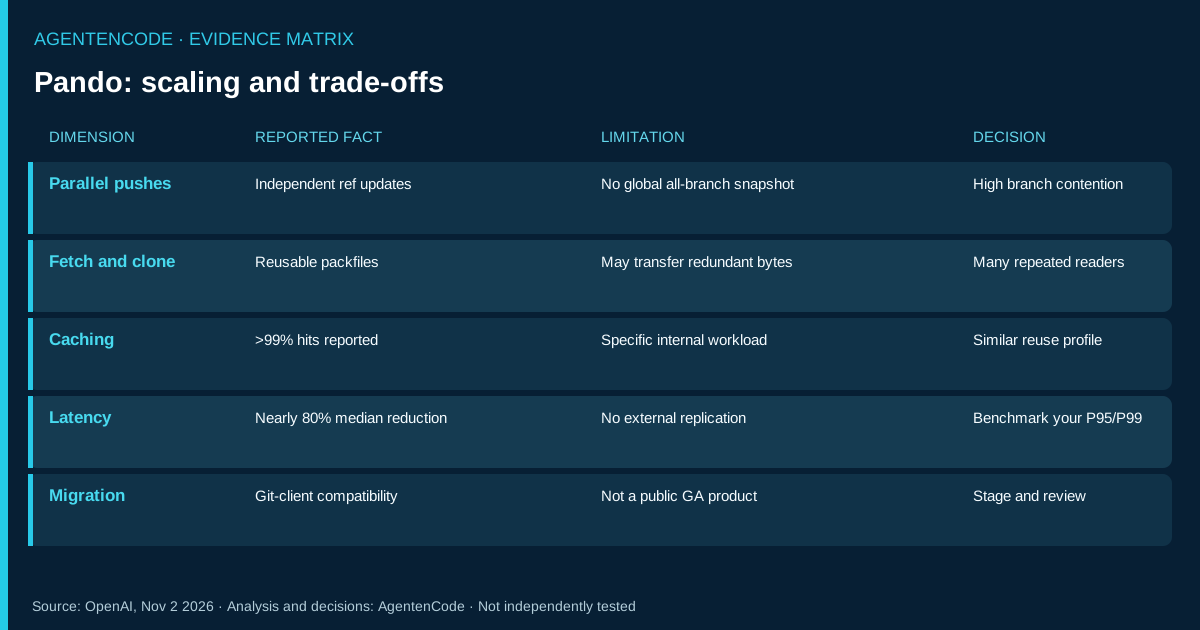
Our matrix separates the architectural benefits from the operational caveats. It is an AgentenCode interpretation of the original engineering report, not our own throughput measurement.
The critical choice is that independent references improve write parallelism but lose an all-branch atomic snapshot. Likewise, reusable packs can reduce server CPU while transferring some already-held objects. The best trade-off depends on an organization's own data, repository size, branches and developer traffic.
| Case | Evidence | What remains open | Approval gate |
|---|---|---|---|
| Parallel pushes | Independent ref updates | No global all-branch snapshot | High branch contention |
| Fetch and clone | Reusable packfiles | May transfer redundant bytes | Many repeated readers |
| Caching | >99% hits reported | Specific internal workload | Similar reuse profile |
| Latency | Nearly 80% median reduction | No external replication | Benchmark your P95/P99 |
| Migration | Git-client compatibility | Not a public GA product | Stage and review |
What other development teams can do now
Pando already serves OpenAI's internal repository, but the post does not announce a generally available commercial or open-source server release with a price. Some improvements to the Git client have been contributed upstream; sharing those patches is not equivalent to releasing Pando itself. Outside teams cannot assume that they can purchase or deploy the same backend today.
A useful three-step audit is available now. First measure push, fetch, clone and merge latency per agentic task. Next measure duplicate CI downloads, cache efficiency and concurrent branch updates. Finally test authorization, code review and rollback so accelerated activity does not bypass safeguards on the main branch. This identifies bottlenecks without assuming access to Pando.
Verdict: coding agents need scalable shared systems
Pando illustrates how coding agents shift pressure onto shared engineering infrastructure. More agents can mean more concurrent repository operations, reviews and tests, regardless of whether the generated code is good. Source control must keep that work observable, reliable and secure.
The right conclusion is narrower than 'Git is obsolete.' This is an informative report on an unusual scale of parallel work, with promising internal operating data and a deliberate consistency trade-off. Teams should measure their own bottlenecks and record the guarantees their agent workflows genuinely need.
Primary sources
- OpenAI, Scaling Git at OpenAI (2 November 2026) – official first-party engineering or research publication.
Frequently asked questions
Can anyone install Pando as a new Git server?
OpenAI describes an internally deployed Git-compatible backend. The announcement does not establish a generally available product.
What does 80% lower push latency mean?
It is a vendor-reported median observation in OpenAI's monorepo, not a guaranteed result for other repositories.
Do coding agents need different Git commands?
OpenAI says Pando retains Git client and protocol compatibility, while altering backend consistency and transfer behavior.