
OpenCode 2.2 gives coding agents persistent terminals and publishable artifacts
OpenCode shipped three new versions of its coding-agent environment on October 30, 2026. The most consequential changes are terminals that preserve session context across server restarts and experimental HTML artifacts. An agent is becoming a persistent workspace rather than an ephemeral command interface.
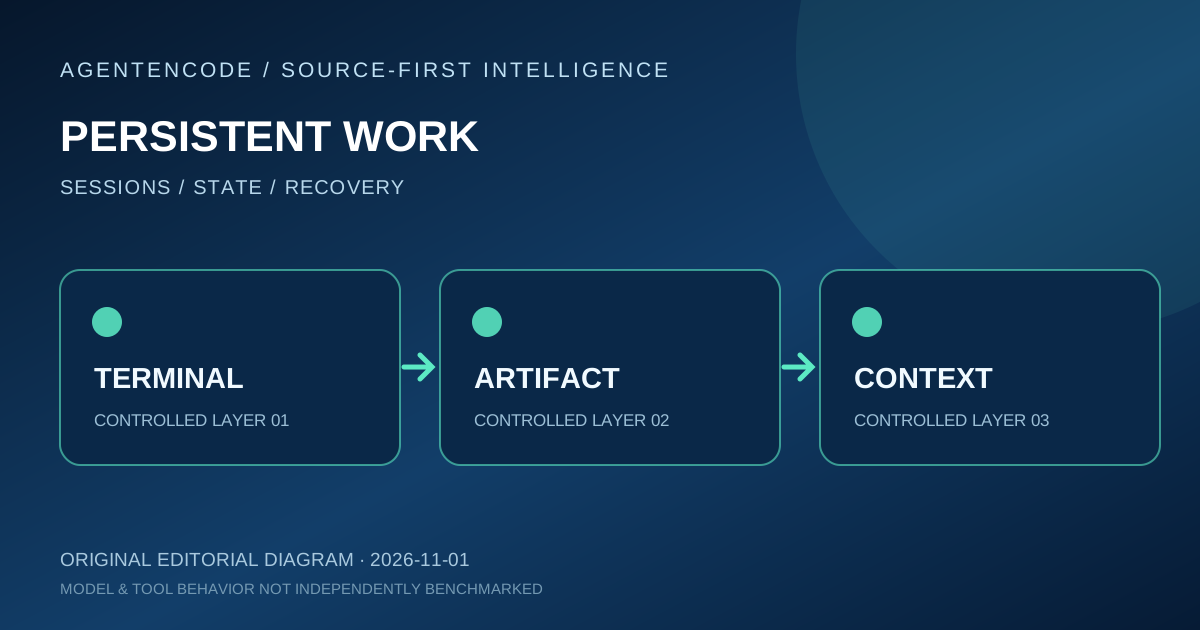
OpenCode is building durable state around the model: persistent terminal sessions, artifact previews and proportional context buffers. That also raises questions about cleanup, process privileges and secret retention.
Sources and evidence limits
- Primary sources
Official October 30, 2026 announcement, first-party technical guidance and version-specific release notes are linked.
- Not independently tested
No AgentenCode benchmark, security audit or blanket compliance claim.
Three releases in one day
The official GitHub release notes list v2.2.3, v2.2.4 and v2.2.5 on October 30. These updates improve the harness surrounding an AI model rather than introduce a new foundation model. Practical agent work often fails when intermediate state is lost, terminal output becomes hard to inspect or context runs out. OpenCode is addressing these surrounding workflow problems.
Desktop terminals retain session state
OpenCode v2.2.4 associates Desktop terminals with sessions. Their scrollback persists across server restarts and remains synchronized with the TUI and other windows. Renamed terminals also keep their names. That can make interrupted work easier to resume and audit. It is not an unconditional promise that every operating-system process survives machine reboots or infrastructure failure.
Artifacts can be published experimentally
According to v2.2.4, enabling experimental.artifacts allows agents to publish and update HTML or static files through built-in local storage or plugin-defined storage. This may help with previews, generated reports and reviewable deliverables. However, generated HTML creates its own trust boundary. Teams must inspect sensitive content, external links, active scripts and where the resulting artifacts are hosted.
Claude Agent is selectable inside OpenCode
The v2.2.3 release documents using an installed Claude Code client and claude auth login to select Claude Agent in OpenCode. This highlights a move toward more interoperable coding-agent environments. It does not establish that every subscription or authentication method is transferable indefinitely or that the integration bypasses the provider's account policies.
The context buffer can scale with model size
v2.2.5 accepts a percentage such as 20% for the compaction buffer instead of only a fixed token count. A proportional reserve can simplify setups using models with different context windows. But reserving tokens is not the same as preserving factual memory: critical constraints and tool results still require explicit storage and validation after compaction.
Persistence requires stronger operational hygiene
Long-lived terminals and artifacts can preserve confidential logs, active tasks and costly processes. Production users should set project-level permissions, session retention rules, plugin review and predictable cleanup. Even if a feature works as documented, that does not prove that a specific deployment is safe when processing untrusted code or running privileged commands.
The real shift is the workspace
OpenCode increasingly treats session history, terminals, worktrees, artifacts and model context as parts of one developer workspace. That could make coding agents more usable across interrupted and multi-step work. The releases document the features but do not offer an AgentenCode-measured productivity or security benchmark. This is an editorial reading of first-party release notes.
Primary sources
- OpenCode official GitHub releases 2.2.3–2.2.5, October 30, 2026
- OpenCode 2.2.4: persistent terminals and artifacts
- OpenCode 2.2.5: percentage context compaction
- OpenCode 2.2.3: Claude Agent, permissions and integrations
Editorial source cutoff November 1, 2026. No independent product or security test.
Frequently asked questions
Do terminals survive all machine restarts?
The release notes specify session ownership and persistence through server restarts, not a guarantee across every host failure.
Are interactive artifacts enabled automatically?
No. OpenCode describes them as experimental and requiring the relevant configuration.
Can every Claude Code plan be reused in OpenCode?
The integration is documented, but account, authentication and permitted-use conditions remain provider-specific.