
GitHub AI Scan is generally available for pull requests, but findings cannot block merges
GitHub adds AI-powered code scanning beside CodeQL for PHP, Shell, Terraform, and more. The critical limitation: findings are advisory only.
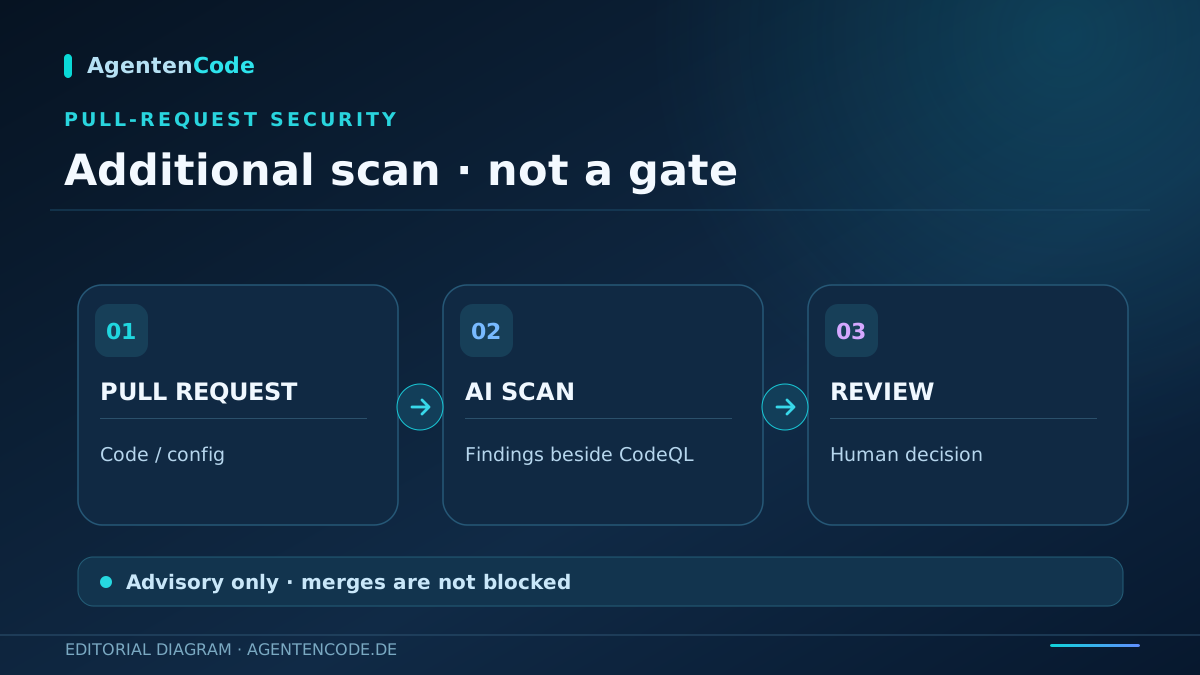
GitHub made AI Scan for pull requests generally available on October 15, 2026. It complements CodeQL by analyzing changes in languages and configurations that CodeQL does not currently cover. A crucial limit: GitHub says AI Scan findings are advisory and cannot block a merge through code-scanning ruleset requirements.
Existing code-scanning processes, including CodeQL, covered many vulnerabilities but did not provide the same coverage for some languages and configuration formats in pull-request changes.
With the relevant settings enabled, AI Scan adds clearly labeled findings and suggested fixes beside CodeQL results. Those findings do not automatically fail checks or enforce a merge block.
What AI Scan adds to existing analysis
GitHub highlights PHP, Shell/Bash, Terraform configuration in HCL, Dockerfiles, JSP for Java, and Blazor for C# as examples of technologies for which AI Scan can complement CodeQL. It is not a replacement for static analysis. Instead, the feature contributes another review signal when a pull request introduces changes in areas where CodeQL currently has gaps.
AI Scan runs automatically when code scanning and the repository's effective AI Scan setting are enabled. GitHub says findings appear on the pull request's Conversation and Files changed tabs alongside CodeQL alerts. An AI indicator differentiates these results from traditional code-scanning output. Findings may explain a security risk and include a suggested autofix, but neither its quality nor its completeness is established by that description alone.
The central limitation: advice without enforcement
GitHub is explicit that these findings do not fail the code-scanning check. They therefore cannot prevent merging via code-scanning ruleset requirements. Security teams should treat this as a product property, not a minor footnote: discovering a possible vulnerability and enforcing a policy against merging vulnerable code are two separate operations.
The scope also has exceptions. GitHub says AI Scan does not run for pull requests opened from forks or created by Dependabot. Organizations need to account for those paths independently. When AI coding agents submit pull requests, they still need human review, appropriate branch protection, and existing analysis. An additional AI scanner does not turn autonomous code generation into a fully guarded release process.
Eligibility, credits, and a practical test
The feature is available for public repositories owned by organizations or personal accounts. Private and internal organization repositories require GitHub Code Security or GitHub Advanced Security. A Copilot license is not required, but AI Scan consumes Code Security AI Credits; GitHub documents billing visibility and SKU-level budgets.
A sensible trial uses a controlled, harmless demonstration flaw in a supported language. Teams can then check whether scanning actually runs, whether the finding is understandable, how the suggested fix behaves, and whether existing review requirements remain effective. These are environment-specific questions. General availability is evidence of release status, not a published guarantee of a particular detection rate or zero false positives.
AgentenCode assessment
AgentenCode assessment: AI Scan can put useful extra security evidence where coding-agent changes are already reviewed. Its enforcement boundary matters even more: a detected issue does not stop the merge. High-assurance teams should combine code scanning, human review, and explicit branch policy rather than mistake an advisory alert for an automated gate.
Sources and verification
Verified October 19, 2026 from GitHub's October 15 primary changelog. Availability, supported examples, exclusions, and billing are vendor statements. We have not independently measured detection accuracy or production security outcomes.