
Google Genie 4 makes AI worlds interactive – and lets you rewrite them live
Genie 4 is rolling out in Project Genie with live scene editing, responsive audio and a community gallery. Access rules and research limits explained.
Beyond generated video: environments that respond
A generated video may look like a virtual place, but viewers cannot normally influence its behavior. With Genie 4, Google is taking a more ambitious approach. People can explore a simulated environment and issue new instructions while moving through it. The model must keep generating a scene that reacts to those changes.
Google announced a rollout to eligible AI Ultra subscribers through Project Genie on November 18, 2026. The more meaningful development is not simply higher-quality visuals but a consumer-facing experiment in worlds generated and controlled through an AI model.
Primary source: Google Blog – Genie 4 is now available (18 Nov 2026)
What Genie 4 adds
Google DeepMind describes improved visual realism, responsiveness and physical behavior compared with previous world models. During a session, a user can change the weather, introduce a character or alter the direction of events with a prompt. Unlike a traditional game, the entire experience does not depend on a world handcrafted in advance.
The model also generates audio alongside the environment, including ambience, soundtracks and dialogue. These abilities remain developer-reported research results, rather than proof that every complex physical interaction or long sequence will behave reliably under independent testing.
Changing the scene while exploring
The distinctive feature is in-session editing. Someone navigating a digital landscape can ask for a new object or event and see the setting respond in real time. Instead of returning a pre-rendered clip, the system produces additional visual and audio experiences based on the evolving context.
That could reduce the technical barrier to experimenting with virtual locations. But generated worlds may also change unexpectedly, lose track of objects or fail at complex interactions. The fluidity of a demonstration should not be confused with fully deterministic simulation.
Background reading: AI knowledge
A creative agent and a community gallery
Project Genie now includes a creative agent that helps users describe and assemble worlds conversationally. It coordinates multimodal models for initial scene design and sound. Google also describes in-session Gemini guidance that can offer contextual suggestions and trigger additional events.
A community gallery lets creators publish, discover and remix interactive experiences. This turns the product into more than a one-off model showcase. It also raises familiar issues around content rights, moderation and what happens when users build from personal photos or other uploaded materials.
Why Genie 3 is still available
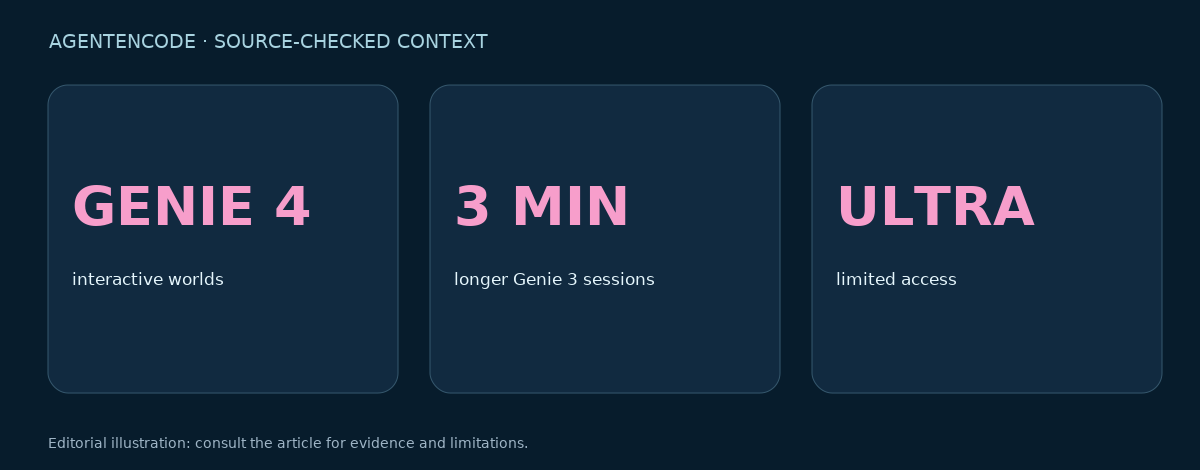
Genie 4 does not displace Genie 3 for every use case. Google is keeping the earlier model in the picker, with longer single sessions of up to three minutes instead of one. Genie 3 can also chain virtual environments together and use 360-degree panoramas as scene references.
That choice illustrates a trade-off between visual fidelity, audio, stability and session length. Users testing interactive storytelling or spatial ideas may find different advantages in the two models rather than one universal winner.
Who can actually try it
Google says Genie 4 is rolling out to eligible Google AI Ultra subscribers using Project Genie. Google AI Pro members can join a waitlist. The new experience is therefore not a globally available free service for everyone.
On November 19, Google separately announced Genie 4 access through the Gemini API and AI Studio for developers. Access restrictions, usage conditions and pricing are distinct from the consumer subscription. Developers should verify their own eligibility rather than assuming all features are available everywhere.
Potential use cases and unresolved limits
Interactive world models could eventually help with game prototypes, film previsualization, immersive learning and spatial design. Generated environments might also be useful for research on robots and AI agents that need places to practice decisions before interacting with the physical world.
Google acknowledges continuing challenges including camera latency, complex physics, real-time audio accuracy and long-term scene persistence. A visual scene must be representative and stable before it can support reliable training or safety-critical testing. Entertainment quality alone is not sufficient evidence.
Our assessment: an interface shift, not a solved simulation
Genie 4 is interesting because the world responds to user actions while it is being generated. That moves beyond passive AI media and hints at a future where creating, exploring and editing digital spaces may become one conversational experience.
Yet we would not treat it as a replacement for mature 3D engines or validated simulators. Long-running consistency, realistic interactions and practical tooling will determine whether these experimental worlds become more than impressive creative prototypes.
Frequently asked questions
What is Google Genie 4?
A generative world model from Google DeepMind that creates interactive virtual environments with responsive visuals and audio.
Can you edit a Genie 4 world while exploring it?
Yes. Google says users can change environments, weather and events through text prompts during a Project Genie session.
Can everyone use Project Genie for free?
No. Google is rolling out Genie 4 to eligible AI Ultra subscribers, while AI Pro users may join a waitlist.
Does Genie 4 replace conventional game engines?
No. Long-term consistency, physical simulation and input latency remain areas of active research.
RESEARCH & CONTEXT
Sources for this article
This analysis relies on the original publications linked below, which readers can inspect directly.
- Google Blog – Genie 4 is now available (18 Nov 2026)
- Google DeepMind – Genie 4 research overview (27 Oct 2026)
Reviewed November 22, 2026. Vendor claims and research results are attributed; future real-world performance is not assumed.
Related agents, systems and context
Product links identify the subject of a report; ecosystem links provide context, not shared feature claims.
- Ecosystem contextGoogle · Gemini & Entwickleragenten
- Background guideWhat is an AI agent?