
Poppy 1.0: A new protocol connects personal AI agents with businesses
Sierra releases Personal Agent Protocol 1.0 with Shopify and Meta Muse support. How discovery, OAuth permissions and business-agent workflows work, and what remains unproven.

A common way for personal agents to reach businesses
On November 13, 2026, Sierra's Bret Taylor and Clay Bavor announced the release of Personal Agent Protocol 1.0, known as Poppy. Instead of approaching every company as an unfamiliar website, a personal agent can learn which business services are designed for agent interaction.
Sierra reports more than 100 design partners. Shopify says support is enabled across its merchant platform, and Meta Muse checks for Poppy when it visits a website. Those are meaningful distribution signals but do not establish that every merchant can reliably complete every action.
Three participants: user, agent and company
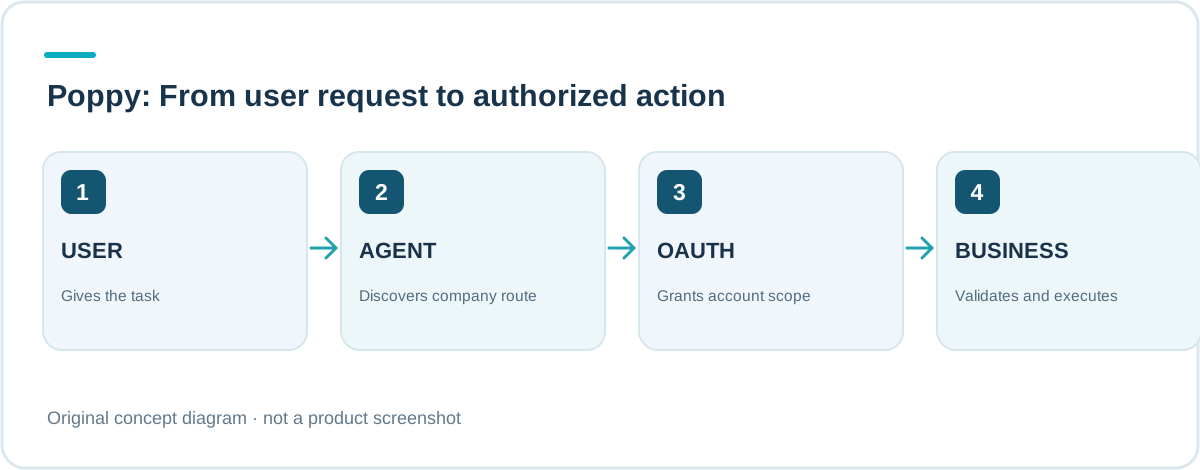
A user asks a personal agent to carry out a task. The company may expose a website, API or business agent as an interaction route. OAuth lets a user authorize access to their own account and manage permissions over time.
The technical specification separates agent identity, session continuity and account access. Recognizing the application does not mean it can automatically act with a user's full authority. Businesses must validate the scope and resources associated with each permitted action.
Why Shopify and Meta Muse matter
Shopify could become a large business-side distribution surface: merchants can publish agent-accessible services, while a commerce extension co-authored with Shopify extends the core format. Developers still need to understand how the extension maps to checkout, customer data and existing controls.
Meta Muse, on the consumer side, now checks for Poppy at visited websites, according to Sierra. The two projects could connect the personal assistant to businesses in a less brittle way than scraping an unpredictable page. Interoperability and consistent approval screens require real integration testing.
Banking and travel show early use cases
Sierra cites Mercury, whose customers can use personal agents to inspect transactions, categorize spending and initiate certain payments under the account's existing approval policy. Turkish Airlines supports selected fare, flight-status and booking lookups; a business-class upgrade still requires customer approval.
Synchrony is exploring financing and rewards as part of agent-assisted shopping. These are examples with different rollout stages. A partner appearing on the design-partner list should not be mistaken for a production certification.
Version status, security and technical caveats
Poppy builds on OAuth, MCP, OpenAPI and industry extensions. There is a relevant version distinction: Sierra's November announcement calls the release 1.0, but the public technical specification identifies itself as Draft 1.0 and notes that further corrections could break compatibility.
Agent builders should verify token-resource binding, authentication, user revocation, audit trails and specific company permissions. A standardized interface is not proof of prompt-injection resistance, correct payments or identical behavior across providers.
AgentenCode assessment: an infrastructure milestone
Poppy attempts to standardize the interface between personal assistants and real businesses. That may ultimately matter more to agentic commerce than a single model upgrade, because identity, user authority and business APIs must work together.
The useful questions are empirical: which actions are available now, where is consent required and which independent integrations work? Our ChatGPT Wallet report examines payment execution; the Agent Name Service analysis considers identity and trust.
Frequently asked questions
What does Poppy do?
Personal Agent Protocol describes how personal AI agents interact with companies through websites, APIs and business agents.
Can a Poppy agent spend money without the user's permission?
The protocol does not bypass company authorization or user approvals. Exact permissions and permitted actions depend on the provider.
Is every partner fully live on Poppy 1.0?
No. Sierra describes both live use cases and design partners; the public technical specification still calls itself Draft 1.0.
RESEARCH & CONTEXT
Sources for this article
This analysis relies on the original publications linked below, which readers can inspect directly.
- Sierra – Releasing Personal Agent Protocol 1.0, 13 November 2026
- Personal Agent Protocol – technical specification, draft 1.0
- Sierra – Personal Agent Protocol project overview
Checked November 14, 2026. Vendor statements, pilot scope and preview benchmarks have not been independently reproduced or certified.