
Gemini for healthcare: how Google plans to govern clinical AI agents
Clinical records, health-plan rules and authorization workflows often live in separate systems. Google's Gemini for healthcare aims to connect them through governed, multi-step agent workflows. The November launch is a US preview, not a blanket authorization for autonomous clinical decisions.

Google Cloud announced Gemini for healthcare in US preview on November 10, 2026. The platform comprises healthcare skills, connectors, partner integrations and centralized governance. Its intended role is to assemble and route evidence for human-reviewed work, not to replace accountable clinical judgment.
Sources and evidence limits
Dated 2026-11-10: Google Cloud original announcement. Product, test and availability statements originate with the vendor.
No hands-on deployment test, reproduced runtime benchmark or independent safety/efficacy audit. The decision framework is editorial inference.
What launched on November 10—and what did not
Google Cloud introduced Gemini for healthcare as an industry-specific extension of its Gemini agent. The offering is designed to coordinate clinical, financial and administrative systems so teams can assemble documents and requests across fragmented environments. The announced availability is US preview, not a general European release.
The term healthcare agent should not be confused with an autonomous doctor. Google describes a governed orchestration layer that gathers evidence and routes multi-step workflows with human oversight. The launch does not establish an EU authorization, universal clinical error rate or unrestricted availability for every hospital.
The four building blocks: skills, connectors, partners and governance
Google identifies four components: domain-expert healthcare skills, connectors to EHR and operational systems, an open partner ecosystem and a centralized governance layer. These components address different requirements; reducing the offering to a single language model misses the architecture that matters to healthcare deployment.
Skills encode task instructions and local policies. Connectors are designed to preserve existing identity and role-based access boundaries. Centralized controls are intended to span users, subagents and workflows. Whether these guarantees operate correctly in a particular hospital still needs local acceptance testing.
The workflow: from patient records to a reviewable packet
For providers, Google describes synthesizing longitudinal patient histories, preparing charts ahead of visits and assembling evidence for prior authorization requests. The agent is intended to surface medication discrepancies, missing consents or gaps in records. For health plans, examples include checking coverage requirements and explaining benefits from plan documents.
Preparing a documented packet for human review is distinct from making a diagnosis or issuing binding coverage decisions without supervision. Cases with conflicting records, stale policies or insufficient sources need an explicit escalation path to qualified personnel.
Identity, permissions and the clinical agent boundary
Google describes distinct agent identities, inherited role-based permissions, need-to-know restrictions and centrally enforced policies. Querying multiple systems should not give an agent broader access than the user or process is authorized to hold. Protected health information makes the distinction particularly important.
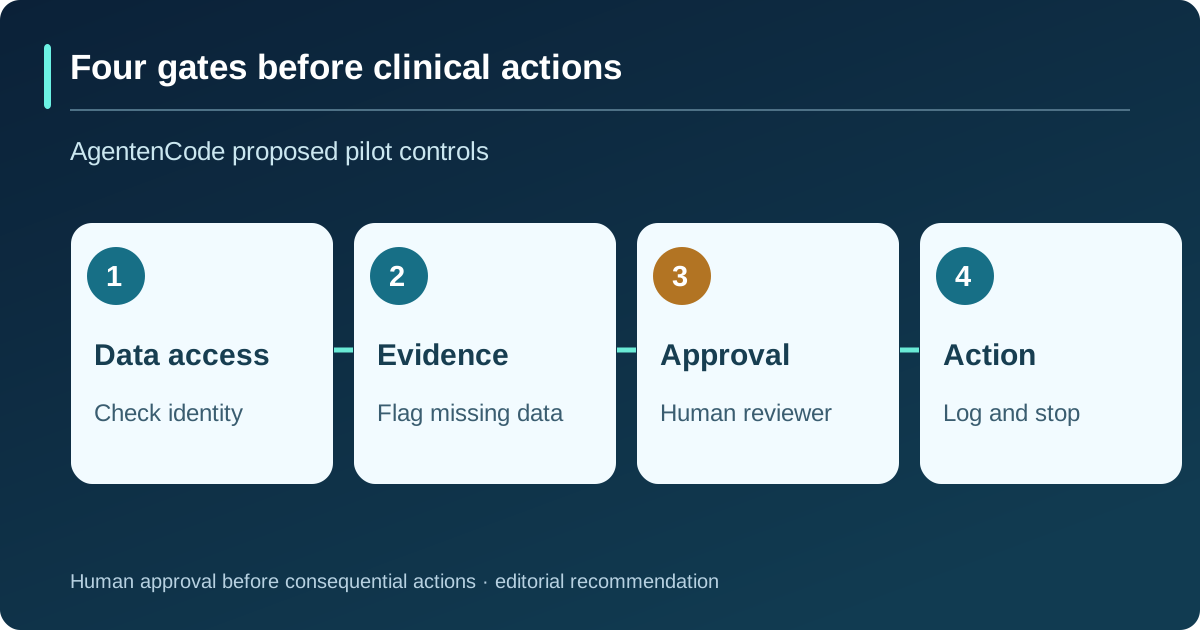
Our original editorial matrix separates read access, evidence preparation, professional sign-off and outbound action. That framework clarifies where automation can help and where independent authorization should remain mandatory. It is an AgentenCode analysis, not a Google security certification.
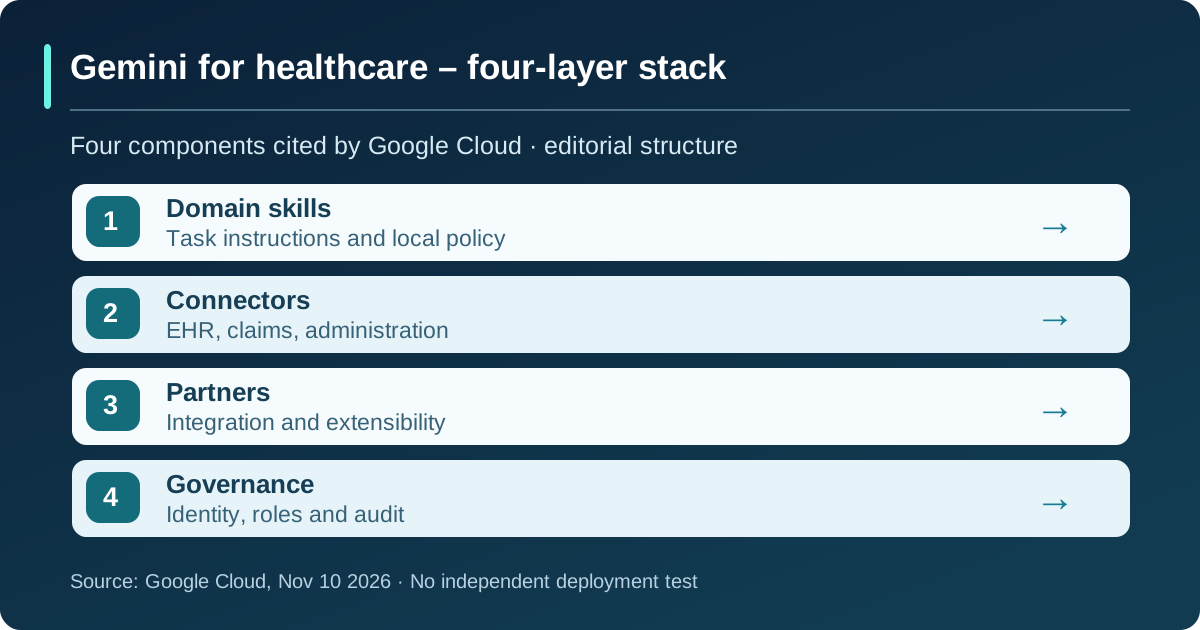
| Scope | Component/model | Value/function | Limit |
|---|---|---|---|
| Skills | Instructions and domain policy | Local organizational context | |
| Connectors | EHR, claims and administration | Inherited permissions | |
| Partners | Extensions and integrations | Provider-specific access | |
| Governance | Agent identity, audit and rules | Requires local configuration |
HIPAA, data handling and the limits of vendor promises
Google says Gemini for healthcare is built to support HIPAA compliance. It further states that clinical data, prompts and generated output remain within the organization's governed environment and are not used to train or fine-tune Google's foundation models. These are important vendor commitments worth checking in contracts and configuration.
Being designed to support HIPAA does not independently certify every deployment. It also does not prove compliance with the EU GDPR or sector-specific local rules. Procurement should inspect the contractual scope, processing regions, processors, audit controls, data retention and actual access configuration.
Partners and availability: what the endorsements do not prove
Google cites organizations including HCA Healthcare, Highmark Health and Northwell Health as collaborators exploring or shaping the offering. Statements of expected value and workflow examples are not randomized studies or proof of universal productivity improvement.
The announcement also lists integration partners and potential connectors. Buyers still need to verify whether each intended connector is released for their tenancy, what authorizations it needs and which fields it accesses. Being named in an ecosystem is not the same as an already operational workflow.
AgentenCode decision framework: four gates to clinical automation
We derive a four-stage pilot from the published architecture: verify the source and role-based access; assemble evidence and flag gaps; obtain professional review; and only then execute a logged, reversible external action. Our diagram distinguishes model-generated draft work from the accountable human decision.
Pilots should measure missing citations, escalations, conflicts across systems, review time and correction quality independently. This evidence is more useful than a broad efficiency claim without a clearly described denominator or clinical scope.
Practical questions before deploying
Before a pilot, clinical leadership and IT should specify data classes, permitted purposes, system identities, tool scope, recipients and approval points. Tests should include incorrect patient matching, outdated policy documents, missing consent, failed connector permissions and a reliable stop path.
The confirmed current rollout is a US preview. Future EU availability, data residency or legal compliance must not be inferred. See our business AI agent guide and security guide for broader operational controls.
Related agent profiles: Gemini Agent and Gemini Enterprise Agent Platform provide broader architectural context, not a dedicated healthcare product dossier.
Frequently asked questions
Is Gemini for healthcare available in Germany?
The November 10 announcement establishes US preview availability; it does not document general availability in Germany.
Does Gemini make autonomous treatment decisions?
The published examples involve orchestration and preparation with human oversight, not independently confirmed autonomous medical decisions.
Does HIPAA support equal certification?
No. Compliance depends on the actual deployment, contracts, controls and organizational responsibilities.
Are reported efficiency benefits independently proven?
Not by the launch announcement. Partner statements and vendor use cases are not clinical outcome studies.
Primary sources and methodology
Primary sources checked November 11, 2026. Vendor disclosures, editorial inference and unverified outcomes are distinguished. We did not run the published benchmarks.