
Adobe opens Creative Cloud to AI agents – but the key rollout starts in 2027
Adobe wants outside AI agents to work with editable Photoshop and Premiere projects, while Firefly takes on recurring creative tasks. The crucial detail: major MCP and always-on features are scheduled for 2027.

Creative Cloud MCP access for third-party agents is announced for early 2027; Firefly always-on agents are slated for beta in early 2027. Today's desktop AI Assistant betas are a different availability stage.
A third-party agent inside native creative work
At Adobe MAX on November 10, Adobe outlined a new direction for Creative Cloud and Firefly. The most consequential component for the agent ecosystem is planned MCP support for third-party AI assistants. Rather than force every creative team into a single chatbot, the design is intended to let a preferred agent call on Photoshop, Illustrator, Premiere and After Effects when a task requires those tools.
Adobe says the integrations will operate on the user's local computer and interact with native project files. Layers, vectors, bins and timelines are meant to remain editable. That distinction matters professionally: an output that can be adjusted in the original application is different from an opaque one-time image or video export.
Do not confuse the desktop beta with future MCP access
Adobe also describes an expanded Creative Agent and AI Assistant beta in desktop products including Premiere, Illustrator, InDesign, After Effects and Frame.io. In the intended workflow, people describe a multi-step task, let the assistant work within project context and retain the ability to intervene using existing desktop editing tools.
However, the cross-assistant MCP integrations are planned for early 2027, according to Adobe's own November 10 post. A demonstration or preview is not a generally available connection that every team can safely enable today. Each app, plan and feature must be checked on its own terms.
Firefly's always-on agents and a different approval problem
A separate Adobe Firefly announcement discusses always-on agents for recurring creative operations. Adobe envisions specialized agents that can be configured for a project, decide when to repeat work and ask for decisions or approvals. An example is a long-running video production where incoming clips are organized, duplicates are flagged and possible image or audio problems are surfaced for review.
Adobe dates the first always-on agent beta to early 2027. These are vendor-described future workflows, not independently tested productivity results. A recurring agent changes the risk profile: a permission that seems harmless for one edit can become consequential when it applies to hundreds of media assets over several weeks.
Availability matrix: now, beta and roadmap
Adobe's announcements cover multiple product families and stages. Some Firefly capabilities are available today, new desktop assistants are described as betas, Creative Cloud MCP support is forthcoming, and always-on agents are planned for a later beta. Treating all of them as a single shipping product would give readers a false impression of readiness.
Adobe also sketches workflows in which external agents may be connected to other MCP tools such as Drive or Slack. That is a possible multi-tool architecture, not proof that future connector permissions, secrets, data retention or end-to-end approvals have already been independently verified.
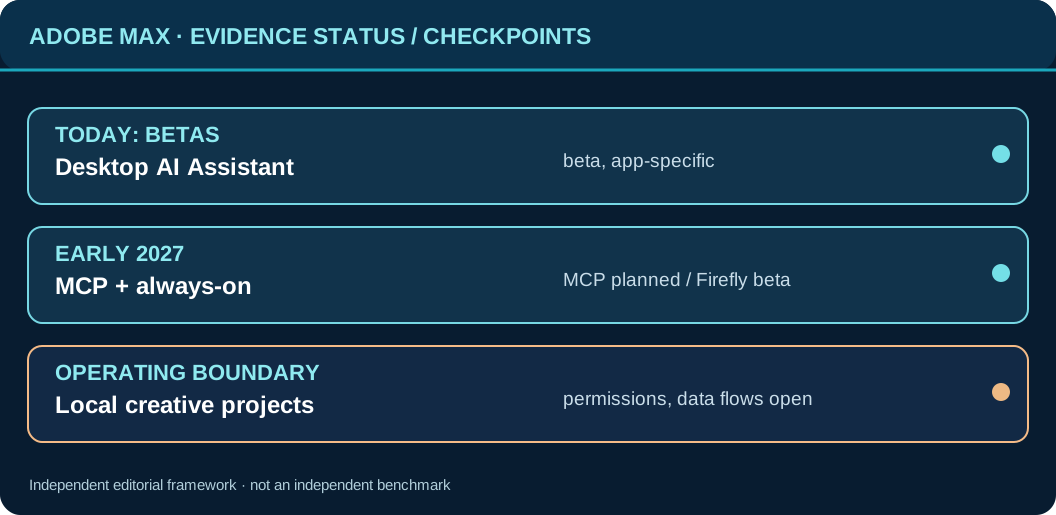
| Component | Vendor-stated status | Buyer verification |
|---|---|---|
| Desktop AI Assistant | New app-specific beta capabilities | Check current entitlement and approval flow |
| Creative Cloud MCP | Planned for early 2027 | Do not describe it as GA today |
| Firefly always-on agents | Beta planned for early 2027 | Review recurring scope, owner and stop conditions |
| Native project files | Layers and sequences remain editable, per Adobe | Test versioning, data transfers and rollback |
AgentenCode assessment: editability does not mean accountability
The real shift is from an assistant that offers suggestions to an agent that can edit working files. In a marketing campaign, an incorrect action can propagate through many designs, videos or branded exports. What matters is whether a person can see exactly which source elements changed, authorize the changes and reverse them safely.
Our pilot framework: start with duplicate, non-sensitive projects. Limit tool scopes, capture a version before any bulk change and require separate approval for publishing, sending content or editing many files. Recurring agents should have explicit owners and stop conditions. These are recommended operational controls, not an Adobe certification or a claim that every upcoming beta implements them.
The unresolved security and data questions
The November posts do not provide an independent success rate for agent-edited projects or a complete authorization matrix for every planned MCP integration. They also do not guarantee a single data-residency, logging or retention policy for all third-party assistants and connectors. Those details must be checked in the relevant beta documentation and actual contract.
Adobe's description of locally editable files is a useful architecture signal, but it should not be extended into a claim that every prompt, model request or external tool transfer stays on-device. Creative teams handling licensed media or client recordings need a precise map of their data flows.
Distinct Adobe products and useful related guides
The Creative Cloud MCP plan is not the same product as Adobe Agent Orchestrator or Adobe CX Enterprise Coworker. Those existing AgentenCode profiles address different workflows, and their permissions or release status should not be borrowed for this desktop integration.
For operating safeguards, see our guides to AI agent security and AI agent monitoring. They help frame scoped actions, review trails and the costs of a continuously running agent.
FAQ and primary-source boundaries
Can any third-party agent already control Photoshop over MCP? Adobe says the relevant Creative Cloud MCP integrations are coming in early 2027, not generally available today.
When will Firefly always-on agents launch? Adobe targets an early-2027 beta rather than announcing general availability.
Did AgentenCode test the new integrations? No. This is a source-led assessment of Adobe's two November 10 announcements, not an independent hands-on deployment or security review.
Official sources and method
- Adobe MAX: Creative Cloud and MCP integrations, 10 November 2026
- Adobe: Firefly and always-on agents, 10 November 2026
- Adobe: prior Creative Agent announcement, 18 June 2026
Editorial source review on November 10, 2026. Vendor statements are identified as such. No independent agent executions, security audits or benchmarks.