
NVIDIA Minerva: An AI operator for the entire GPU factory
NVIDIA Minerva aims to turn billions of infrastructure signals into actionable diagnoses for AI factories. Its value proposition is end-to-end visibility, not proven autonomous repair.
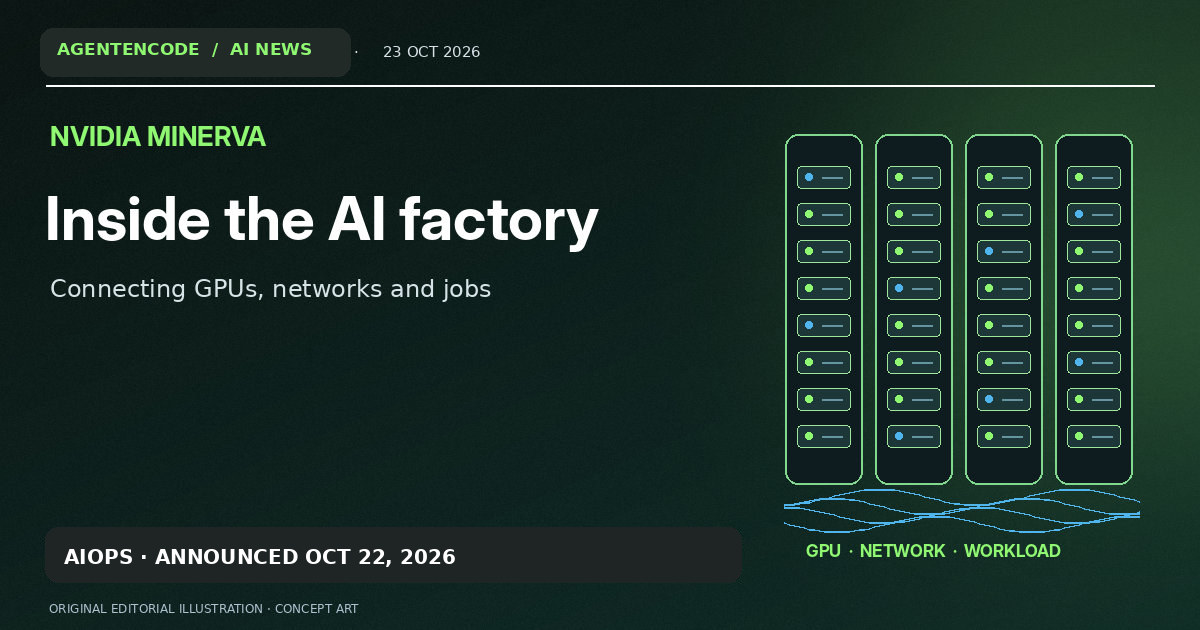
NVIDIA introduced Minerva on October 22, 2026 as an AIOps platform for AI factories. It connects GPU, networking, storage, scheduler and workload signals through a dynamic knowledge graph and adds an AI assistant for root-cause analysis. NVIDIA claims analysis of billions of telemetry points per hour. IREN is described as using it, while several other firms plan to deploy it.
CLAIM-LEVEL EVIDENCE
What is evidenced and still open
First-party announcements, vendor claims and open questions remain separate.
- Primary source
Platform unveiled on October 22
NVIDIA documents the launch and intended architecture.
Source: NVIDIA Blog – Minerva end-to-end AI factory observability ↗
- Vendor claim
Billions of telemetry points
The scale figure is a NVIDIA statement, not an externally audited universal rate.
Source: NVIDIA Blog – Minerva end-to-end AI factory observability ↗
- Vendor claim
IREN uses; others plan deployments
Current usage and future intentions are distinct in the company's announcement.
Source: NVIDIA Blog – Minerva end-to-end AI factory observability ↗
- Open question
Independent uptime improvement
No broad external benchmark establishes a fixed availability or repair-time gain.
Source: NVIDIA Blog – Minerva end-to-end AI factory observability ↗
Vendor releases are not independent effectiveness tests. Methodology →
The real cost of a slow GPU cluster
AI factories are more than collections of powerful accelerators. Their GPUs depend on networks, storage, cooling and job schedulers that must operate together. One degraded link can hold up an entire training run even if every model parameter and software library is correct. NVIDIA introduced Minerva on October 22, 2026 to connect this operational picture. The AIOps platform focuses on factory yield: useful work produced by installed computing capacity. That shifts attention from isolated hardware dashboards toward the actual performance and continuity of training and inference workloads across a facility.
A knowledge graph across hardware and jobs
NVIDIA says Minerva collects information from accelerators, SuperNICs, switches, storage and the schedulers that run jobs. It represents connections between these assets and the workloads using them in a dynamic knowledge graph. This context is designed to help engineers identify whether a training slowdown originates in an overloaded device, bad network path or failing component. The company claims to analyze billions of telemetry data points every hour with supervised and unsupervised machine learning. Such scale is plausible for huge clusters but remains an attributed vendor statement; the public announcement does not offer a fully independent assessment of detection precision or incident coverage.
An AI assistant is not blanket repair authority
The platform includes a native assistant that lets operators ask questions about live system data and receive suggested remediations. Minerva can also connect to external agentic systems. NVIDIA describes different execution models: a person can review and implement a fix, or an organization can connect recommendations to automation through existing infrastructure APIs. That distinction matters. A mistaken alert can cause unnecessary workload migrations, cancelled experiments or disrupted customer traffic if remediation is automatic. Mature operations need permissions scoped to each action, peer review for risky changes, audit trails, rollback procedures and clear rules for when an agent must stop.
Customer references need careful reading
NVIDIA identifies IREN as an operator already using Minerva. It separately says Aolani, Bitdeer AI, IBM, Jio, Lambda, Quake AI and Tesla plan deployments, while manufacturers including Dell, Lenovo and Supermicro are involved in portfolio offerings. A planned implementation is not evidence of a completed production rollout. The company's examples indicate market interest but do not constitute independent benchmarking across facilities. Announced benefits such as greater uptime and shorter time to repair should be treated as goals until controlled measurements show how much improvement a given site actually realizes.
How operators can evaluate the promise
A careful trial recreates known infrastructure degradations in a nonproduction environment, then measures detection lead time, root-cause accuracy, false alerts and the effect on accepted GPU work. Operators should compare Minerva with their existing observability stack under equivalent conditions. Suggested repairs can be reviewed manually before any automation privileges are enabled. The large strategic point is that AI operations software is becoming part of the infrastructure that runs AI itself. That may improve resilience at enormous scale, but trust depends on reproducible evidence and the ability to reject or reverse an automated recommendation.
EDITORIAL ASSESSMENT · NOT INDEPENDENT TESTING
AgentenCode analysis
AI factory observability is emerging as a key part of AI economics. Minerva's cross-layer model is interesting; deployment decisions still require independent measurements, bounded permissions and safe remediation paths.
Primary sources
Original announcement: 2026-10-22; editorial publication: 23.10.2026.
Frequently asked questions
What is NVIDIA Minerva?
An AIOps platform announced October 22, 2026 that connects AI infrastructure and workload telemetry.
Does Minerva autonomously fix cluster issues?
It recommends actions and can connect to automation; NVIDIA also describes human-controlled remediation.
Have uptime gains been independently established?
The public launch provides vendor statements and operator references, not a broadly reproducible independent uptime benchmark.