
Kling Image 4.0 launches with native 8K images and consistent ten-image sets
Kuaishou's Kling Image 4.0 promises native 8K, ten consistent images, improved typography and layer editing. What the new AI image model actually offers.
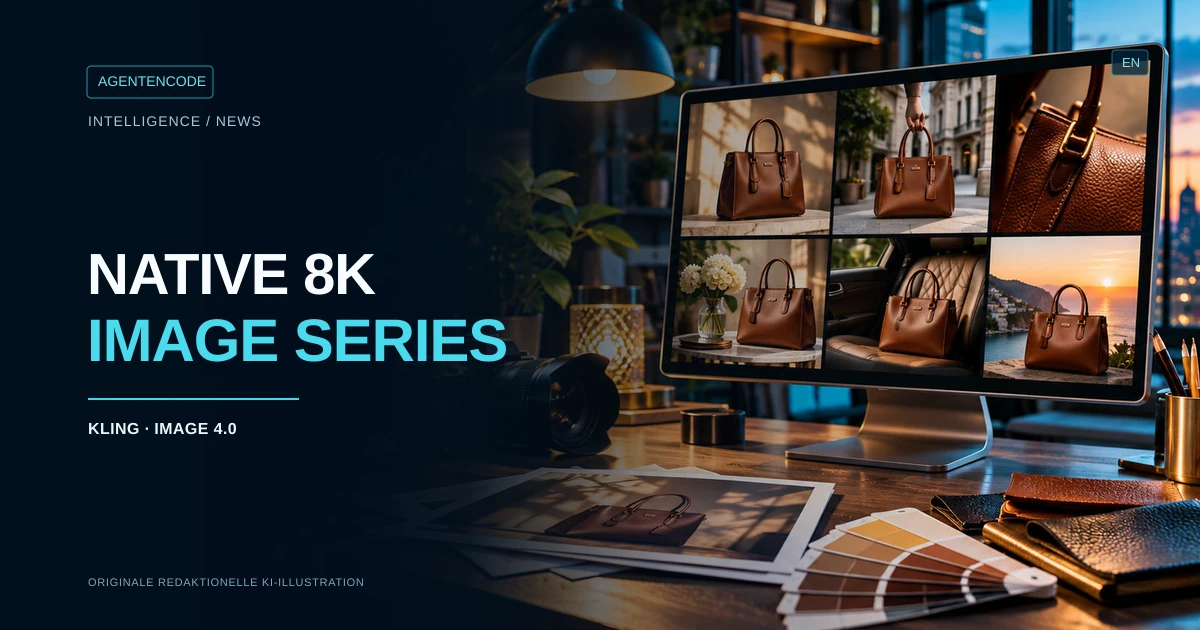
Kuaishou targets AI image production, not just one-off pictures
Kling AI published its new Kling Image 4.0 guide on November 17, 2026; the release was reported internationally on November 18. The Kuaishou-backed model is intended to improve realism, lighting, small details and instruction-following while making coordinated visual campaigns easier to create. Its emphasis is a meaningful shift from generating an attractive standalone picture toward creating usable sets of designs.
For businesses, consistency matters as much as beauty. A campaign may require multiple views of a product, portraits that retain an identity and layouts that match across a website. Kling says its latest version addresses those tasks, but the official guide is product documentation rather than an independent benchmark of reliability.
Native 8K is the headline specification
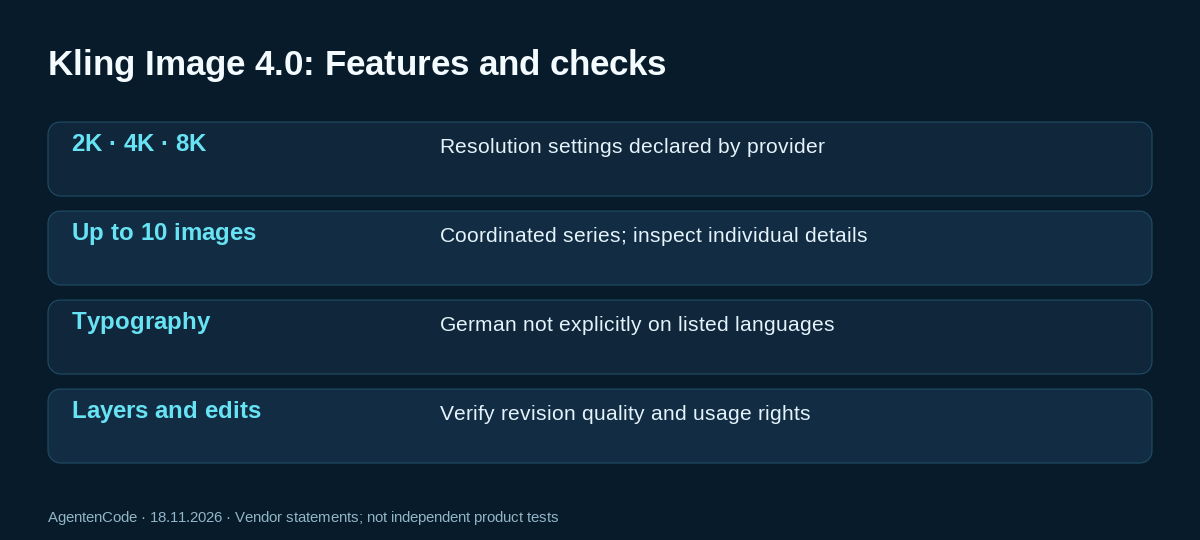
Kling lists output choices of 2K, 4K and native 8K. Larger images could help with high-resolution displays, printing and close crops for marketing materials. They do not automatically improve every workflow: a thumbnail may not benefit from the extra pixels, and detailed outputs may take additional resources to store and process.
The claim of native generation needs to be separated from verified visual fidelity. A high pixel count does not guarantee anatomically correct hands, readable labels or accurate technical shapes. An effective review should inspect image edges, small repeated details and text at full resolution, and distinguish generated detail from simple interpolation.
Series Mode aims to retain identity across ten images
The new Series Mode is documented as creating up to ten consecutive, related images from a single request. It can retain visual attributes such as characters, product design and style across different scenes. Kling also supports up to ten image references, allowing people to supply more context about the look they want.
That could streamline fashion lookbooks, product listings, storyboards and advertising sequences. Yet every frame still needs inspection: logos can drift, accessories can change and a character's face may become subtly inconsistent. Consistency is the aim of the feature, not proof that every output meets production standards.
Better typography, with clear language caveats
The guide advertises input prompts up to 15,000 tokens, generated text of up to 2,000 characters in an image and a library of more than 70 commercially licensed fonts. Its explicitly listed output-text languages are Chinese, English, Japanese, Korean, Spanish and Portuguese. These are product specifications, not external measurements of spelling accuracy.
Notably, German is not explicitly listed in the supported output-text languages. This does not prove that individual German words fail, but it makes any claim of dependable German advertising copy premature. Longer typography, numbers, punctuation and product claims all require proofreading before publication.
Layer-level editing changes the revision process
Kling also describes layer editing for particular long-form images. Users can separate parts of a composition and modify, replace, remove or regenerate them without starting from scratch. An online store could update one product detail or text element while attempting to preserve the rest of a visual.
Whether that separation is reliable for reflective surfaces, semitransparent objects and complex shadows remains a practical question. The strongest evidence would be successful revisions on diverse real projects, including an audit of unintended changes elsewhere in the image. A demonstration in a user guide is a starting point, not a universal guarantee.
Creative Studio and API access serve different users
According to TNGlobal's November 18 report, the model is offered in Kling Creative Studio and via an API. Creative Studio is oriented toward direct image generation and editing; API integration could help developers build catalogs, automated content pipelines or design tools.
Specific access rights still matter. The material reviewed does not establish one universal free 8K quota or blanket commercial licensing across markets. A company should inspect credit pricing, high-resolution charges, product terms and the rights attaching to reference images before building automated production around the service.
Rights and disclosure become more important as realism rises
Tools that preserve a face or product appearance across many images increase both productivity and the potential for misleading content. Uploading a person's picture is not proof of their consent, and having access to a font library does not give a user rights to every uploaded logo or photograph. Commercial creators need a record of source materials and publication permissions.
For journalism, the distinction between an illustration and evidence of a real event remains essential. A photorealistic generated location, product or person should not be presented as an authentic news photograph. Clear labeling and human review matter even when a generation tool becomes extremely good at producing believable scenes.
AgentenCode view: evaluate the whole campaign, not one beautiful image
Kling Image 4.0 illustrates a market shift toward end-to-end creative output. The useful deliverable is not a single polished render but a set of consistent, correctly labeled and properly licensed images that can be revised without restarting the job. If that works, marketing teams and small businesses could save considerable time.
A fair test would create ten connected assets, check small visual features in each, inspect typography and request a targeted revision. Count the manual corrections and total production cost. At launch, the new capabilities are documented, but their advantage over competing products has not been independently established. Further context: AI agent security and permissions.
Frequently asked questions
Can Kling Image 4.0 generate native 8K images?
The official guide lists native 2K, 4K and 8K output. AgentenCode has not independently verified the visual fidelity of generated samples.
What does the ten-image feature do?
Series Mode is described as generating up to ten coordinated images per request, with up to ten image references accepted as input.
Does it reliably generate German text?
German is not explicitly included in the guide's list of supported text-rendering languages; generated copy should be checked manually in any language.
Is 8K output free for every user?
The reviewed sources do not confirm universal free access or fixed commercial terms. Pricing, credits and license conditions depend on the actual service and plan.
RESEARCH & CONTEXT
Sources for this article
This analysis relies on the original publications linked below, which readers can inspect directly.
- Kling AI: Kling Image 4.0 User Guide, 17.11.2026
- Kling AI API: Image generation with Kling Image 4.0
- TNGlobal: Kuaishou launches Kling Image 4 with native 8K output, 18.11.2026
Checked November 18, 2026. Vendor statements, pilot scope and preview benchmarks have not been independently reproduced or certified.
Related agents, systems and context
Product links identify the subject of a report; ecosystem links provide context, not shared feature claims.
- Background guideAgent evaluations and testing