
Claude Code adds Code Mode: AI agents program their own tool calls
Claude Code 2.1.323 introduces experimental JavaScript-driven tool calls, while 2.1.325 tightens security and sandbox approvals. Our technical assessment.
An experimental change to how tools are invoked
In Claude Code v2.1.323, released November 12, 2026, Anthropic added Code Mode. The official changelog describes an experimental opt-in where Claude writes JavaScript to call its tools. The feature is not a new default for all users or deployments.
This is an architectural rather than merely cosmetic shift. An agent can potentially express relationships between multiple tool calls as executable logic, instead of only selecting the next tool one step at a time. Anthropic's announcement alone does not establish a general improvement in cost or completion rate.
Why programmatic tool orchestration matters
A coding agent may search hundreds of files, run tests, compare outputs and decide whether to edit a repository. Separate model-tool interactions can create overhead and make multi-step workflows harder to reason about. A structured script can potentially organize some of that work.
For example, a controlled JavaScript step might invoke several permitted repository-inspection tools and reduce their outputs to a compact summary. That is a possible design pattern, not an AgentenCode benchmark or proof that every task executes faster with Code Mode.
Code execution does not equal unrestricted access
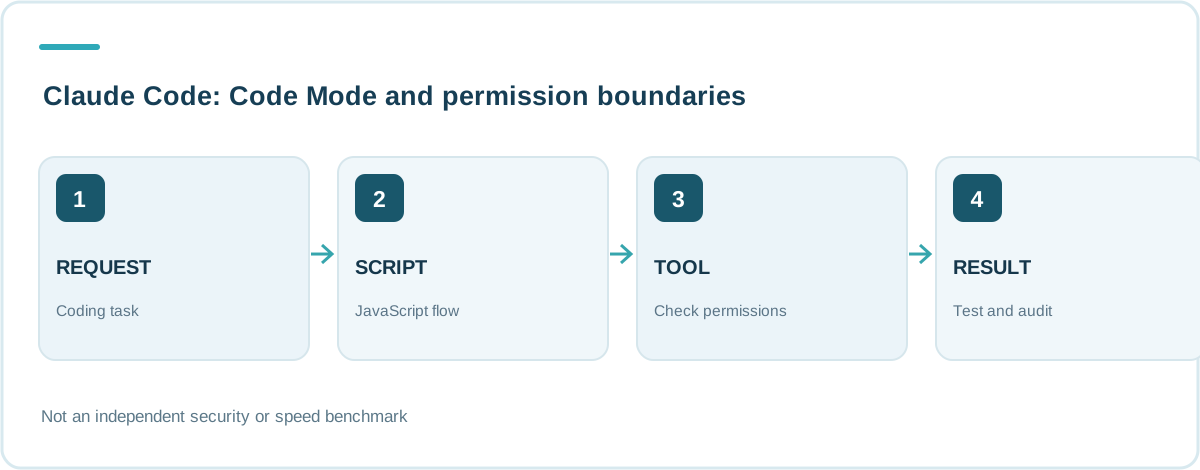
Code Mode means the assistant writes JavaScript to invoke its tools. It does not imply automatic permission to read every file, execute arbitrary host commands or change external accounts. Actual capabilities still depend on the host runtime, tool exposure and configured permission checks.
Organizations must verify that each invoked tool remains subject to policy. A trusted tool call should not silently authorize downstream shell commands, sensitive-file reads or third-party MCP actions. Script composition is not a substitute for identity, least privilege and approval gates.
Plugin compatibility becomes an explicit contract
Claude Code v2.1.323 also added support for the `engines["claude-code"]` range in `plugin.json`. Plugins outside their stated compatible version range should no longer be installed, updated or loaded. Installers choose the newest version that fits the specified engine constraints.
Additionally, `claude plugin validate` now type-checks TypeScript hooks modules, and `--strict` can fail on warnings. This can catch compatibility mistakes earlier. Passing a validation check does not establish that a plugin is safe, free of malicious behavior or operationally correct.
Version 2.1.325 changes security and sandbox behavior
On November 13, Anthropic followed with v2.1.325. Its official release notes identify a security fix for decoding zstd-compressed responses and changes to sandboxed Bash: commands follow normal permission prompts by default unless the relevant auto-allow setting is explicitly enabled.
The release also addresses several permission-check gaps and Code Mode session behaviors. For teams running automated agents on sensitive repositories, these changes are operationally meaningful. Their actual effect still depends on the installed version, configuration, host and organization policy.
Auditable execution matters more as agents gain flexibility
An agent that composes tool calls can turn one request into several state-changing actions. That makes reproducible logs, explicit approvals, trusted tool implementations and strict handling of untrusted web content essential. A source page should never be promoted into an instruction that grants additional privileges.
The same principle applies to MCP servers and shell integrations. The AI agent security guide and our methodology separate source observation, technical execution and actual product claims for precisely this reason.
A sensible rollout plan for development teams
Before enabling Code Mode, inspect `claude --version`, installed plugins, local permission files and organization-level controls. Pilot on a disposable repository without production credentials. Test read-only steps, forbidden-file access, edits, nested tool calls, cancellations and audit logging explicitly.
The Code Mode documentation describes opt-in activation and organizational disablement. Successful execution in one developer environment does not certify another host, cloud tenant or plugin configuration.
AgentenCode assessment: the workflow architecture is changing
Code Mode matters because coding-agent performance is not solely a property of the language model. It also depends on how efficiently the agent can plan, execute and observe authorized tools. Programmable orchestration could become a valuable layer for complex workflows.
The meaningful evaluation is task completion, incorrect side effects, approval failures and cost per successful outcome, not tool-call volume alone. We regard Code Mode as a promising experiment rather than a proven productivity breakthrough. Our Agent Architect provides a practical framework for planning those permission and tool boundaries.
Frequently asked questions
What is Claude Code Code Mode?
An experimental opt-in introduced in v2.1.323 in which Claude writes JavaScript to invoke available tools.
Is Code Mode on by default?
No. Anthropic explicitly describes it as an experimental opt-in.
Can JavaScript bypass existing permissions?
It should not be treated as a new grant of authority. Teams must confirm that host and tool policies still apply.
What did v2.1.325 fix?
Among other changes, a zstd decoding security issue and the default approval behavior for sandboxed Bash commands.
RESEARCH & CONTEXT
Sources for this article
This analysis relies on the original publications linked below, which readers can inspect directly.
- Anthropic Claude Code release v2.1.323 – Code Mode, plugin compatibility and validation (12 November 2026)
- Anthropic Claude Code release v2.1.325 – zstd security fix and sandbox permission changes (13 November 2026)
- Anthropic official Claude Code changelog – full release-history context
- Anthropic Claude Code documentation – Code Mode (experimental)
Checked November 16, 2026. Vendor statements, pilot scope and preview benchmarks have not been independently reproduced or certified.