
Gemini 4 Argon vs Muse Wonder: What the AI model race proves
Google and Meta released new frontier AI models. Our source-first comparison checks availability, pricing, capabilities and why vendor benchmarks cannot name a clear winner.
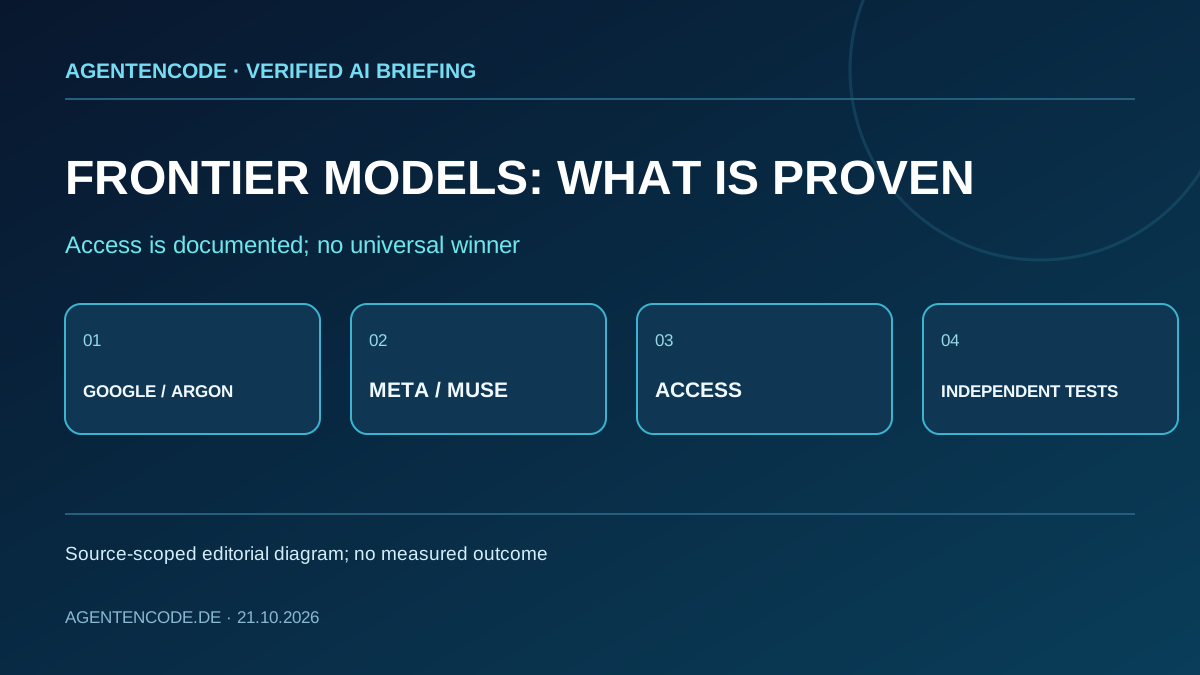
Google offers Gemini 4 Argon through its API and selected subscriptions; Meta provides Muse Wonder through the Meta Model API and Muse Code. Both claim frontier performance. The releases do not establish an independently verified head-to-head winner.
Model competition has often been condensed to one leaderboard or a headline declaring a winner, even when assessments use different tasks and settings.
Google and Meta are widening developer access and emphasizing long-horizon agents. For users, pricing, access conditions, auditability and independent task evaluation matter alongside benchmark scores.
What is actually available from Google?
On October 13 Google expanded access to Gemini 4 Argon. The official Gemini API documentation identifies the stable model as gemini-4-argon and lists capabilities including function calling, structured outputs and preview computer use. Google says developers and enterprises can use the API, while the Gemini app and AI Mode require eligible Google AI subscriptions; Antigravity access is tied to a narrower subscription tier. The vendor lists introductory token rates of $2 per million input tokens and $10 per million output tokens, scheduled to rise to $4 and $20 after November 30. These are dated offer terms, not universal prices for every Google product.
What has Meta released?
Meta introduced Muse Wonder and Muse Wonder Full on October 12. Its newsroom says Muse Wonder can be accessed through the Meta Model API and Muse Code, while Muse Wonder Full is available to Muse Code subscribers. Meta describes Active Memory for recalling relevant information across conversations and Active Focus for working through harder tasks, recovering from errors and asking before consequential actions. These capabilities are vendor descriptions and should be checked in real deployments. A later rollout in the Muse consumer app was announced as forthcoming, not documented as fully completed.
Can the claimed benchmarks establish a winner?
Google cites a number-one result on the Vals Index and describes internal engineering improvements. Meta highlights performance in professional agents, coding and long-running tasks. These are not identical tests with matched tool settings, prompts, budgets or human evaluation standards. Comparing separate charts and declaring a universal champion would misrepresent the evidence. Independent head-to-head tests would need common tasks, reproducible prompts, failure reporting, realistic costs and clearly stated access versions. Until then the defensible statement is that both vendors have published new models and made specific access paths available.
What buyers should examine beyond scores
The practical questions are whether models reliably call external tools, handle long documents, keep sensitive information within approved boundaries and provide a way for a human to stop or review high-impact actions. Teams must also compare latency, regional eligibility and total costs after promotional rates end. A convincing result on one benchmark cannot establish safety in finance, law or health. The competition is intensifying, but procurement decisions should rest on documented deployment boundaries and tests using the organization's own representative tasks.
AgentenCode assessment
Both Google and Meta have documented new model access, but the announcements alone cannot establish a universally better AI model. Durable costs, real-world task performance, developer restrictions and independent validation matter more than isolated marketing rankings.
Sources and fact-checking
Reporting and source claims are evaluated separately. Vendor descriptions are not independent proof of effectiveness. Source dates and editorial review dates are distinct.