
llama.cpp 1.0 arrives: Why local AI now has a more predictable foundation
llama.cpp and ggml reached v1.0.0. The release sets clearer API compatibility rules for private, cross-platform AI while hardware and model support keep evolving.
A milestone for local inference
The team behind llama.cpp released library version 1.0.0 on November 13, 2026. Its underlying tensor library ggml also reached 1.0.0. The project powers inference for many model families, across personal computers and servers.
The milestone is primarily about infrastructure. It is not a new foundation model, a universal speed improvement, or proof that every model runs efficiently on a phone.
What version 1.0 promises
The official release defines clearer semantic versioning for the public C APIs. Major releases flag breaking changes, minor versions add compatible features or backends, and patch versions address bugs.
Projects using libllama or libggml should still test compilation, ABI expectations and their selected runtime backends before upgrading. A 1.0 label does not replace integration checks.
Why compatibility matters
Desktop assistants, local retrieval systems and enterprise tools often depend on a common inference layer. Clearer version boundaries can reduce maintenance surprises as developers package and update these applications.
The maintainers report support for more than 150 architecture variants and mainstream speculative decoding approaches. These are breadth claims, not benchmark guarantees across all hardware.
Privacy depends on the whole application
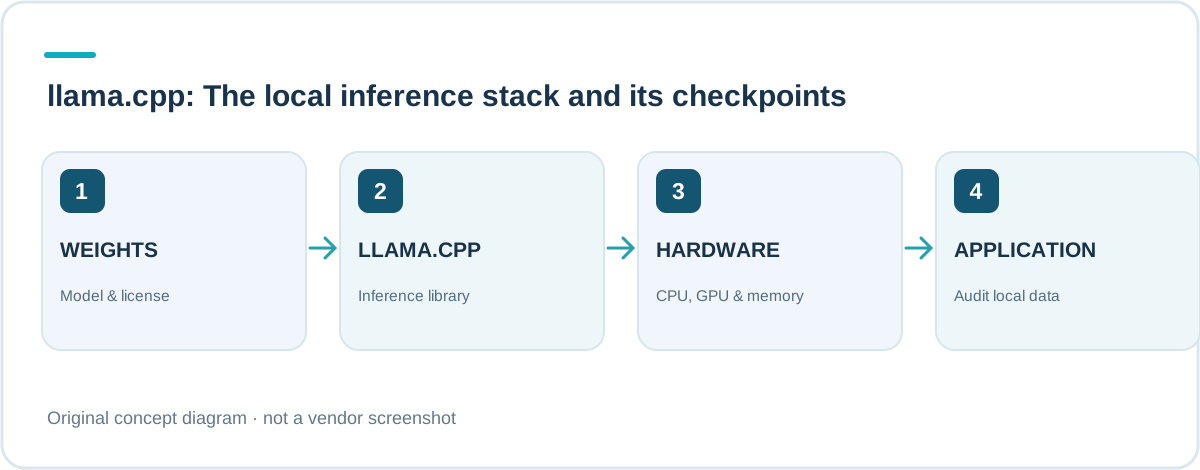
Running a model locally can keep routine prompts and files from being transmitted to a remote inference provider. But optional tools, telemetry, downloads and connected services may still send data over a network.
For sensitive use, inspect actual network traffic, tool permissions, model provenance and license terms. Our AI agent security guide explains why a local runtime alone cannot guarantee privacy.
Hardware portability and quantization
Portable C/C++ implementation, optimized backends and quantization support many devices and memory budgets, allowing developers to deploy open models without relying on one cloud vendor.
A serious evaluation measures model, quantization setting, input length, throughput, memory footprint and output quality on the specific target hardware.
Who benefits
Developers embedding local inference gain clearer upgrade expectations. Organizations can evaluate private document and coding assistants within controlled infrastructure. Home users may benefit when downstream desktop apps ship tested updates.
Non-developers rarely need to compile the library themselves. Installing a trusted app update, retaining backups and reviewing permissions is usually more practical.
What the major version does not establish
Version 1.0 does not make every extension stable or close every security risk. The release notes describe separate changes to libraries, servers and tools; components still need configuration and regression testing.
Licenses for the model weights are separate from the inference engine's license. Open runtime software does not automatically make each model unrestricted or safe.
AgentenCode verdict: A foundational release
AI headlines mostly focus on benchmark gains, but this is a different kind of advance: clearer contracts underneath a large ecosystem of local tools.
Its value will become clearer as subsequent releases test backward compatibility in real products. The announcement matters for developer confidence, not for inflated claims of instant autonomous intelligence.
Frequently asked questions
Is llama.cpp 1.0 a new AI model?
No. It is a version of an open inference library that runs many different models.
Does local inference guarantee privacy?
No. External tools, telemetry and connected application features can still transmit data.
Should I upgrade immediately?
Test dependencies, backends and your own API usage before upgrading production systems.
Does 1.0 make every model fast?
No. Speed varies with the model, memory, quantization and hardware.
RESEARCH & CONTEXT
Sources for this article
This analysis relies on the original publications linked below, which readers can inspect directly.
- ggml-org / Hugging Face – llama.cpp v1.0.0: A stronger foundation for the local AI ecosystem, 13 November 2026
- ggml-org – llama.cpp v1.0.0 official release
- ggml-org – ggml v1.0.0 official release
Checked November 14, 2026. Vendor statements, pilot scope and preview benchmarks have not been independently reproduced or certified.