
OpenAI plans Pierre acquisition: what Codex gains around Git and code review
OpenAI plans to acquire Pierre Computer. Trees and Diffs are in Codex already, while Code Storage integration is a future ambition pending deal closing.
OpenAI plans to acquire Pierre Computer. Trees and Diffs are in Codex already, while Code Storage integration is a future ambition pending deal closing.
Sources and limitations
- Primary source
- Primary source
- Editorial analysis, not a test
Vendor-published primary sources; no independent agent runs, exploitation tests or contract audits. Availability and scope are limited to the stated publication date.
1. Trees, Diffs, Highlights, and Code Storage do different jobs
Trees helps developers navigate repository files. Diffs makes changes inspectable and, according to the vendor, its edit mode lets reviewers fix code in context. Highlights is a fast syntax highlighting component designed for interactive edits and streamed agent output. Code Storage is a service/API for storing code and preserving Git history.
A good code diff is not a secure deployment pipeline. A storage API does not by itself imply enforceable human approval. This separation matters because one agent may generate code, another review it, and a third execute tools or ship releases. Those rights must remain explicit and auditable.
2. Existing capabilities versus a future integration
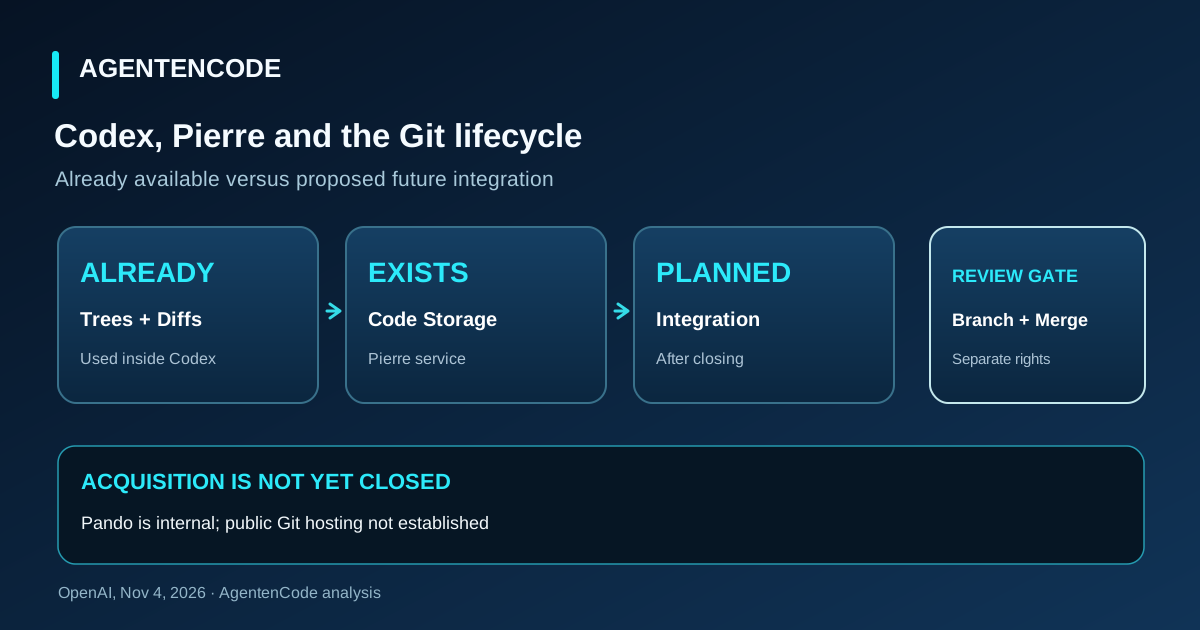
OpenAI explicitly says Trees and Diffs already run inside the Codex app. It does not say Code Storage is bundled with all Codex plans today. The document promises continued Code Storage availability for customers after closing and expresses an intention to bring its capabilities into Codex later.
A purchase announcement is not general availability, a support SLA, a regional-data guarantee or a published price list. Teams should treat any assumed combined plan, migration support or enterprise compliance parity as open until official product terms exist.
3. Pando is a clue, not a product promise
Two days earlier, OpenAI described Pando, an internal Git-compatible source-control backend built to handle parallel development by humans and agents. Pierre adds code navigation, large-diff review and developer-facing storage APIs to the strategic picture.
Our inference: OpenAI wants a more integrated code lifecycle connecting agent-created branches, review context and eventual delivery. Not a vendor fact: That inference does not mean Pando is generally available, that Codex has become a full GitHub replacement or that any existing GitLab/GitHub integrations will be retired.
4. Where the security boundaries belong
Reliable coding-agent workflows need separate permissions for read, write to an isolated branch, submit for review, and merge/deploy. They also require agent identity, protected branch rules, secret hygiene, reproducible CI, review traceability and recovery from a faulty action.
Whether a future combined Codex/Code Storage offering will expose these controls at the necessary granularity is not established. Engineering teams should keep existing repository governance active rather than migration-planning around a projected feature.
5. What remains open source
OpenAI says Pierre's existing open-source projects will remain open and receive contributions. That matters to organizations seeking reusable UI libraries rather than mandatory platform lock-in. It does not establish that the managed Code Storage service will be free, self-hostable or available under a particular open license.
Decision-makers should check component licenses, maintainer responsibility, export paths, audit logs, data locality, user provisioning, retention, deployment rights, contracts and pricing separately. Open-source code and a managed cloud service have different operational boundaries.
6. AgentenCode availability and decision matrix
| Component | Publicly supported status | Decision gate |
|---|---|---|
| Trees/Diffs in Codex | Already used, according to OpenAI | Validate code-review ergonomics |
| Highlights | Pierre library | Check license and integration |
| Code Storage API | Existing Pierre service | Verify API, cost, export and region |
| Acquisition | Announced, not closed | Do not imply ownership has transferred |
| Code Storage inside Codex | Future intention | Do not budget as GA |
| Pando | Described as internal OpenAI system | Do not imply public hosting |
| Open-source libraries | Continuity promised | Monitor licenses and maintenance |
The status column is grounded in two official publications; the decision gates represent AgentenCode editorial analysis. An original evidence SVG should make clear which lifecycle stages are already available, existing elsewhere or merely planned.
7. Three practical choices
Now: strengthen branch protection, agent identities and review ownership in the tools you already use. Next: evaluate diff-heavy agent workflows for reviewer speed, mistakes caught and migration friction, not just code generation throughput. Later: re-evaluate portability and source-control governance if a fully specified combined Codex/Code Storage offering actually ships.
This acquisition signals a shift in the competitive battleground: from generating code to controlling the workflow where code is examined, approved, versioned and shipped. Whether Pierre gives OpenAI a durable advantage depends on real product integration, not the transaction announcement alone.
FAQ
Is the purchase complete? No. The announced transaction remains subject to closing and regulatory conditions.
Does Codex now replace GitHub? No such replacement or generally available source-control hosting product is established by the announcement.
Will Pierre's libraries stay open-source? OpenAI says the existing open-source projects will remain open-source and receive contributions; future service terms are separate.
Can current Code Storage customers continue using it? OpenAI says yes after closing while the companies work toward integration; detailed long-term commercial terms are not provided.
Editorial methodology and original sources
AI-assisted editorial drafting based on the two original, dated OpenAI statements. No independent deal, software-security, product or infrastructure tests are claimed. Vendor statements are distinguished from our readiness, governance and portability analysis. Validate proposed AgentenCode internal links before publishing.
Primary sources: https://openai.com/index/openai-to-acquire-pierre/ ; https://openai.com/index/scaling-git-at-openai/
Related AgentenCode: the existing Pando analysis /en/news/openai-pando-git-codex-agents-parallel-source-control-2026/, agent governance and the GitHub Copilot coding-agent dossier.