 Agenten
Cursor · Agent orchestration / Governance · November 11, 2026
Cursor Projects goes multiplayer: shared context for teams of coding agents
On November 10, 2026, Cursor launched multiplayer Projects in beta. Several people can now work with their own coding agents inside one shared Project. The key advance is a team-wide layer of context and work coordination—not merely more agents running in parallel.

What changed on November 10
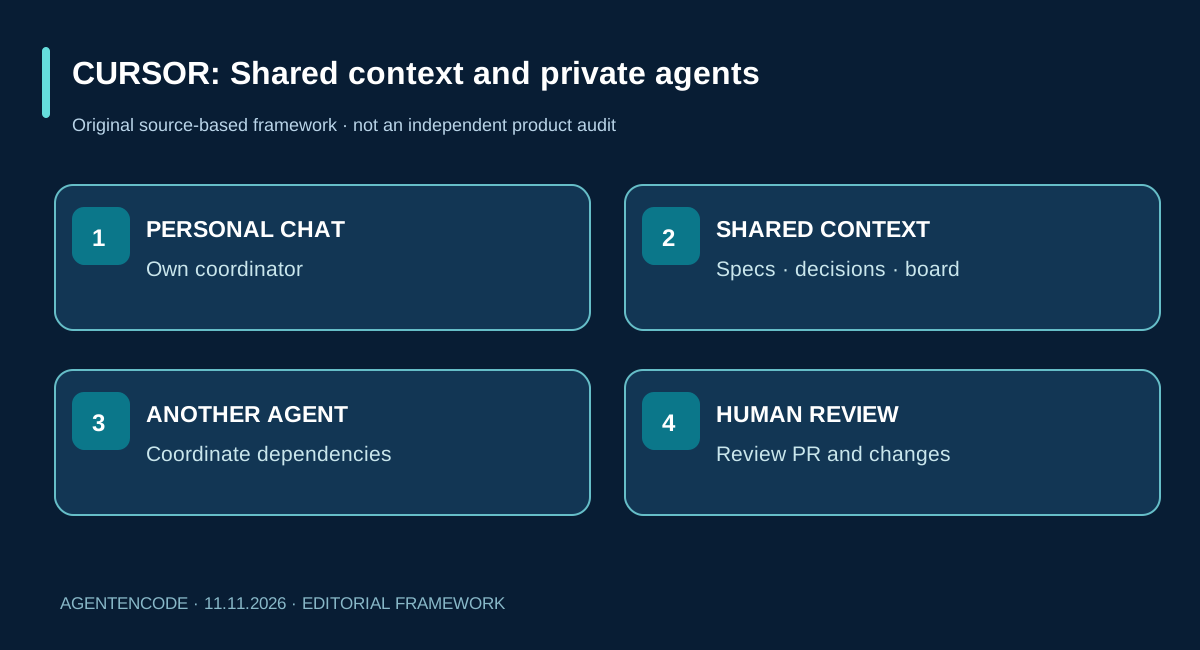
Cursor first introduced Projects in September 2026 as a way for a single person to direct a fleet of coding agents through a coordinator. The November update adds multiplayer collaboration: engineers, designers and product managers can enter a common Project while retaining their individual agent interactions. This is a product-scope change, not the release of a new foundational model.
The shared layer can contain specifications, diagrams, requirements and mockups, along with project-level decisions. Cursor describes a unified task board connecting work items, participants, active agents and pull requests. The announcement outlines the intended behavior of its beta; it does not independently establish performance for teams of any size.
Shared context solves one problem and creates another
When architectural decisions live exclusively in private chats, teams spend time recreating history. Cursor says a Project can make a decision in one conversation available to agents working elsewhere in the same shared workspace. New teammates can join with the current documentation already in context, reducing repeated setup.
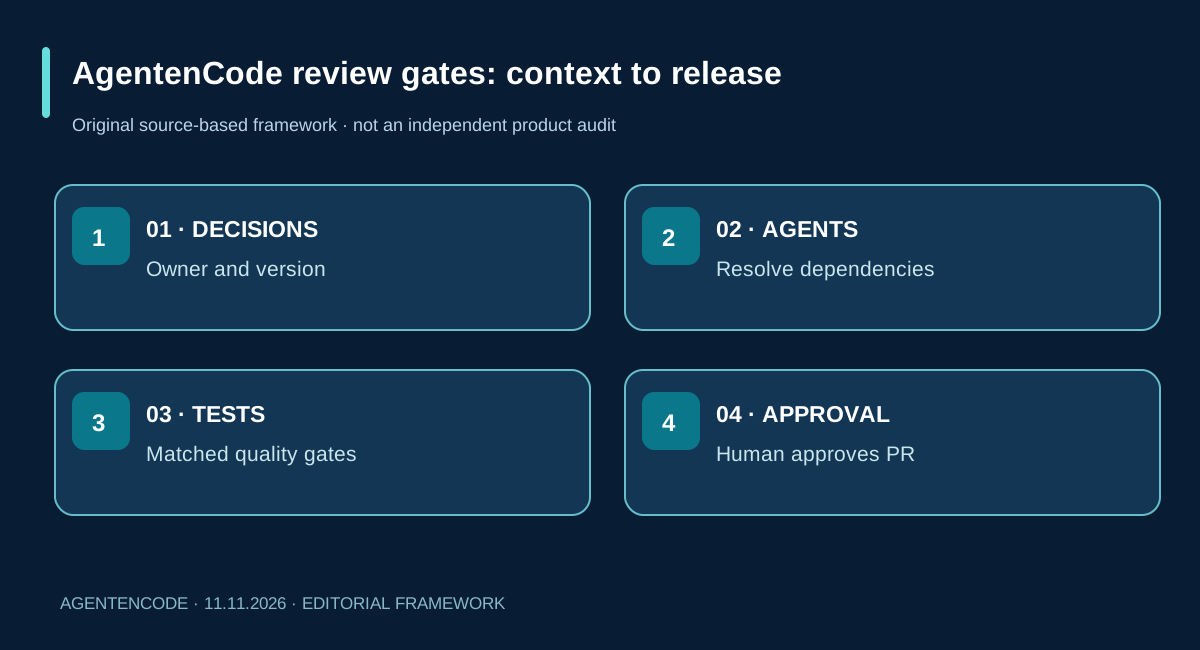
That creates a new governance question: who can replace a decision, and how does an agent know which version remains authoritative? A shared knowledge layer can propagate obsolete guidance as efficiently as correct guidance. Our recommendation is to assign owners to project-level decisions, time-stamp meaningful changes and separate proposed context from approved context. This is editorial guidance, not an independently verified Cursor feature.
Agent-to-agent communication across people
Cursor describes coordinators communicating across teammates to resolve dependencies early. Its examples include a designer modifying the same page an engineer is extending, and a database-schema change that should precede an application change. The objective is to negotiate an implementation order before incompatible work is merged.
The significance lies in cross-person orchestration, rather than just multi-agent execution inside one chat. Yet automated negotiation needs a resolution rule. When two agents disagree, the final decision should be inspectable, attributable and subject to human escalation. The launch post does not quantify how often the approach prevents regressions.
Task board, pull requests and operational handoffs
The shared board aims to show assignment, agent progress and the pull request associated with each task. Cursor also gives an internal on-call example: when an engineer takes over a shift, their coordinator can resume from current incidents, notes and outstanding work without rebuilding context from scratch.
Operational convenience is not the same as an immutable audit trail. Teams should verify whether they can export actor identities, context changes, tool calls, approval records and incident history. A successful handoff must preserve both the next action and the reasoning behind it.
Security boundary: personal and shared information
Projects deliberately combine local agent conversations with an organization-wide work layer. That makes scope and ownership essential. Requirements often include customer data, infrastructure diagrams and credentials; none should automatically become available to every participant or model simply because it is convenient.
The announcement explains the collaboration architecture but does not contain a complete independent assessment of role-based permission coverage, retention periods or log export. Enterprises should validate actual policy settings in their tenant before introducing sensitive repositories. Least privilege, human review and a rollback process remain practical safeguards.
Why more agents need not mean more productivity
Parallel engineering can expose more dependencies than it removes. One agent may depend on a migration completed by another, while a third waits for tests or design review. Cursor describes coordination benefits, but its short launch announcement provides no controlled comparison of time saved, rework avoided or total token consumption.
A credible pilot should compare matched tasks with and without multiplayer coordination. Record failed tests, duplicate work, abandoned patches, human review time, total spend and accepted changes. A board full of activity is not a measurable outcome unless the end result survives the same tests.
AgentenCode decision framework for a pilot
Start with two roles touching a bounded feature, such as an API change and its UI adaptation. Use non-sensitive source material, a known baseline, a limited agent budget and a required human review before merging. Define clear expected behavior and test it with both the multiplayer setup and an ordinary workflow.
We separate three gates: approved shared context, coordinated agent execution and authorized production release. No gate automatically grants permission for the next. The accompanying diagram is our editorial control framework, not a Cursor-issued certification or a claim that the product enforces every proposed step.
Availability, pricing and unresolved questions
Cursor says multiplayer Projects began rolling out in beta to all Cursor users on November 10, 2026. The announcement does not provide an exhaustive plan-by-plan schedule, uniform usage limits or a comprehensive estimate of costs for concurrent agent fleets. Access should therefore be checked against current account and pricing information.
Before adoption, ask who can invite collaborators, who can change shared decisions, which private conversations stay isolated, how stale guidance is invalidated, whether logs can be retained, and how code merges are approved. The answers matter more than the simple ability to run several coding agents at once.
Frequently asked questions
Is Cursor Projects multiplayer generally available?
Cursor describes a beta rollout to all Cursor users starting November 10, 2026. Specific plan limits and availability should be verified in current documentation.
Does the shared context mean all private chats are shared?
No blanket conclusion follows. Cursor distinguishes personal coordinator chats from the shared Project layer; administrative scope needs separate verification.
Does the task board replace code review?
No. A task board tracks work, while testing, code review and authorized merge approval are separate governance steps.
What should a team measure in a pilot?
Use matched tasks and track quality gates, review time, duplicate work, conflicts, rework and total cost—not just agent activity.
Sources, method and evidence limitations
Product claims originate from the official announcements. Control recommendations are original editorial analysis. We did not independently deploy the product, validate the benchmarks or measure impact.
Related AgentenCode pages: Related agent profile · Build AI agents · Trust · Google Antigravity adds /swarm: agents plan, code and verify in parallel.