 Agenten
Google Antigravity · Agent orchestration / Governance · November 11, 2026
Google Antigravity adds /swarm: agents plan, code and verify in parallel
Google expanded access to Gemini 4 Carbon on November 10, 2026 and introduced /swarm in Antigravity preview. Specialized agents coordinate and execute changes in separate Git worktrees, while verifier agents challenge their work. This raises a more important question than raw parallelism: can teams measure quality and cost?
What changed after the October 28 Carbon announcement
Google first announced Gemini 4 Carbon on October 28, 2026, with a deliberately restricted initial cybersecurity rollout. The November 10 news is different: paid developers and enterprises gained broader access, Google AI Ultra subscribers received access in supported products, and Antigravity introduced /swarm in preview. Our previous coverage of Carbon focused on its early cybersecurity positioning; this article evaluates multi-agent orchestration and new access boundaries.
Carbon targets particularly demanding long-horizon development, scientific and verification tasks. Google itself says Argon remains suitable for most everyday coding and knowledge work. A stronger frontier model is therefore not necessarily the best model to assign to every routine agent task.
How /swarm coordinates a team
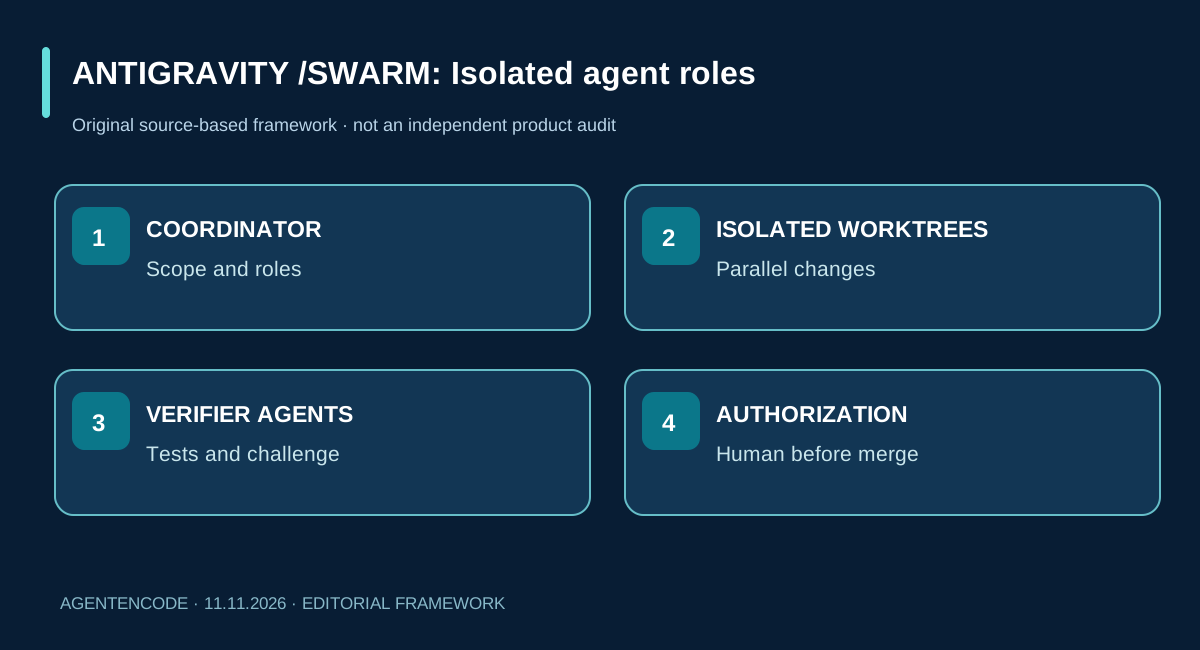
According to the Antigravity launch post, a coordinator decomposes an initial request into work for specialized agents. Parallel workers operate in isolated Git worktrees to avoid direct editing collisions. They share an append-only message board, allowing agents to exchange status and dependencies instead of routing everything through one coordinator context.
The design is meant to overcome the bottleneck of a single orchestration chat. Yet separate worktrees do not eliminate semantic conflicts: two changes can be individually valid and still be incompatible when merged. Google provides a product architecture description, not an independent measurement of how reliably these conflicts are detected.
Builders and verifiers have different jobs
Google describes adversarial verifier agents that run tests and challenge proposed diffs. Carbon may serve roles that require deeper reasoning—architecture, coordination, security review and verification—while faster or lighter models handle routine parallel edits. The product supports pinning different models to individual agent roles.
A verifier in the same toolchain is not the same as an external auditor. Correlated reasoning errors, inadequate test coverage and permissive tools can still undermine a result. Deterministic checks, code review and explicit release authorization remain necessary for sensitive systems.
Live Board and graph replay improve observability
Antigravity adds a Live Board, member roster and replayable graph view so users can inspect current trajectories and move between agent conversations. The /swarm board command and terminal shortcut expose a live view in the CLI. These interfaces may help developers understand what parallel agents are doing.
However, interactive visibility is not evidence of immutable governance records. Teams should verify whether tool invocations, model switches, decisions, approvals and artifacts can be exported and independently correlated. The brief launch post does not establish all of these controls.
Choosing Carbon versus Argon by role
Google recommends placing Carbon in deep reasoning roles such as architecture or adversarial auditing while keeping routine implementation on lighter models. That is a sensible cost-control hypothesis, not a documented saving for every workload. /swarm can be configured with mixed models to match tasks to capabilities.
Our editorial recommendation is to divide work into planning decisions, parallel implementation and final verification. Measure token spend, retries, integration failures and review time for each role. Without those records, more model calls may only produce a faster-looking workflow rather than a lower total cost.
API pricing and quota implications
Google lists public Gemini 4 Carbon introductory API pricing at USD 2 per million input tokens and USD 10 per million output tokens through November 30, 2026. Thereafter the announced rates rise to USD 4 and USD 20. The statement applies to the public Carbon API model; other enterprise, caching and product terms may differ.
Google also explicitly cautions that parallel agent systems use quota much faster than a standard chat, even where idle waiting does not consume tokens. A real budget must account for repeated calls, coordination, automated verification and human review. Unmeasured claims of significant savings would be misleading.
Permissions, isolation and release gates
An isolated Git worktree reduces edit collisions, but it does not by itself confine API credentials or prevent a tool from making unauthorized changes elsewhere. Sensitive agent workflows need restricted tool capabilities and a clear boundary between writing a patch and deploying it.
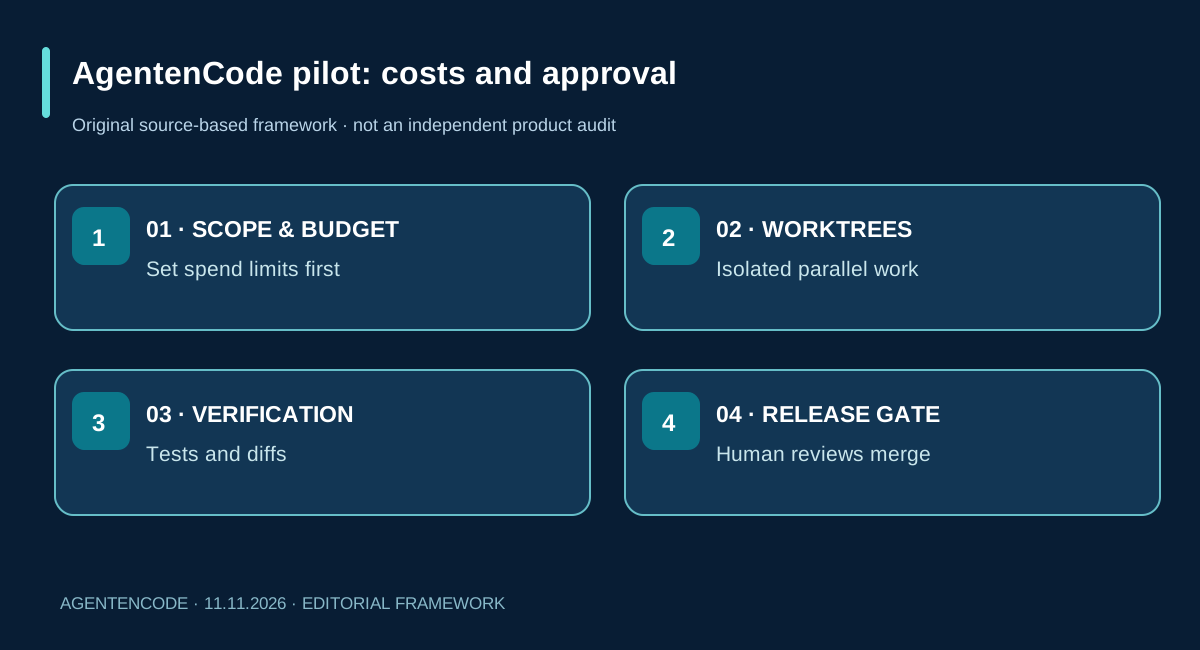
Our four-gate decision framework is: define scope and budget, run workers in isolated environments, verify output with deterministic and adversarial checks, and require explicit human merge authorization. This is AgentenCode editorial guidance, not a claim that the product enforces every proposed control.
Availability and a reproducible pilot
According to Google, AI Ultra subscribers can access Carbon in Antigravity applications and tools; /swarm began rolling out in preview for Antigravity App and CLI on November 10. Enterprise Carbon availability through Gemini for business should not be treated as proof of identical /swarm access across all plans.
An appropriate evaluation is a bounded software change with separable sub-tasks, such as tests, refactoring and documentation. Run a comparable baseline with a single agent, record both versions using the same acceptance criteria, and compare total cost and rework. A compelling demo is not yet a reproducible operational advantage.
Frequently asked questions
Is /swarm generally available?
Google describes a preview rolling out in the Antigravity App and CLI from November 10, 2026. Access may vary by account and product.
How does /swarm differ from ordinary subagents?
Google describes isolated Git worktrees, a shared append-only board, multi-model role assignment and dedicated verifier agents.
How much does Gemini 4 Carbon cost?
Google lists introductory public API prices of USD 2 per million input tokens and USD 10 per million output tokens through November 30, increasing to USD 4 and USD 20 afterward.
Do verifier agents guarantee safe code?
No. They offer an additional review layer, not independent assurance. Deterministic tests, tool permissions and human approval still matter.
Sources, method and evidence limitations
Product claims originate from the official announcements. Control recommendations are original editorial analysis. We did not independently deploy the product, validate the benchmarks or measure impact.
Related AgentenCode pages: Related agent profile · Build AI agents · Trust · Cursor Projects goes multiplayer: shared context for teams of coding agents.