
Google's AI agents help verify mathematical proofs: What /teamwork really demonstrates
Google reports multi-agent progress in mathematical proofs and systems research. We explain Lean verification, headline figures, accessibility and the limits of the claims.
Beyond conventional chatbot answers
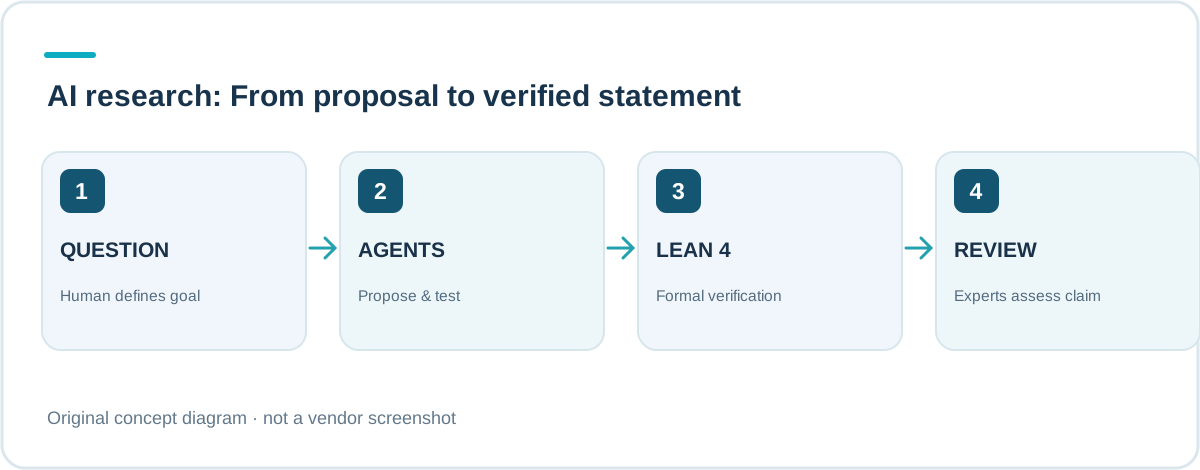
On November 13, Google Research described research results from Antigravity's /teamwork capability. Specialized agents examine literature, write experimental code, test hypotheses and pass work to separate checking agents. Human researchers define questions and validate their meaning.
This is a vendor's research report, not independent proof that any open mathematical problem can be solved without human input.
How the teamwork architecture works
Google describes planners, workers, critics and verification tools. Each agent receives targeted files and tools to reduce context overload across long projects. A dedicated verifier can test outputs instead of trusting the original model's explanation.
Checks range from unmodified software tests to Lean 4. A machine-checked proof is valid for its formal theorem statement; whether that statement correctly captures the informal research problem remains a human responsibility.
The headline number: 1.8 million lines of Lean
According to Google Research, agents produced a roughly 1.8-million-line formalization of the Weil conjectures over 28,800 subagent calls. These conjectures were already proven historically. The new achievement is machine-checked formalization, not the first solution of an unsolved Weil conjecture.
Google also reports more than 919,000 lines for a formalization related to Hilbert's tenth problem. Line count shows scale, not by itself proof quality, mathematical originality or peer-reviewed acceptance.
Which work may be genuinely novel
The announcement separately describes results in adaptive data analysis, algorithms and graph processing. They combine model-generated exploration with human collaborators and objective checks, and must be judged claim by claim.
A useful distinction is vendor reporting, independently inspectable mathematical or experimental evidence, and subsequent scientific peer review. These are not interchangeable milestones.
Why this matters beyond mathematics
The architecture could generalize to software: one agent proposes a change, another tries to falsify it and a third runs objective benchmarks or security checks before any human approval.
A multi-agent system is not inherently more reliable. More agents can amplify shared errors and costs if the evidence gate is weak.
A realistic company pilot
Use bounded tasks with frozen datasets, explicit acceptance tests, retained logs and human sign-off. Measure successful outcomes and regressions, not token counts or the number of running subagents.
Agent security remains fundamental. Formal correctness of one artifact does not authorize access to confidential data or uncontrolled external actions.
Availability versus research demonstration
Google describes /teamwork and /boost as available in Antigravity, with additional specialized workflows still to come. The reported research campaigns were substantial collaborations, not necessarily one-click consumer features.
Access tiers, pricing, regional availability and usage limits should be checked directly in the current product rather than inferred from the research announcement.
AgentenCode verdict: Verification is the real story
What matters is making long AI workflows inspectable: intermediate artifacts, independent test suites and explicit human responsibility. That could move AI beyond plausible explanations toward traceable results.
Commercial value still depends on measured accuracy, latency, costs and oversight. This is a significant research signal, not a blanket guarantee of autonomous discovery.
Frequently asked questions
Did Google autonomously prove an unsolved conjecture?
The announcement mixes new research findings with formalizations of previously established proofs. Each claim needs separate verification.
What does Lean 4 verify?
It mechanically checks proofs of precisely formalized theorem statements; the mapping from informal claims remains important.
Is /teamwork publicly usable?
Google describes availability in Antigravity, while specialized research workflows and limits may differ.
Are more agents always better?
No. Gains require explicit tests, independent critiques, permissions and cost controls.
RESEARCH & CONTEXT
Sources for this article
This analysis relies on the original publications linked below, which readers can inspect directly.
- Google Research – Advancing science & engineering with Antigravity's /teamwork, 13 November 2026
- Google Antigravity – Teamwork research workflows and access
- Lean 4 – official open-source theorem prover
Checked November 14, 2026. Vendor statements, pilot scope and preview benchmarks have not been independently reproduced or certified.