
A multi-agent system coordinates several specialized agents or roles so they can divide work, exchange results or supervise one another. The benefit is specialization; the cost is more coordination and more trust relationships.
AGENTENCODE · ORIGINAL DATA / EDITORIAL ANALYSIS
What AgentenCode's own data adds
An expert reading of our source-linked registry — not an invented lab benchmark.
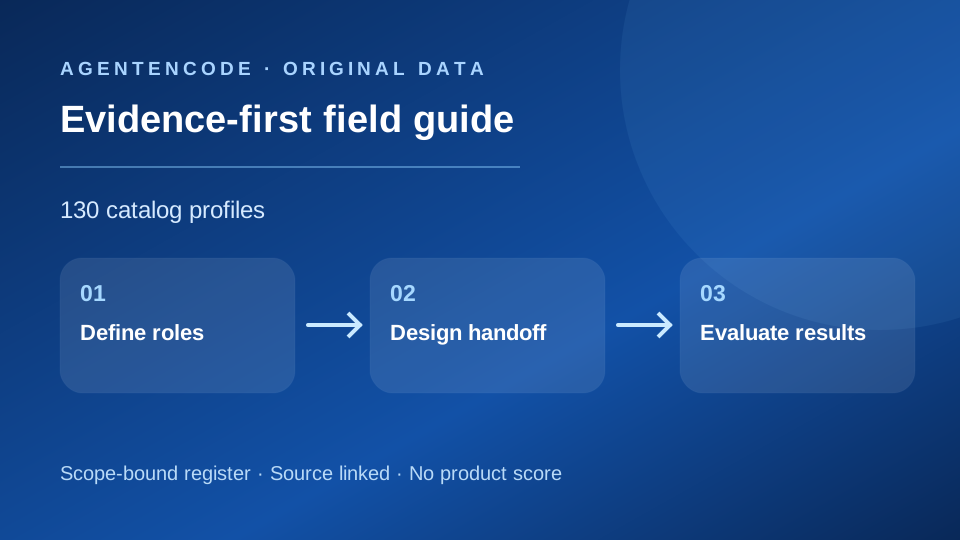
The catalog contains 130 profiles; AgentenGraph's separate multi-agent architecture layer contains specifically scoped implementation and evaluation relations. We do not infer one framework's orchestration pattern for other products.
Three documented agent examples
These deliberately different profiles illustrate how application scope changes what the concept means:
Microsoft Agent Framework Microsoft
AgentenCode records Microsoft Agent Framework (Microsoft) in the Automation segment. Use the individual profile to check the exact product, plan and deployment limits rather than projecting another agent's abilities onto it.
Google Agent Development Kit Google
AgentenCode records Google Agent Development Kit (Google) in the Automation segment. Use the individual profile to check the exact product, plan and deployment limits rather than projecting another agent's abilities onto it.
CrewAI AMP CrewAI
AgentenCode records CrewAI AMP (CrewAI) in the Automation segment. Use the individual profile to check the exact product, plan and deployment limits rather than projecting another agent's abilities onto it.
Method: the named profiles come from the AgentenCode catalog (snapshot 2026-10-08). Protocol relations, where shown, come from the explicit AgentenGraph relation set (snapshot 2026-10-05). This is editorial interpretation of primary-source-backed records, not independent hands-on testing, formal certification, proof of production deployment or an exhaustive market census. Unknown does not mean false. Read methodology →.
Why use multiple agents?
Different agents can specialize in research, planning, coding, review or domain-specific work. This can reduce prompt complexity and make responsibilities clearer.
A multi-agent architecture can also isolate permissions: one agent may be allowed to read sensitive data while another can perform a narrow external action. That separation can be useful when it is enforced technically rather than only described in prompts.
Orchestration patterns
Common patterns include a central orchestrator that routes work, peer-to-peer handoffs, planner-executor systems and reviewer patterns where one agent checks another. Some systems mix deterministic workflow steps with agentic handoffs.
The orchestration layer needs clear rules for task ownership, timeouts, retries and escalation. Otherwise coordination overhead can exceed the benefit of specialization.
Shared state and handoffs
Agents need a way to exchange context. That can be a shared workspace, messages, artifacts or structured task state. Every handoff should make it clear what information is transferred and what the receiving agent is expected to do.
Uncontrolled shared memory can create hidden coupling. One agent may write information that influences another agent later, so memory boundaries and provenance matter.
New risks from coordination
More agents create more trust relationships. A compromised or mistaken agent can pass bad instructions downstream, and delegated permissions can become difficult to trace.
Prompt injection, identity confusion, excessive delegation and unclear responsibility can all worsen in multi-agent systems. The system should preserve which agent produced each action or artifact.
Observability and evaluation
Tracing should cover routing, handoffs, tool calls, retries and final outcomes. Evaluations should test the system as a whole rather than only each agent in isolation.
A multi-agent design may improve quality on some tasks while increasing cost and latency. The right comparison is against a strong single-agent or workflow baseline, not against a simplistic chatbot.
When not to use multi-agent
If one agent can reliably complete the task with a small tool set, adding more agents may only add failure modes. Multi-agent architecture is most justified when specialization, permission separation or parallel work creates measurable value.
Sources and further reading
- DeepMind Institute – Artificial Symbiotic Intelligence ↗
- DeepMind Institute – Cheaters and Whistleblowers in the Agent Swarm ↗
Frequently asked questions
Is a multi-agent system always more capable?
No. It can improve specialization but also adds coordination cost and new failure modes.
Do agents need a special protocol to communicate?
Not necessarily. They can share structured messages or workflow state; protocols such as A2A can standardize cross-system communication.
How should multi-agent systems be audited?
Logs should preserve routing, handoffs, identities, tool calls and important state changes across agents.