
OpenAI launches ChatGPT for Sales with 30-plus plugins and persistent AI agents
OpenAI launches ChatGPT for Sales with 30+ partner plugins, CRM context and persistent agents. What it can do, who controls access and what remains unproven.

A sales assistant that works across existing business tools
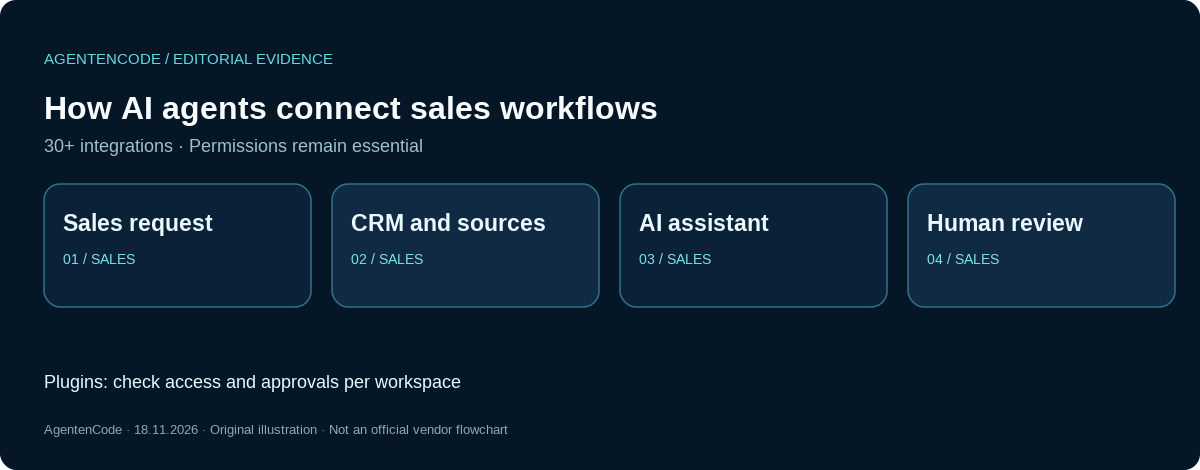
OpenAI introduced ChatGPT for Sales on November 17, 2026. It brings together a first-party Sales plugin and more than 30 new or enhanced partner plugins for customer research, meeting preparation, sales documents and follow-up actions. Rather than copying data between a CRM, call notes and a presentation app, a seller can ask ChatGPT to organize a defined part of that work in one conversation.
The official announcement is notable for putting practical business workflows ahead of model benchmark scores. The intended audience includes different sizes of sales teams, but OpenAI also says feature and partner-plugin availability depends on plan, region and workspace settings. A launch should not be mistaken for unrestricted access to all supported services.
The partner ecosystem is the real infrastructure
OpenAI names Salesforce, HubSpot, Close CRM and monday CRM for account management, with Apollo, Clay and Common Room among research tools. Gong, Otter.ai, Granola and the Meetings plugin can provide meeting context. Gamma, Canva, Docusign, Ironclad and PandaDoc are among tools for presentations, proposals and agreements. Other plugins assist with performance analysis and sales operations.
This is more than a list of logos. Each integration offers a potential source of data or an authorized action, and both need to match the user's existing permissions. A connected customer record does not automatically grant the right to alter a contract or send messages on someone else's behalf. Integration quality, account access and error handling will determine whether the combined workflow is actually useful.
Preparing for a customer meeting becomes a multi-source task
One concrete workflow is to assemble account history, notes from earlier calls, unresolved questions and product information into a meeting brief. The assistant can suggest the next questions, organize a tailored pitch and help prepare a follow-up. The attraction is reducing the manual effort of moving between disconnected tabs while keeping the conversation focused on a customer need.
However, the output inherits the quality of the underlying records. Outdated pipeline information, an incorrect customer note or missing contractual context can make a polished briefing misleading. Sales teams should distinguish retrieved facts from AI-generated interpretation and require direct links to underlying records where practical. A fluent summary is not evidence of a verified account history.
Persistent dots can keep working after the conversation
OpenAI says the same partner plugins and account context can be used by a dot, its persistent agent in ChatGPT. An agent could prepare meeting briefs, watch for deal changes, produce suggested next steps and bring developments back for review. That shifts the product from an on-demand chat to delegated work that continues between meetings and conversations.
Persistent authority creates different governance requirements. The team should know which accounts are monitored, when alerts will be produced, what data is shared and how a recurring task is stopped. A prepared email or quote is not the same as an authorized external communication. Human review should remain explicit for customer-facing commitments and changes with financial consequences.
From lead discovery to deal-risk monitoring
OpenAI illustrates workflows that prioritize prospects, explain why a company might be a good fit and identify deals that may be stalling. Sales staff could compare CRM signals, past conversations and current research to find unanswered commitments. In some supported combinations, the assistant can prepare an update and save an approved next step through a connected service.
These capabilities could be useful when the pipeline is complex, but value needs to be measured against real outcomes: correct account matching, relevant outreach, fewer missed commitments and deals won. Producing more messages is not the same as winning more business. Teams should track whether the recommendations were accurate and whether they created unnecessary contact attempts.
Vendor testimonials are not independent performance studies
The launch quotes one user, NeoBid, estimating roughly 65% less manual effort for a limited set of prospect research and CRM enrichment activities. That is a customer-reported estimate for specific tasks, not an independently audited 65% productivity gain for every sales organization. Other featured statements are also testimonials from customers and partners rather than controlled comparative trials.
A careful evaluation can hold the workload constant: a set of similar accounts processed with the ordinary toolset and then with the connected ChatGPT workflow. Measure research time, record accuracy, human edits, accepted outreach and final business results. Include plugin costs, setup and ongoing permissions review before drawing conclusions about return on investment.
Sensitive customer information changes the risk profile
CRM records, agreements and call transcripts often contain personal and commercially sensitive information. Connecting them through a single assistant can make work faster, but it can also concentrate access. OpenAI describes Business and Enterprise administrator controls for making plugins available and reviewing supported actions. Those permissions are part of a deployment, not a substitute for the organization's security assessment.
Before connecting a sales stack, a team should review data categories, retention, contractual terms, regional requirements and how access is revoked. Write actions and customer communication need stronger approval boundaries than read-only brief generation. The broader principles are covered in our AI agent security guide.
AgentenCode assessment: the workflow is becoming the product
The significance of ChatGPT for Sales lies in how it joins existing customer systems, research, document creation and potential follow-through in one delegated workflow. Persistent agents strengthen that direction by carrying context across sessions. The competitive challenge for CRM and sales software is therefore not merely better natural-language answers, but whether a system can complete an authorized sequence reliably.
As of November 18, 2026, the launch and named integration categories are documented. Broad rollout rights, third-party pricing and the practical accuracy of each configured workflow are not universally established by the announcement. The most useful first deployment is a bounded, measurable task with source checking and human approval for consequential changes.
Frequently asked questions
What is ChatGPT for Sales?
OpenAI's November 17 launch combines a first-party Sales plugin with over 30 new or enhanced partner plugins to support research, CRM-related work, meeting preparation and follow-ups.
Does it replace an existing CRM?
No. The announced approach connects to services such as Salesforce and HubSpot; it is not a general replacement for those systems.
Can its agents update customer data?
Supported actions vary by plugin, account permissions and workspace configuration. Teams should review write scopes and approvals.
Is every plugin included at no extra cost?
OpenAI states that availability varies by plan, region and workspace setting, and does not promise universal free access to all partner services.
RESEARCH & CONTEXT
Sources for this article
This analysis relies on the original publications linked below, which readers can inspect directly.
- OpenAI: Introducing ChatGPT for Sales (17.11.2026)
- Deyron Labs: ChatGPT for Sales – Einordnung der Integrationen (18.11.2026)
- TMC Insight: AI Unifies Sales Data & Powers Seller Outreach Tasks (17.11.2026)
- OpenAI: Plugin-Verzeichnis und Sales-Integration
Checked November 18, 2026. Product features, customer productivity claims and standards proposals have not been independently reproduced or certified.
Related agents, systems and context
Product links identify the subject of a report; ecosystem links provide context, not shared feature claims.
- Ecosystem contextOpenAI · ChatGPT & Codex
- Background guideContext engineering