
Cisco brings Claude Mythos to AI-agent red teaming – what is actually available?
Cisco wants AI Defense to test agent vulnerabilities using Claude Mythos while Splunk evaluates the cost and quality of agent work. The release has important limits.
Cisco links red teaming, agent evaluation and cost control. Mythos-enabled testing is not generally available yet.
In brief
Cisco says it will add Anthropic's Claude Mythos to the controlled red-teaming workflow of AI Defense, alongside Splunk Agent Observability updates designed to connect AI-agent behavior, evaluation quality and spending. This is a staged product announcement, not an immediately available end-to-end security guarantee.
1. What is changing
AI Defense aims to construct context-specific, multi-step attacks against AI applications and agents. Splunk's upcoming Tokenomics links agent costs with evaluation outcomes; Eval-G1 and Evaluation Tuner help teams derive specialized quality checks from traces and expert feedback. Cisco IQ adds infrastructure exposure context and integrations with data, MCP and ServiceNow workflows. The architectural ambition is a cycle of test, observe, prioritize, remediate and retest, rather than a one-off model leaderboard score.
2. The authorization boundary
Cisco describes Mythos access through a structured product interface, not open-ended prompting. Tests require enterprise-authorized targets, named operator attribution, a human-defined job and objectives, time-limited execution and revocation. These are vendor-described safeguards, not independently validated guarantees. Buyers should insist on evidence that the boundary holds when agents reach browsers, external APIs, credentials and production systems.
3. Availability and claims
| Capability | Stated stage |
|---|---|
| Mythos-enabled adaptive red teaming | Coming soon to select enterprise customers |
| Tokenomics | Private preview planned for December 2026; AWS Marketplace GA targeted for early 2027 |
| Eval-G1 and Evaluation Tuner | GA starting November 2026, per Cisco |
| Cisco IQ/MCP/ServiceNow integration | Product additions described; individual feature/tenant availability requires confirmation |
Cisco's claims of up to 98% lower evaluation costs and 2.5x faster responses for next-generation Eval-G1 are vendor-reported comparative metrics, not AgentenCode benchmarks.
4. What operators should evaluate
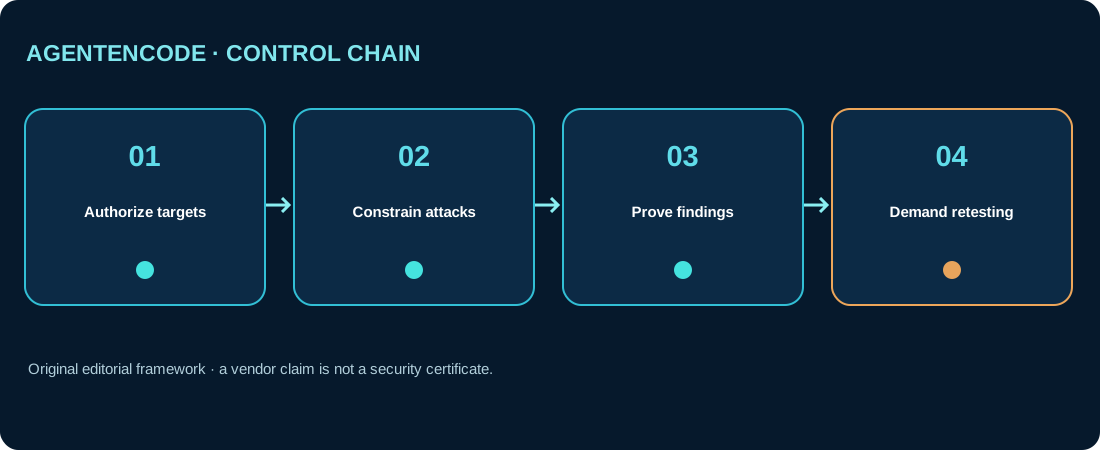
Set explicit authorized targets and stop conditions before a test; segregate production secrets from adversarial workflows; measure whether findings are reproducible; require remediation ownership and a second verification pass; and separate token cost from the total cost of inaccurate decisions and human review.
5. Limitations
The announcement does not establish a universal AI-agent security certification, independently measured field effectiveness, or a blanket release of Claude Mythos. Availability, retention, regional boundaries and commercial terms must be confirmed separately.
6. Assessment
The consequential shift is toward assessing what agents can do, not merely what models can say. Cisco offers a credible framework for discussing those controls, but a buyer should treat it as a product roadmap with selectively available components until live pilot evidence exists.
7. FAQ
Is Mythos red teaming GA today? No, Cisco says it is coming soon to select enterprises.
Are the quoted evaluation savings independently measured? Not by AgentenCode; they are Cisco's comparative claims.
Does red teaming replace permission control? No. Tool scope, consent, logging, revocation and reproducibility remain separate obligations.
---