
Gemini Computer Use goes GA: Who controls an AI agent's next click?
Google made Computer Use generally available on October 30, 2026. Developers can now build agents that interact with user interfaces through supported Gemini APIs. The harder question is what happens when a plausible click becomes an unauthorized real-world action.
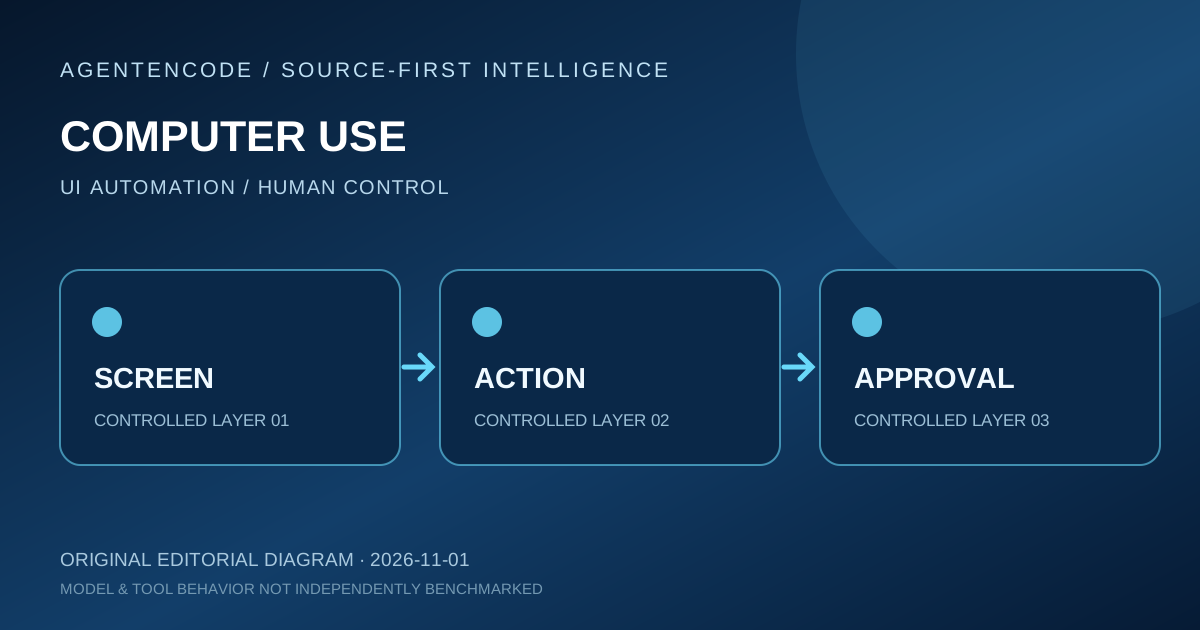
GA means regular API availability, not proven reliability or permission to run unattended. Google's safety decisions still require enforcement by the application executing the actions.
Sources and evidence limits
- Primary sources
Official October 30, 2026 announcement, first-party technical guidance and version-specific release notes are linked.
- Not independently tested
No AgentenCode benchmark, security audit or blanket compliance claim.
What Google actually shipped
The official Gemini API changelog confirms Computer Use as generally available in the Interactions and GenerateContent APIs on October 30. This marks a deployment milestone, not a universal guarantee across every model, account or region. Engineering teams still need to examine current model support, billing and their specific API environment before treating the feature as operationally ready.
Why UI control changes the equation
Google's documentation covers browser, desktop and mobile environments. An agent interprets screen state and requests defined interactions. That may help with legacy applications whose workflows lack a stable API. But visual state is fragile: moving buttons, authentication screens and dynamic pages can make a plausible plan trigger the wrong action. Computer Use is an interface capability, not a substitute for application-level authorization.
Approval must be enforced in the host
Google documents safety categories for financial transactions, sensitive data changes, communication, account creation and legal consent, among others. A generated action may carry a decision requiring user confirmation. The host must actually pause execution and handle that approval. Recording the request, limiting the privileges of the executing account and defining a cancellation path remain application responsibilities.
Prompt injection moves onto the screen
Hostile instructions can appear inside a page, a form or an uploaded document. The technical guide describes a prompt-injection detection option, but it is not an independent assurance that attacks cannot succeed. A secure pilot separates read and write capabilities, uses controlled sites and accounts, and tests whether malicious page content can steer the agent toward secrets or unintended operations.
What general availability does not prove
GA is not a benchmark for long sequences of actions. Neither the release note nor a demonstration establishes an independently measured completion rate for payments, regulated services or enterprise accounts. AgentenCode has not run such tests. Availability, cost and model compatibility must be confirmed for each deployment instead of being inferred from a short announcement.
A bounded pilot is more useful than a demo
Start with read-only tasks and synthetic records. Set a domain allowlist, timeout, explicit approvals and a spending limit. Measure incorrect clicks, bad recovery, accidental disclosure and unauthorized tool calls as carefully as successful task completion. Repeated tests and reviewable traces are necessary before an organization grants an agent more consequential privileges.
The larger governance shift
Computer Use moves part of the action boundary from typed APIs to visual context. That unlocks some applications while making attribution and oversight more important. The sustainable advantage is not simply that an AI can operate a screen: it is whether humans can understand, approve and reverse what the agent actually does. This is a primary-source analysis, not a hands-on security certification.
Primary sources
- Gemini API release notes – 30 October 2026
- Gemini API Computer Use documentation
- Google Computer Use – safety policies
Editorial source cutoff November 1, 2026. No independent product or security test.
Frequently asked questions
Does GA mean the agent may operate any site unattended?
No. Model, website, access and safety restrictions still apply even though the API tool is generally available.
Does Google's safety system replace human approval?
No. The host application must process relevant safety decisions and enforce its own approval boundaries.
Did AgentenCode test Computer Use?
No. We analyzed Google's changelog and technical documentation; no independent performance or security benchmark is claimed.