
BioBasicsBench: GPT-6 Astra scores 66.7%—but lab agents still need controls
OpenAI and Ligo test wet-lab raw-data interpretation: GPT-6 Astra earns 66.7% rubric credit but still makes consequential reasoning errors.

1. Why this benchmark matters
Published scientific graphs are usually polished. Real lab work contains misleading labels, conflicting controls, untidy gel photographs, raw microscope footage and instrument exports. BioBasicsBench focuses on whether agents interpret these materials and know when evidence is insufficient. The 100 tasks span protein methods, imaging and cytometry, quantification and assays, nucleic acid methods, and molecular cloning. Scientists assembled tasks from experiments, with internal and external reviews of the grading criteria. It is an analysis benchmark, not a robotic experiment or clinical trial.
2. Read the numbers correctly
| Model at xhigh | Mean rubric reward | 95% confidence interval | Output tokens/task |
|---|---|---|---|
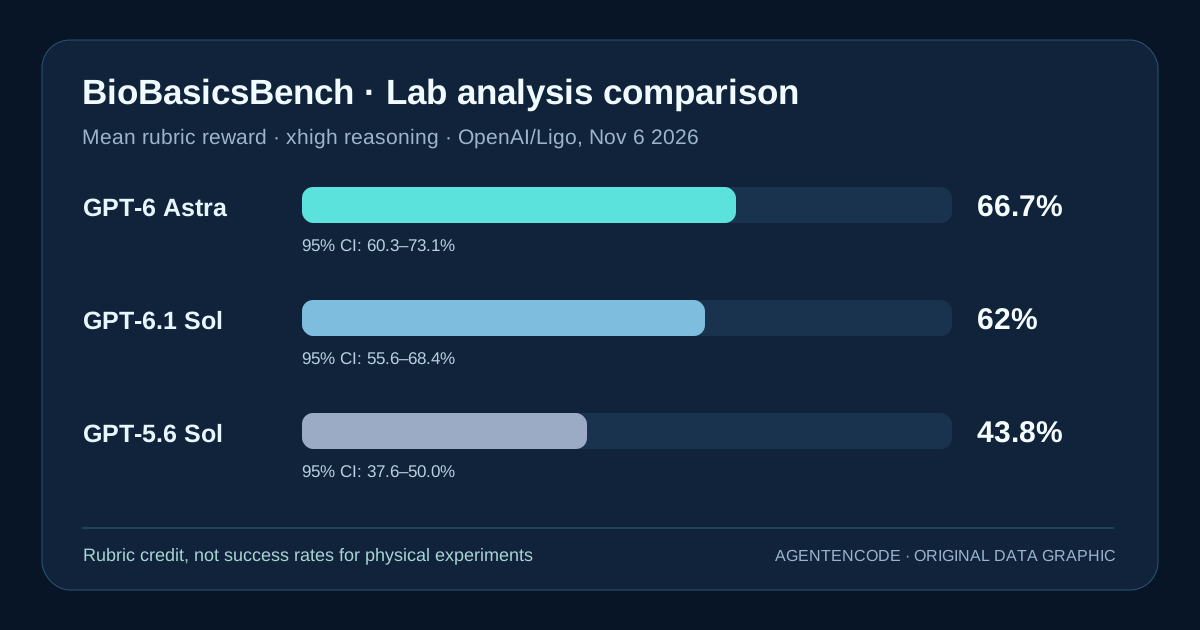
| GPT-6 Astra | 66.7% | 60.3–73.1% | 4,704 |
| GPT-6.1 Sol | 62.0% | 55.6–68.4% | 5,238 |
| GPT-5.6 Sol | 43.8% | 37.6–50.0% | 9,099 |
Mean reward is partial grading credit, not the percentage of whole experiments solved. OpenAI describes seven models, 37 model/effort settings, five attempts per task and 18,500 responses. Intervals are based on resampling complete tasks. AgentenCode did not reproduce the benchmark. A curated set of 100 tasks does not validate every laboratory workflow or biosafety setting.
3. An impressive success: Rejecting an invalid control
OpenAI describes a DNA cloning task in which Astra read “LB Kan50” on a plate apparently intended as a negative control. That label indicates kanamycin, whereas the experiment required ampicillin. The plate therefore could not establish the intended control condition. GPT-5.6 Sol reportedly inferred too much from its empty appearance.
AgentenCode analysis: A useful agent must check whether evidence is valid before using it. Labels, provenance, units and experimental controls belong in the workflow, not just the final answer. The same rule applies to security logs, finance and enterprise automation.
4. A revealing failure: Correct perception, wrong selection
In a colony-PCR example Astra visually separated band patterns but assigned the wrong experimental meaning. It selected colonies 4, 6, 7 and 8, while the benchmark reference identified 5, 9 and 10. Another case produced a colony overcount of roughly 12%. A model can correctly detect a pattern yet issue an incorrect actionable recommendation.
5. Original AgentenCode go/no-go matrix
| Workflow | Editorial verdict | Required control |
|---|---|---|
| Organize experimental evidence | Supervised pilot | Preserve originals |
| Flag invalid controls | Supervised pilot | Verify labels and protocol |
| Count colonies or signals | Cross-check required | Reference and uncertainty |
| Recommend follow-up experiment | Proposal only | Expert authorization |
| Execute consequential lab action autonomously | No-go on this evidence | Separate real-world safety case |
This is our editorial risk matrix, not an OpenAI certification. The transition from perception to interpretation and then action deserves its own approval gate.
6. Lessons for general-purpose agents
Strong workflows record original data, validate controls and units, consider alternative explanations, report uncertainty and request separate authorization before consequential action. Teams should measure wrong final decisions after correct partial observations as a distinct failure class. An answer-level score alone can hide it.
7. Evidence limitations and availability
The November 6 report is from the benchmark creator. External task review is not an independent replication of its model performance. No general authorization for fully autonomous wet-lab operation, clinical suitability, global availability or product pricing follows from the release.
FAQ
Does Astra solve two-thirds of wet-lab experiments? No. The score measures average rubric credit on data interpretation tasks.
Were lab robots tested? No, the task is interpretation of experimental materials.
Why do bad controls matter? A confident answer based on an invalid control can be wrong despite good visual perception.
Can lab approvals be delegated to Astra now? Not on this evidence.
Source and methodology
OpenAI: Measuring how AI agents handle everyday wet-lab science (November 6, 2026). All measurements and case descriptions are provider reports; the decision matrix is original AgentenCode analysis. No independent lab test, benchmark replication or safety certification.
Primary sources and limitations
Primary-source reporting and original editorial analysis. No independent replication, agent safety certification, or universal availability/cost guarantees.