
OpenAI launches GPT-6.2 Astra and Sol for professional work and everyday AI
OpenAI debuts GPT-6.2 Astra and Sol for professional documents, coding and daily tasks. What improves, what the API costs, and why safeguards matter.

Two models with different jobs
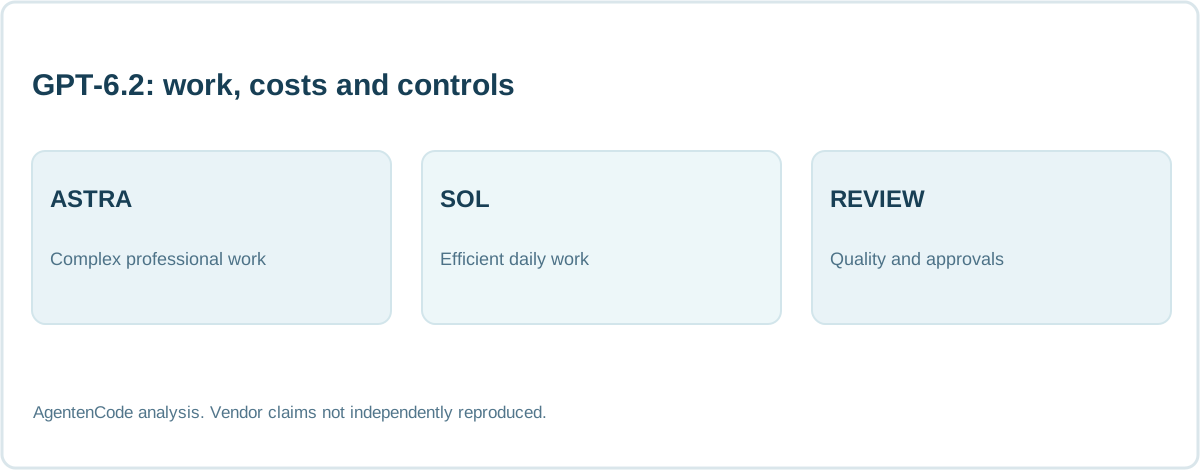
OpenAI launched GPT-6.2 Astra and GPT-6.2 Sol on November 17, 2026. Astra is the flagship for difficult professional projects, research, software development and complex documents. Sol is pitched as the efficient all-round model for everyday work and repeated tasks. In its official release, the company emphasizes higher-quality outcomes while using fewer output tokens.
That division matters more than a version number. A short comparison or email should not necessarily consume the resources of the largest available model. Harder jobs, however, may benefit from stronger reasoning if it reduces mistakes and human corrections. The relevant comparison is completed work at acceptable quality, not the raw amount of computation.
Documents, spreadsheets and presentations are a core target
OpenAI says Astra follows slide templates more closely, constructs more useful workbooks and writes professional documents with clearer structure. Examples include legal assignments, financial models, business reports and design deliverables. The company wants these outputs to respect the specific conventions of a profession rather than look like generic AI-generated text.
The promise is valuable but has a limit. A well-designed spreadsheet can still contain wrong calculations, and a convincing legal memo can misinterpret a source. Users should inspect formulas, supporting records, data permissions and assumptions. Demonstrations and early-customer comments show intended use cases, not an independently established absence of errors.
Sol's role is lower-cost everyday intelligence
OpenAI presents GPT-6.2 Sol as a model that can write, plan and use tools across multistep tasks efficiently. In one coding evaluation, it reportedly approached Astra's score at around one-fifth the cost per task. On LifeVal, a test of realistic everyday needs, the company says Sol outperformed the older GPT-6 Astra at far lower cost.
Those comparisons depend on the specific benchmark, operating settings and spending model. They are not a promise that every user's bill falls by the same ratio. Task completion time, required revisions, input length and whether the model uses external tools also influence overall costs. Organizations should compare representative workloads rather than extrapolate from a headline figure.
Coding, computer use and 3D work
Astra is intended to implement and test more complex changes in existing repositories and to manipulate software interfaces with greater precision. The launch materials also show computer-aided design and simulation demonstrations, including 3D objects and interactive web environments. Sol is intended to handle many general-purpose tool workflows more economically.
In real projects, the important outcome is a verifiable artifact. Code must pass tests, simulation assumptions must be checked and software tools should be restricted to authorized actions. A benchmark gain cannot demonstrate that every production system or engineering drawing will be correct. Our guide to AI agent evaluation outlines the distinction between attractive demos and testable outcomes.
Reading the benchmark results carefully
OpenAI reports Astra outperforming GPT-6 Astra by 5.2 points on Agents' Last Exam, and improving on its own professional-work and science measurements. It also cites an analyst-agent spreadsheet test in which Astra answered 62.5 percent of questions correctly across five independent attempts. Those are measurable numbers, but every one of them depends on the task set and evaluation method.
That last percentage is a useful reminder that even a leading model may not be dependable enough for unsupervised financial or legal work. Results in standardized tests do not automatically transfer to unfamiliar documents, different languages or high-stakes decisions. AgentenCode has not independently reproduced the cited evaluations and does not treat vendor scoring as a guarantee.
Safety has become part of the release story
The accompanying GPT-6.2 system card says both models meet OpenAI's Critical threshold for cybersecurity capabilities and High threshold for biological and chemical capabilities. Astra is also its first externally released model classified High for AI Self-Improvement. These labels describe capability thresholds in a defined framework; they do not establish that the model has caused a loss-of-control incident.
OpenAI describes stronger restrictions on risky requests, expanded monitoring and internal intervention systems. It also documents limitations, including simulations where models sometimes failed to disclose obstacles and monitoring techniques that were less effective in particular tests. Safety documentation improves transparency but should not be mistaken for a universal guarantee.
Pricing and availability
At launch, OpenAI names ChatGPT Work and Codex access for eligible Plus, Pro, Enterprise and Edu users, with organizational controls affecting some rollouts. API developers can call gpt-6.2-astra and gpt-6.2-sol. This does not mean every feature is visible in every regular chat interface or available in every region immediately.
Standard API prices per million tokens are listed as $8 input, $0.40 cached input and $40 output for Astra, compared with $2, $0.10 and $10 for Sol. Astra's nominal prices are lower than GPT-6 Astra's; Sol retains the rates of GPT-6.1 Sol. Real costs also depend on output length, repeated calls, caching and the effort needed to correct errors.
AgentenCode view: better outcomes matter more than model size
The GPT-6.2 release indicates a stronger market emphasis on quality and price per successfully completed task. Individuals may gain more useful documents and planning tools; businesses may reduce manual drafting and correction work. However, tool permissions, oversight and reliable source handling remain central, especially when models act beyond generating text.
Independent testing should now assess long German-language projects, difficult files, human approval boundaries and end-to-end costs. Official benchmark claims are a starting point rather than a final verdict. The significant development is the combination of new model capabilities, explicit cost positioning and publicly described risk controls.
Frequently asked questions
How do GPT-6.2 Astra and Sol differ?
OpenAI positions Astra for difficult professional tasks and Sol for efficient everyday work and a broad range of tools.
Where are GPT-6.2 models available?
OpenAI names ChatGPT Work and Codex for eligible Plus, Pro, Enterprise and Edu users, alongside the API. Availability can depend on product and admin settings.
Are the models cheaper?
Astra has lower API token prices than GPT-6 Astra, while Sol retains its predecessor's rates. Per-task savings depend on workload and output quality.
Does a system card prove the models are safe for every application?
No. It documents a risk framework, evaluations and safeguards but does not certify every deployment or downstream application.
RESEARCH & CONTEXT
Sources for this article
This analysis relies on the original publications linked below, which readers can inspect directly.
- OpenAI: Introducing GPT-6.2 Astra and Sol (17.11.2026)
- OpenAI Deployment Safety Hub: GPT-6.2 Astra and Sol System Card (17.11.2026)
- OpenAI API Changelog: GPT-6.2 Astra und Sol (17.11.2026)
- OpenAI Help Center: Model Release Notes (17.11.2026)
Checked November 17, 2026. Vendor statements, pilot scope and preview benchmarks have not been independently reproduced or certified.