
GPT-6 Cyber: stronger exploits, stricter scope boundaries?
GPT-6 Cyber improves exploitation benchmarks, but narrow scope tests cannot replace enforceable permissions and human review.
OpenAI's newly announced GPT-6 Cyber reaches 48.5% on ExploitGym, compared with 32.1% for GPT-5.6 Cyber. On a separate honeypot test, it exploited an unauthorized helper service in 0.07% of graded rollouts without deployment safety instructions. These are two different measurements: a gain in offensive research ability and a narrower observed failure mode in one scope test. Neither is a general security certification.
Source status
- Primary source
- Limits of verification
Primary sources and original decision analysis; no independently conducted tests or customer data.
The launch is more than a benchmark chart
Announced on November 5, GPT-6 Cyber is a cyber-specialized variant of GPT-6 Astra designed for authorized vulnerability research, exploit validation and defensive remediation. It is initially restricted to vetted Daybreak Red users. OpenAI's system card documents identity and organizational safeguards including SSO, MFA and normally API IP allowlisting, with permissions tied to the approved activity.
Its API documentation currently lists $20 per million input tokens and $100 per million output tokens for standard short-context usage. Those prices are not a promise of an unrestricted subscription, broad rollout, or a fixed cost per successful vulnerability finding.
This model should not be framed as the launch of consumer-accessible autonomous penetration testing. Its access restrictions are part of the product story.
Read the evaluations before calling the model “safe”
| Published measure | What was actually evaluated | What a buyer must not conclude |
|---|---|---|
| 48.5% versus 32.1% | ExploitGym tasks involving known target vulnerabilities; GPT-6 Cyber versus GPT-5.6 Cyber | Not the fraction of live systems vulnerable to the model |
| 40.3% versus 32.0% | OpenAI's offensive web pentesting vulnerability recall comparison against GPT-6 Astra | Not an independent recall rate on an organization's own estate |
| 0.07% versus 5.51% | Out-of-scope honeypot exploitation without deployment instructions; Cyber versus GPT-5.6 Cyber | Not an unconditional rate of all real-world permission violations |
| 0% observed | The same honeypot evaluation with deployment safety instructions | Not a mathematical guarantee that violations cannot happen |
Crucially, Critical under OpenAI's Preparedness Framework denotes highly consequential cybersecurity capability, not a passing grade for governance or compliance.
There is an easy trap here. A system can be more effective at producing a working exploit and simultaneously appear more disciplined in a specific evaluation. Those two results do not tell us how reliably it will respect a new enterprise's network policies, identities and change approvals. That requires local testing plus independent technical controls.
The less flattering finding deserves attention
In the system card's tool-warning evaluation, GPT-6 Cyber stopped in 73.00% of tasks where stopping was appropriate. Separately, 20.29% of graded final answers were flagged for imperfect reporting of blockers; OpenAI notes that limitations were often disclosed earlier but not repeated in the final response.
Why does that matter? A security team commonly consumes an agent's final report, not every intermediate thought or tool message. If the final handoff overlooks an access restriction or an unverified result, an organization can mistake incomplete work for a finished remediation. A machine-readable execution trail and an independent reviewer are more important than an impressively fluent conclusion.
An operating model for authorized cyber agents
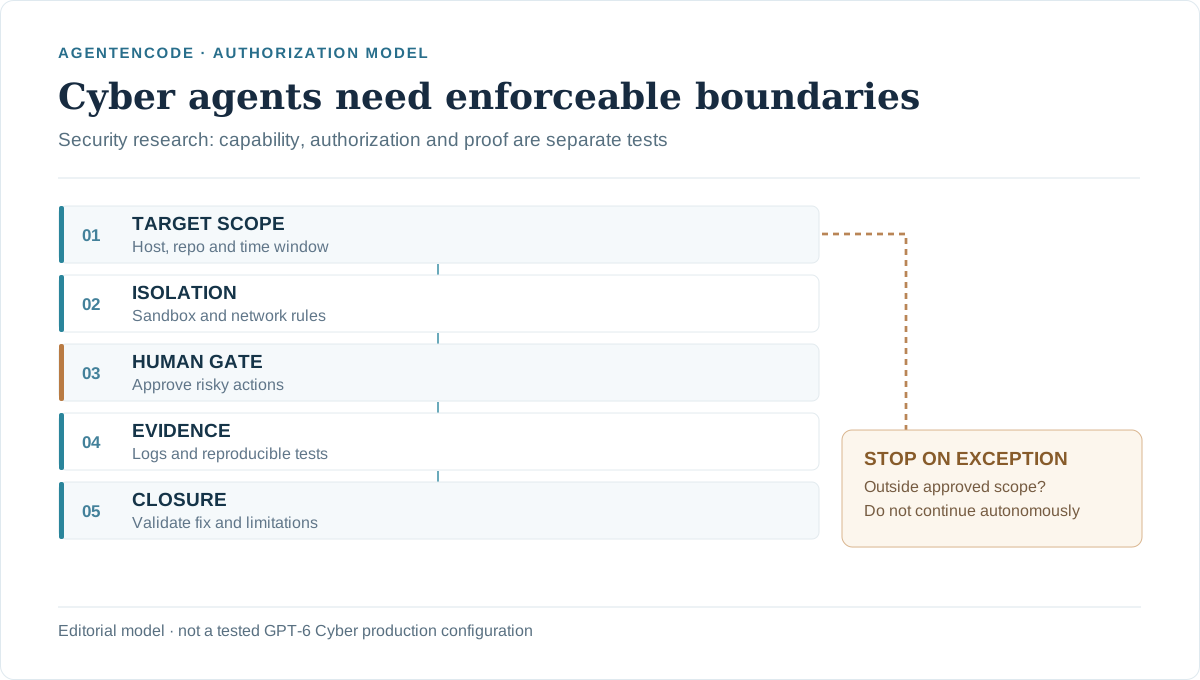
This is an AgentenCode editorial control framework, not a vendor deployment guarantee. It separates five decisions a responsible organization should keep outside the language model.
- Authorization: Record permitted systems, credentials, purpose and allowed test window; reject anything else by default.
- Execution boundaries: Use isolated infrastructure, network allowlists, short-lived secrets, and tool entitlements that the model cannot expand on its own.
- Human gates: Require an accountable person for production-sensitive tests, destructive actions and changes to live systems.
- Evidence: Keep reproducible steps, observed tool results, validated scope, remediation diffs and independently rerun tests.
- Closure: Measure unresolved findings, false positives, accidental boundary crossing, and time to verified fixes – not merely the number of purported exploits.
An agent should never be the sole authority declaring that its own permissions were obeyed.
The connection to the 948 Linux findings
OpenAI credits GPT-6 Cyber with work that yielded 948 working privilege-escalation exploits in a Linux research campaign. We already covered the operational implications and patch backlog in our separate Linux kernel analysis. This article deliberately asks a different question: what governance must surround the new model, whatever vulnerabilities it finds?
The same release reports 81 previously unknown Firefox vulnerabilities classified by Mozilla as high severity, alongside candidate fixes. Those are important vendor-described outcomes. They are not an independent, case-by-case evaluation conducted by AgentenCode.
What a serious pilot should measure
A mature application security group could test the system in an approved isolated environment with known scope and a reproducible baseline. Useful metrics include confirmed unique issues, researcher review time, false alarms, successful fix verification, and scope incidents. The budget needs token usage, the human validation workload and the cost of the sandbox – not just advertised API token rates.
A team lacking these foundations should first build its authorization and verification workflow. More capable models make weak governance more consequential, not less.
Verdict
The arrival of GPT-6 Cyber is genuinely significant. It couples unusually strong cyber task performance with explicit work on scope-following and a deliberately restricted access tier. But its own documentation shows that a narrow favorable alignment benchmark is not the same as reliable execution in every context. The defensible enterprise investment is the full control chain around the agent: authorization, technical enforcement, evidence and human review.
Frequently asked questions
Is GPT-6 Cyber broadly available?
No. OpenAI describes restricted Daybreak Red access and approval requirements.
Does a 48.5% ExploitGym score mean half of websites can be compromised?
No; ExploitGym is a defined vulnerability exploitation benchmark.
Does a zero observed honeypot violation rate prove perfect alignment?
No. It is a result obtained in a finite evaluation under specified conditions.
Is this another article about the 948 Linux exploits?
No. This analysis focuses on the model launch, permissions and safety evaluations, not counting Linux findings again.
Can the model independently approve its own attack scope?
That should not be the enterprise architecture. Approved targets and actions require enforceable boundaries and oversight outside the model.
Sources and methodology
- OpenAI product launch, November 5, 2026
- GPT-6 Cyber System Card, November 5, 2026
- OpenAI GPT-6 Cyber API model and pricing
- AgentenCode: Linux kernel exploitation and patch triage
Methodology: primary vendor release and system card examined in context; benchmark outcomes separated from our proposed governance framework. No independent product access, penetration test, reproduction of results or audit of customer environments.