
948 Linux root exploits: what OpenAI’s security agents actually proved
OpenAI reports 948 distinct Linux kernel local-privilege-escalation cases. Here is why causal proof, maintainer review and patch rollout matter more than the headline.

OpenAI reports 948 distinct Linux kernel local-privilege-escalation cases. Here is why causal proof, maintainer review and patch rollout matter more than the headline.
Sources and limitations
- Primary source
- Editorial analysis, not a test
Vendor-published primary sources; no independent agent runs, exploitation tests or contract audits. Availability and scope are limited to the stated publication date.
1. The numerical funnel
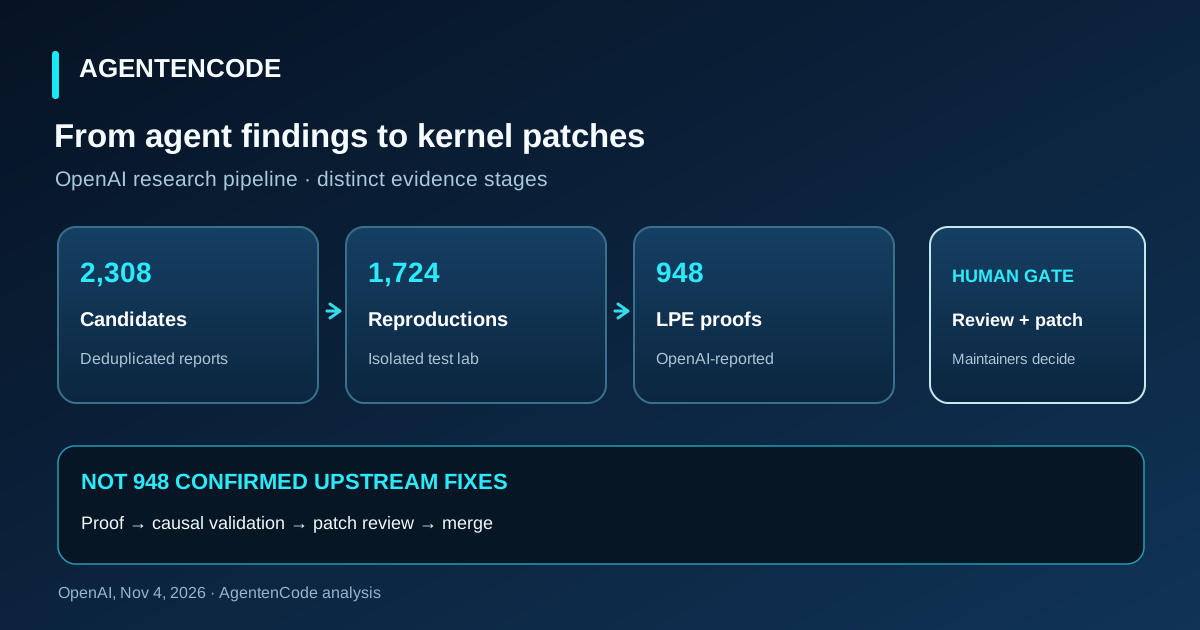
OpenAI reports that its Scout agents first selected 5,034 security-relevant audit targets covering roughly 2.8 million lines of code, or about seven percent of the kernel codebase evaluated. Analyst agents then generated 2,308 deduplicated candidate findings. Later stages dynamically reproduced 1,724 flaws. The run produced 948 working LPE exploits and 291 information-leak proofs of concept. These measures describe different stages and overlap; adding them would be analytically wrong.
The campaign targeted a specific kernel snapshot and controlled environment in mid-October 2026. A product owner must still establish whether an affected code path exists in the exact kernel version, configuration, isolation boundary and patch level used in production.
2. Agent roles, not a magic one-shot prompt
Scout agents identify reachable code. Analyst agents propose flaws and root causes. Controlled execution attempts to reproduce each issue. Specialized validation tests whether the claimed vulnerability actually underlies the observed effect. Patch generation produces candidate fixes and supporting evidence. Human researchers and Linux maintainers still decide whether a report or patch is correct and ready to ship.
That final gate is crucial. “Autonomous research” is not “autonomous production kernel patch deployment.” An organization adopting similar methods needs explicit authorization and an audit trail for every analysis, validation, report and patch approval step.
3. Root access is not sufficient proof
An especially instructive failure mode appears in the original report. Of 200 early exploit successes, 20 obtained root by exploiting a different zero-day than the assigned finding. The terminal outcome looked successful even though the causal attribution was wrong. OpenAI says it tightened its tests to verify that each exploit exercised its assigned flaw.
Our interpretation: Agent evaluation must capture *how* a result was achieved, not merely whether the final state was reached. This applies to software agents that edit repositories, run tools, handle customer records or remediate incidents, not just security research.
4. Understanding the cost claim
The reported run used $1.213 million in API credits, approximately $1,279 per reported LPE exploit. OpenAI models an illustrative $18.9 million–$66.3 million comparison using historic competition bounty levels. These are hypothetical reference values, not actual bounty receipts or a proven return on investment. Duplicate vulnerabilities, contest eligibility, remediation timing, infrastructure cost, human triage and disclosure constraints matter.
For defenders, a more relevant metric is cost per independently confirmed, previously unpatched, environment-relevant vulnerability that receives a reviewed and deployed fix. This metric cannot be derived directly from the headline numbers.
5. Faster discovery increases maintainer pressure
OpenAI describes multiple findings that had already been patched or were being discussed while its research run was under way. That makes current-branch revalidation, duplicate suppression and careful disclosure as important as generation. A report without accurate versions, root causes, supporting reproduction and a reasonable patch can shift the workload to unpaid maintainers rather than improve security.
Operational gates should include an authorized target scope, isolated execution, known test image and kernel build, root-cause validation, human sign-off, maintainer coordination, post-fix regression tests and rollback plans.
6. AgentenCode decision matrix
| Stage | Reported evidence | Required control | What it cannot establish |
|---|---|---|---|
| Select audit surface | 5,034 targets | Authorized scope | Exhaustive code coverage |
| Candidate discovery | 2,308 findings | Deduplication and ownership | Exploitability |
| Dynamic validation | 1,724 reproductions | Controlled environment | General production impact |
| LPE validation | 948 working exploits | Independent causal verification | All versions affected |
| Proposed patches | Candidate fixes | Maintainer review and regression testing | Patches are upstream and deployed |
The figures are from OpenAI; the controls and decision framework are AgentenCode's editorial analysis. The accompanying original SVG should visualize the evidence funnel and the human approval line without offensive instructions.
7. The broader agent lesson
Security-agent capability can scale faster than institutional review. Reliable deployments therefore need to measure validated fixes that reach affected systems, not the number of generated exploit or issue reports. They also need independent evaluation of causal correctness: OpenAI's own 20-of-200 example shows why an apparently successful agent run can fail the evidentiary standard.
Open-source communities may benefit from stronger reports, but they can also be overwhelmed by unverified automation. Identity, rate limits, source provenance, minimal privileges, contributor policies and maintainers' approval authority are part of the technical safety system.
FAQ
Did OpenAI patch 948 Linux vulnerabilities? No. It reported working exploits and candidate patches; the article does not demonstrate 948 merged fixes.
Does this mean every Linux server is vulnerable? No. Exposure depends on specific versions, configurations, code paths and updates.
Can teams buy and run the exact pipeline? OpenAI describes a research prototype and an upcoming cyber model, not an established generally available product.
What should defenders do now? Maintain patch hygiene, authorize any security testing, isolate research environments and independently check root causes and remediation results.
Methodology and related coverage
This article was drafted with AI assistance from OpenAI's dated primary publication. All quantitative claims remain vendor-reported; no independent exploits, code audits or agent runs are claimed. Contextual internal links to AgentenTrust, agent evaluation and prior formal-verification coverage should be validated at publication time.
Primary source: https://openai.com/index/a-thousand-fewer-paths-to-root/