
GitHub Copilot adds plugin-only controls for MCP tools and custom agents
GitHub adds source controls for MCP servers, skills and custom agents. Learn why plugin-only is not an allowlist, plus the practical governance checks.

A new administrative boundary for agent tools
On November 16, 2026, GitHub announced a setting that allows GitHub Enterprise Cloud administrators to require eligible Copilot customizations to originate from plugins or enterprise-managed settings rather than standalone user or project configuration.
That is a meaningful source-control mechanism for coding-agent environments. It is not proof that an installed plugin is safe or that every agent action is authorized.
The official GitHub changelog states the new enterprise setting and its boundaries; other policies remain necessary.
Five categories with distinct privileges
The strictPluginOnlyCustomization setting covers skills, custom agents, hooks, MCP servers and executable Copilot extensions. Administrators may apply it across all five categories or select individual ones. For example, MCP servers and executable extensions can be restricted while skills stay open.
Selective rollout matters: a blanket restriction without an inventory can disrupt existing workflows, while narrower policies can target the highest-impact execution and data-access surfaces first.
Plugin-only does not mean an approved marketplace
GitHub explicitly distinguishes the new source rule from an enterprise marketplace allowlist. Plugin-only controls how a customization is provided; it does not automatically determine which plugin marketplace is trusted. GitHub points administrators to strictKnownMarketplaces for a second restriction layer.
Conflating plugin-only with enterprise-managed-only access would overstate the protection. A policy can exclude loose local customizations while leaving an overly broad set of plugins available.
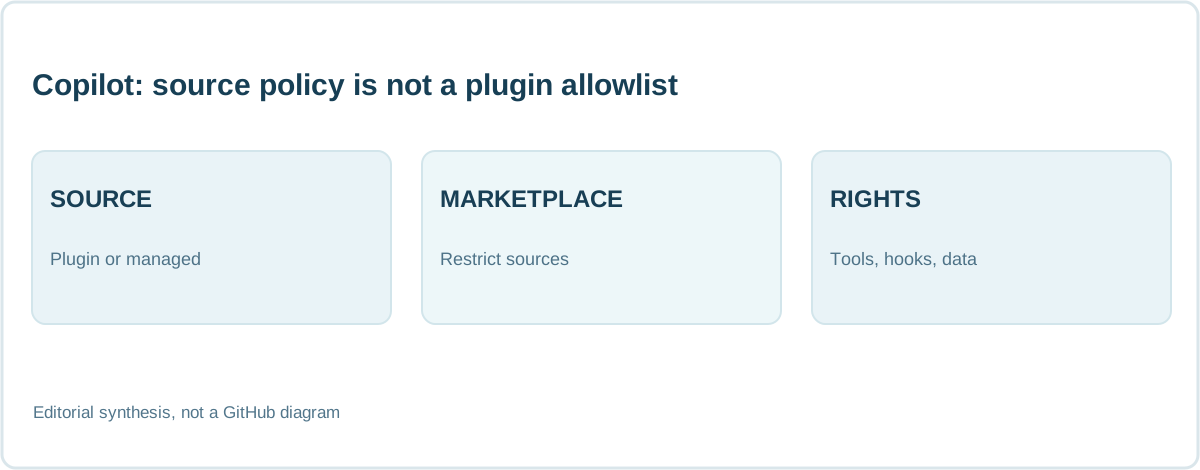
How managed settings work together
GitHub documents extraKnownMarketplaces to add approved marketplace sources and enabledPlugins to require or block particular plugins. Managed enterprise settings take precedence over repository defaults and user choices. Private plugin-marketplace repositories still require appropriate read access.
A serious rollout should connect each plugin to its origin, version, owner, required permissions and review history. Configuration policy is one governance layer—not a substitute for runtime monitoring or software review.
An AgentenCode five-question assessment
Origin: Which marketplaces supply the tool? Identity: Which agent or developer loads it? Permissions: Which repositories, files and MCP actions can it access? Execution: What can hooks or extensions run? Evidence: Where are configuration changes and approvals logged?
This is AgentenCode's own operational checklist derived from the published policy surface, not a benchmark or certification by GitHub.
Eligibility and rollout limits
GitHub scopes the announcement to GitHub Enterprise Cloud members with Copilot Business or Copilot Enterprise licenses supplied by their enterprise or its organizations. It does not establish universal availability for every GitHub Copilot tier, offline editor or GitHub Enterprise Server setup.
Organizations should verify client support, existing settings and migration paths before enabling restrictions across their workforce.
What the setting cannot prevent
An allowed plugin may still request broad permissions or contain vulnerable code. A tool response might attempt prompt injection; credentials can be exposed through unsafe runtime behavior; and a policy may authorize a component without verifying its outputs.
Least privilege, verified MCP servers, protected branches, human approvals for consequential actions and incident-ready audit trails remain necessary.
AgentenCode assessment: central source controls are only the start
The announcement moves part of Copilot governance away from uncontrolled local customization toward centrally distributed rules, potentially reducing configuration drift across teams.
For a defensible decision, separate where the tool came from, what it may do, and what it actually did. See AI agent security and AgentenTrust for broader controls.
Frequently asked questions
What does strictPluginOnlyCustomization do?
It allows enterprise admins to require eligible Copilot customizations to come from plugins or managed settings across five categories.
Does plugin-only imply an approved plugin list?
No. Marketplace restrictions such as strictKnownMarketplaces are separate.
Who is eligible?
GitHub identifies GitHub Enterprise Cloud members with enterprise-issued Copilot Business or Copilot Enterprise licenses.
Does it replace a security audit?
No. Permissions, runtime behavior, versions and change approvals require separate controls.
RESEARCH & CONTEXT
Sources for this article
This analysis relies on the original publications linked below, which readers can inspect directly.
- GitHub Changelog, 16 Nov 2026 – Control where GitHub Copilot customizations come from
- GitHub Docs – Managing plugin marketplaces and plugins with enterprise-managed settings
Checked November 17, 2026. Vendor statements, pilot scope and preview benchmarks have not been independently reproduced or certified.