
Claude Duet preview: A proactive AI agent, but not for everyone
Claude Duet brings a proactive agent to calendar, email and work apps, with approval gates for sensitive actions. It is a US waitlisted research preview, not a global release.
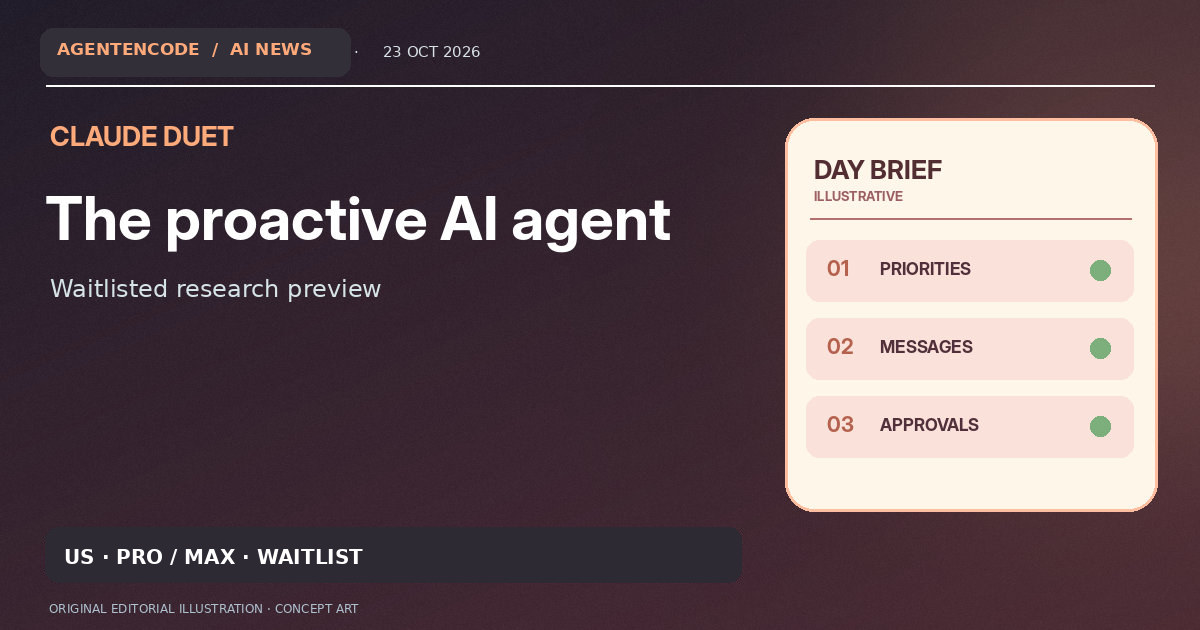
Anthropic announced Claude Duet on October 21, 2026 as a research preview. Access initially opens via waitlist to US Pro and Max subscribers. Built around Claude Opus 5.5, the agent checks connected apps, continues tasks in its own virtual machine and, according to the vendor, requires approval before sending messages, paying, signing or deleting.
CLAIM-LEVEL EVIDENCE
What is evidenced and still open
First-party announcements, vendor claims and open questions remain separate.
- Primary source
US waitlist, not global launch
Anthropic says the research preview initially targets US Pro and Max subscribers.
- Vendor claim
Background proactive work
Duet uses its own virtual machine and periodically inspects connected services.
- Vendor claim
Human approval gates
The vendor describes confirmation before messages, payments, signatures and deletion.
- Open question
Reliability in real workflows
Anthropic warns about missed priorities, limitations for personal errands and invisible browser work.
Vendor releases are not independent effectiveness tests. Methodology →
From chatbot to agent that reaches out first
Most AI assistants wait for the user to type a question. Claude Duet is designed to do the opposite. It reviews approved sources such as email and calendars, creates a morning briefing and contacts the user when it judges that something deserves attention. Anthropic announced the new product on October 21, 2026 as an early research preview, with Claude Opus 5.5 at its core. Duet is a separate application for iOS, Android and claude.ai, but availability requires an invitation. The positioning is ambitious: a proactive partner for professionals and small businesses, rather than a chatbot that handles one turn at a time.
Research preview, eligibility and usage limits
The current gate matters more than the demo. Anthropic is starting with Pro and Max users in the United States who join a waitlist. The company has not announced universal European access. The preview sits within those subscription plans and shares their limits. Background checks count against usage, just like foreground tasks, and lengthy projects can require many more model steps than a simple question. That makes the actual economics dependent on frequency and complexity. A daily briefing sounds inexpensive, but repeated monitoring of several business systems should be counted and capped before broader adoption.
Connected tools create a different security problem
Duet runs on its own virtual machine and browser so it can continue after the user's laptop or phone goes offline. According to Anthropic, it reads and prepares material autonomously while seeking approval before sending a message, signing a document, making a payment or deleting anything. Some financial actions, including trading securities and moving money between accounts, remain prohibited. The vendor describes isolated credential handling, protections against malicious hidden instructions, red-team exercises and external penetration testing. Those are relevant engineering practices, but the announcement does not provide an independently reproduced rate of prevented attacks across customer environments.
Where Anthropic admits Duet is immature
Anthropic says Duet can access connectors and plugins in the Claude Marketplace for workplace tools, including email, finance, sales and project platforms. More reach means more ways to make a consequential mistake. A confused thread summary could lead to an awkward business response; an overbroad connection could expose sensitive material. Anthropic acknowledges that Duet may misread a conversation or misjudge urgency, is less mature for personal errands and does not yet show the user its browser activity. Those constraints make its user experience and auditability quite different from conventional software automation with a visible event log.
A measured pilot is better than blanket access
A sensible pilot grants read-only access to test accounts first, then measures whether reminders are relevant and summaries match the underlying sources. Only afterwards should teams try drafted messages requiring human confirmation. Evaluations should include erroneous disclosures, denied requests, missed deadlines, unwanted notifications, access revocation and plan-limit consumption. The important change is not simply another agent feature. It is a proposal to let AI decide when to interrupt a person and which connected tools to coordinate. That responsibility calls for stricter oversight, especially before handling payroll, customer data or external communications.
EDITORIAL ASSESSMENT · NOT INDEPENDENT TESTING
AgentenCode analysis
Claude Duet points to a future where assistants initiate useful work. Its practical value depends on the accuracy of prioritization, clear approval boundaries, controlled app access and transparent usage—not the mere fact that it runs in the background.
Primary sources
Original announcement: 2026-10-21; editorial publication: 23.10.2026.
Frequently asked questions
Is Claude Duet available globally?
No. Anthropic initially offers a US Pro/Max waitlist research preview and has not promised general global access.
Does it work while my computer is off?
Anthropic says Duet runs in its own virtual machine and can keep working in the background.
Can it send messages or pay without approval?
The vendor describes approval gates for those sensitive steps and blocks certain financial operations entirely.