
Perplexity launches Multiagent: Up to 16 AI agents collaborate across models
Perplexity Computer adds Multiagent above Ultra. Up to 16 Claude, GPT and Gemini agents share findings and check each other's work. Max-only access and costs explained.

An AI assistant becomes the leader of a team
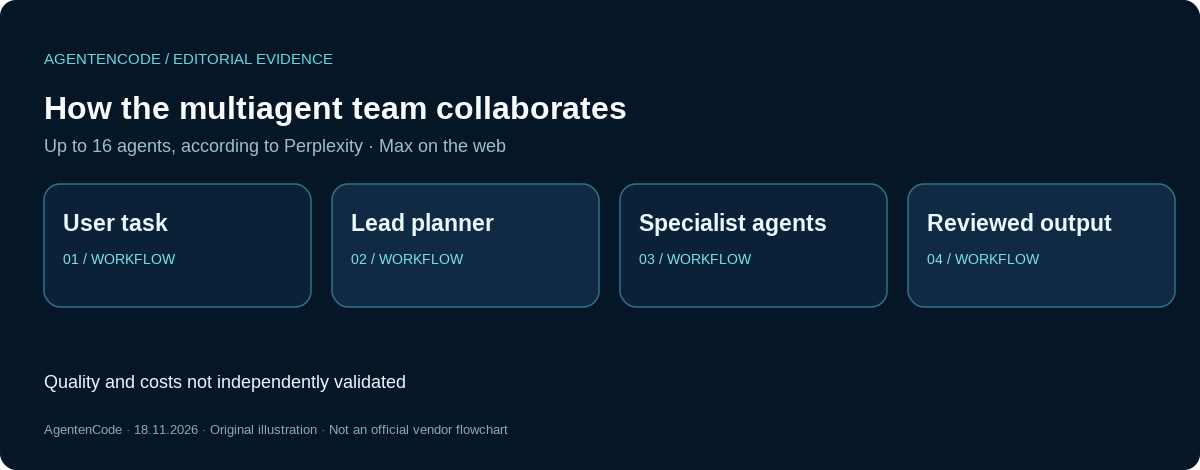
Perplexity introduced Multiagent for Perplexity Computer on November 17, 2026. The new effort level allows a lead agent to coordinate up to 16 agents, rather than only assigning isolated subtasks to helpers. The team can work in parallel, exchange findings directly and inspect conflicting assumptions before combining the work into one deliverable.
The idea is to tackle complex, interconnected assignments. A single assistant might produce a convincing financial forecast while missing a key assumption; a group could divide the work into scenarios, source reviews and independent checks. Whether the team actually performs better depends on the quality of collaboration, not simply how many models run. The wider product is covered in our Perplexity Computer profile.
Different AI models work on one assignment
According to Perplexity's official announcement, Claude Fable 5.2 plans the task. The default supporting set includes Claude Opus 5.5, GPT-6.1 Sol and Gemini 4 Carbon. Additional models such as GPT-6 Astra may join when requested or when a particular subtask justifies their use.
Mixing providers could expose weaknesses that a single system overlooks. Yet several models can also inherit the same bad source or reinforce each other's mistakes. Cross-checking only adds value if evidence, assumptions and disagreements remain visible rather than being flattened into a confident-sounding summary.
What direct agent-to-agent communication means
Perplexity says the team members can share findings and coordinate edits to shared files as a task progresses. One agent might change revenue assumptions in a workbook and inform another agent that its valuation should be recalculated. The lead agent remains the user's point of contact and gathers the outputs into the requested report or artifact.
Follow-up instructions can update the existing work without restarting every subtask. The company says users can see which agents and models are active, while stopping the conversation thread stops the team. How reliably concurrent document edits and unexpected conflicts are handled still needs real-world verification.
Where Multiagent is designed to help
The official use cases include financial scenario planning, annual-report reviews, deal-data-room diligence, deep research and complex tax preparation. These jobs contain related but distinct parts. One agent can examine footnotes, another analyze figures and a third check whether a contract alters the assumptions behind a forecast.
Such examples are vendor illustrations, not audited proof that tax advice is legally sound or a valuation is correct. Financial and legal work still requires accountable human review, evidence tracing and explicit approval before any external action. Users should treat a polished report as a draft until its critical details are verified.
How it differs from Ultra and Model Council
Perplexity distinguishes three modes. Ultra has one lead delegate work, with supporting agents reporting mainly to the leader. Multiagent encourages supporting agents to communicate directly, cross-check findings and contribute to shared deliverables. Model Council focuses more on separate models answering the same question independently before their perspectives are compared.
An interconnected project with many moving parts may suit Multiagent, while a high-stakes judgment requiring independent perspectives might fit Model Council. There is no reason to assume that the largest group is automatically the best choice. Extra collaboration creates communication overhead and possibly greater model and tool costs.
Availability and pricing limitations
The important access restriction is that Multiagent is available to Perplexity Max subscribers on the web, selected through Computer's effort slider. The announcement does not claim a general free release or identical access for every Pro subscriber and mobile client.
Perplexity also does not specify a universal fixed credit charge for a Multiagent task. Up to 16 active agents and multiple frontier models make cost visibility important. Anyone planning recurring analytical work should inspect current credits and spending limits rather than assuming this setting will always be more economical than Ultra.
A test that could show a real improvement
A practical evaluation would use an anonymized annual report containing known inconsistencies and ask Multiagent to compare disclosures, reconcile figures and produce a traceable review log. Run the same assignment in Ultra and optionally Model Council. Measure correct findings, missed errors, unsupported claims, total elapsed time and actual credit use.
Teams should also inspect permission boundaries and shared-file version history. If several agents can edit one workbook, the organization needs to know who changed which assumption and why. Parallel execution makes a compelling demo; reliable, reproducible collaboration is a much higher standard.
AgentenCode assessment: agent teams become a product category
This launch shows the move from one chatbot to a coordinated team of AI workers using multiple model families. Direct communication between agents is the notable technical step. It could improve complex analysis if the shared evidence and coordination mechanisms work as intended, but more agents also create more failure paths and variable costs.
As of November 18, 2026, Multiagent is a newly released feature for eligible Max web users, not merely a research roadmap. The 16-agent capacity and model mix are documented product details. Independent evidence that it improves results or lowers costs across real workloads is still needed.
Frequently asked questions
How many AI agents can Perplexity Multiagent coordinate?
Up to 16 agents, according to the official launch post, with direct information sharing and cross-checking.
Which AI models are used?
Perplexity names Claude Fable 5.2 as lead and Claude Opus 5.5, GPT-6.1 Sol and Gemini 4 Carbon as default supporting models, with optional additions.
Is Multiagent available on the free plan?
No. The announced availability is for Perplexity Max subscribers on the web; the post does not publish a single fixed price per task.
How is this different from Model Council?
Multiagent coordinates agents on connected subtasks, while Model Council collects largely independent perspectives on the same question.
RESEARCH & CONTEXT
Sources for this article
This analysis relies on the original publications linked below, which readers can inspect directly.
- Perplexity: Introducing Computer's Multiagent effort level, 17.11.2026
- Perplexity: Effort Mode, GPT-6 Astra & Skills Marketplace, October 2026
- MarkTechPost: Perplexity Computer adds Multiagent, 17.11.2026
Checked November 18, 2026. Vendor claims, partner pilot scope and productivity benefits have not been independently reproduced or certified.
Related agents, systems and context
Product links identify the subject of a report; ecosystem links provide context, not shared feature claims.
- Ecosystem contextPerplexity · Computer, Comet & Research
- Background guideMulti-agent systems