
Meta AI chief Alexandr Wang sees superintelligence approaching: What the Riemann proof really shows
Alexandr Wang says superintelligence is arriving. What the certified Claude-assisted Riemann proof demonstrates—and what remains unproven for AI agents.
Why Meta AI chief Alexandr Wang calls this a turning point
In his essay “Superintelligence is Arriving”, Meta Chief AI Officer Alexandr Wang links recent advances in AI-assisted mathematics to a much broader forecast: artificial intelligence may soon surpass human research capabilities in fundamental ways. His November 2026 argument draws heavily on an extraordinary development involving the Riemann hypothesis. Wang also raises the question of whether people will retain meaningful control as AI systems become more capable.
Two claims must be kept separate. A formally verified mathematical proof is a specific scientific result; the arrival of generally superhuman intelligence is a much wider assertion. Wang offers a strategic interpretation, not a measured demonstration that an available autonomous agent can outperform every human across all domains. A useful analysis therefore begins with the verified mathematics and only then examines what the event may imply for agent systems.
Primary source: Alexandr Wang – Superintelligence is Arriving (Originalessay, 22. November 2026)
What was actually certified about the Riemann hypothesis
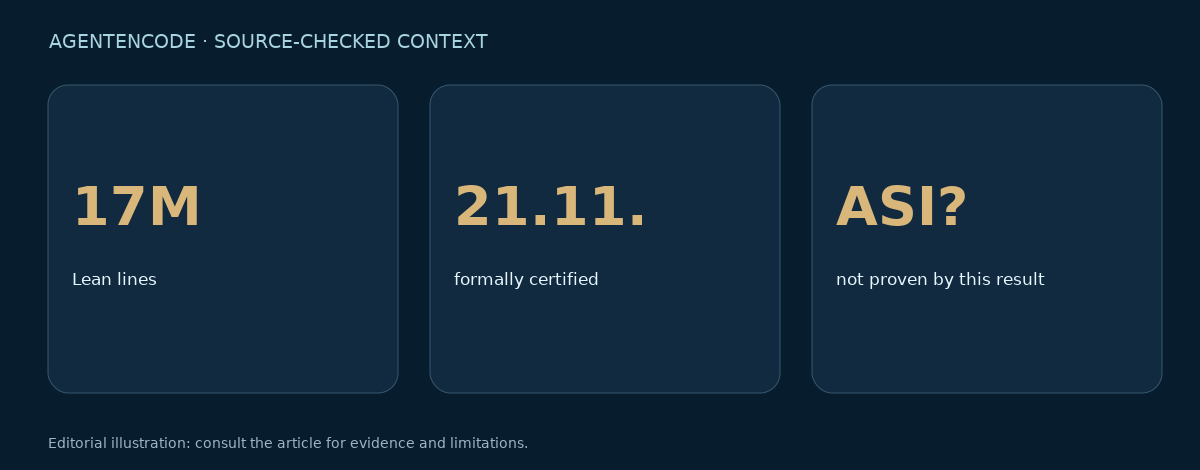
On November 20, Anthropic mathematician Levent Alpöge announced that he had found a proof of the Riemann hypothesis while working with Claude. The 1859 conjecture concerns nontrivial zeros of the Riemann zeta function and has deep implications for number theory. The initial proof artifact was an exceptionally large Lean library of roughly 17 million lines rather than a conventional mathematical exposition accessible at a glance.
On November 21, the Lean and Mathlib communities jointly certified the formal statement and proof after independent checks. Their statement reports successful compilation, confirmation that the proved theorem matches the carefully scrutinized Mathlib statement, and acceptance of the exported proof by several checkers. That is much stronger evidence than a company press release. It does not mean the full mathematical strategy has already been condensed into an explanation that researchers can readily survey and teach.
Claude's contribution and the mathematician's direction
Alpöge's first-hand account complicates claims that a machine solved the problem alone. He had spent years thinking about the conjecture, identified promising connections and guided the investigation toward specific mathematical settings. At the same time, he describes Claude producing unexpectedly powerful suggestions late in the work. The collaboration was neither ordinary chatbot summarization nor a controlled experiment showing an unattended agent completing the same task from scratch.
Public evidence cannot support a precise percentage split of original insight between Alpöge and Claude. What can be described is the process: generating hypotheses, following alternative lines of reasoning and ultimately checking the result inside a formal system. This is substantial evidence of AI-assisted discovery. Whether the same model could have reached the outcome without Alpöge's expertise, problem selection and ongoing direction is a different question that remains unanswered.
Background reading: AI knowledge
Four claims that should not be conflated
First: independent Lean and Mathlib specialists certified the formal proof. Second: Claude contributed to the argument according to Alpöge's account. Third: the episode provides compelling evidence that AI can support research at an extraordinary mathematical level. None of these propositions logically requires a finding that a particular model has already reached general superintelligence.
Fourth: Wang's broader claim that superintelligence is arriving is a forecast and interpretation. The formal proof checks did not evaluate autonomous competence across all scientific disciplines, businesses and real-world environments. They did not establish unlimited recursive self-improvement or reliable decisions under safety constraints. A remarkable number-theory result is an important capability signal, but it is not a universal benchmark for agents and cannot grant broad operational authority by itself.
Why the result matters to research agents
For agent development, the striking feature is the combination of idea generation, tool use and independent verification. A specialized assistant proposes candidate arguments, a proof checker can reject invalid formal steps, and a human researcher can select goals, worthwhile subproblems and productive methods. This arrangement may be far more robust than asking one language model to judge another model's plausible-sounding text without an external standard.
The Riemann episode points toward research agents able to handle long tasks, pursue intermediate goals, revise approaches after formal feedback and create reproducible artifacts. The pattern is especially useful where success criteria can be machine checked. Software engineering has related approaches using tests and formal verification. Even there, however, a passing test cannot automatically prove that requirements were complete, permissions were appropriate or the project pursued the right objective.
Why mathematics is not equivalent to every scientific field
Formal mathematics benefits from a precisely stated theorem and machine-verifiable validity conditions. Other fields are much messier. In medicine, biology and materials research, hypotheses generally require experiments, measurements and independent replication. A compelling explanation, realistic simulation or valid intermediate calculation is not a substitute for that evidence. Moving from mathematical discovery to scientific autonomy involves additional institutions and physical constraints.
Autonomous agents in these fields need data rights, specialized instruments, resource budgets, error handling and human approval. Outstanding mathematical performance does not prove that the same system can reliably discover a medicine, run a critical production service or make high-stakes safety decisions without supervision. The practical questions are task specific: Are outcomes independently measurable? Can results be reproduced? What failures remain possible even when a model performs its immediate steps correctly?
The governance issue behind the superintelligence argument
Wang's essay also concerns human agency. As more planning, research and operations become delegated to AI, someone must still determine goals, constrain tools and investigate unexpected behavior. Autonomous agents need scoped permissions, action logs, explicit approvals and reliable interruption mechanisms. Intellectual capability by itself is not a governance or security framework.
The perspective has a relevant institutional context. Wang leads the AI organization of a company competing to develop powerful models. His intervention matters in the public debate, but it is not an independent risk assessment. Organizations should neither treat the Riemann achievement as a universal production authorization nor dismiss the breakthrough. The constructive response is to evaluate measured reliability, verify human control points and distinguish model suggestions from tests and real-world actions.
Assessment: a scientific breakthrough, not a universal ASI proof
The formally verified Riemann proof is an extraordinary mathematical development. Alpöge's work with Claude documents the role AI can play in a problem that resisted generations of researchers. Independent Lean and Mathlib verification makes the evidence unusually substantial. A readable exposition and further community analysis are still valuable, but their absence should not be confused with the formal checks already completed.
The most durable lesson for autonomous agents is not that superintelligence has now been established beyond doubt. It is that systems combining powerful reasoning with specialized, independently verifiable tools can contribute to highly complex discovery. Wang's prediction deserves serious examination, while remaining distinct from the certified mathematical result. Credible progress will depend on transparent sources, independent tests and enforceable boundaries around autonomous decisions.
Frequently asked questions
Did Claude prove the Riemann hypothesis without a mathematician?
That is not established. Alpöge describes a collaboration in which he directed the research and Claude made significant suggestions.
Was the formal proof independently certified?
Yes. On November 21, 2026, the Lean and Mathlib communities certified both the statement and the formal proof after several independent checks.
Does the proof establish that artificial superintelligence already exists?
No. It is important evidence of exceptional AI-assisted mathematics, not a universal test of autonomous capability across all domains.
What should developers of AI agents learn from the episode?
Use independent validators, scoped tool permissions, human approvals and reproducible workflows rather than trusting spectacular model output alone.
RESEARCH & CONTEXT
Sources for this article
This analysis relies on the original publications linked below, which readers can inspect directly.
- Alexandr Wang – Superintelligence is Arriving (Originalessay, 22. November 2026)
- Levent Alpöge – A remark (Originaler Forschungsbericht, 20. November 2026)
- Lean / Mathlib – Lean verification of the Riemann Hypothesis (21. November 2026)
- Lean-Gemeinschaft – Formale Beweisdateien
Reviewed November 23, 2026. Vendor claims and research results are attributed; future real-world performance is not assumed.
Related agents, systems and context
Product links identify the subject of a report; ecosystem links provide context, not shared feature claims.
- Background guideWhat is an AI agent?