
Microsoft brings Aion Instruct to Edge: AI runs inside the browser
Microsoft Edge replaces Phi-4-mini with 2.3B-parameter Aion Instruct. What local inference, the Prompt API origin trial and experimental Decisions API actually mean.
A new place for AI: inside the web browser
On November 19, 2026, Microsoft introduced Aion Instruct as the new built-in small language model for Edge, replacing Phi-4-mini. The company also made the model weights available on Hugging Face. The goal is not another general-purpose search engine, but practical text intelligence that compatible websites can use directly on suitable user devices.
The broader strategy is hybrid inference. Simpler tasks can run locally, while demanding work may use a deliberately configured cloud provider. That separation could improve responsiveness and cost, but the implementation must remain understandable to users.
Primary source: Microsoft Edge Blog – Hybrid intelligence on the Web: Introducing Aion Instruct and Prompt API in Microsoft Edge (19 Nov 2026)
Why 2.3 billion parameters matter
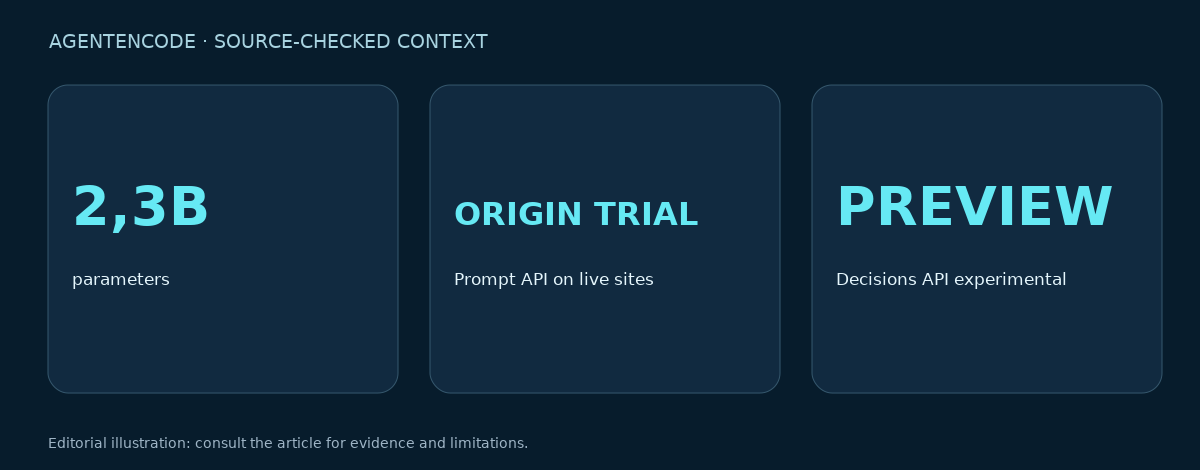
Aion Instruct contains 2.3 billion parameters. Microsoft describes it as smaller and faster than Edge's previous model, with comparable quality on common tasks such as summarization, instruction following, text drafting and structured outputs. These comparisons are company claims, not an independent performance evaluation.
Small models can be accessible on more devices, but they are not automatically suitable for specialist reasoning, very long context or complex planning. Actual latency and reliability depend on the browser, local hardware and task. Comparing Aion unconditionally with flagship cloud models would misrepresent the intended use.
What on-device processing changes
Microsoft says Edge downloads the model when a site or browser feature first needs it, provided that the device meets requirements. Users may disable on-device AI in settings, which removes the local model and prevents future downloads.
On-device computation can reduce the need to send inputs to external inference endpoints. It does not mean a website stops communicating with servers. Site analytics, separate services and hybrid fallback paths can still transfer data. Those flows need their own privacy review.
Background reading: AI knowledge
Prompt API opens a trial for live sites
Previously, developers could experiment with the Prompt API primarily in Canary and Dev builds. An origin trial now allows registered websites to test the capability with real visitors using compatible versions of Edge. Potential applications include short summaries, content classification and structured text assistance.
An origin trial is not a promise of universal browser support or a stable final web standard. APIs and device requirements may change. Production designs need graceful fallback when local inference is unavailable, and should not silently send sensitive text elsewhere as a substitute.
Decisions API: structured responses without long prose
Microsoft also presented an experimental Decisions API for yes-or-no questions, multiple-choice classifications and numerical scores. Instead of generating paragraphs, the model can return compact outputs with probability and confidence information.
Applications could categorize support requests or route product feedback. For now, the Decisions API remains a developer preview in Edge Canary and Dev. Confidence estimates should be calibrated against real examples before they control important actions or user experiences.
Potential business benefits and costs
Local AI may reduce inference charges and network delays for narrow, repetitive tasks on high-traffic websites. It might also help organizations keep selected text processing on user devices where that is preferable.
However, deployment still involves model downloads, hardware variation, quality monitoring, unsupported devices and maintenance. Cost and privacy claims require measurements of the complete system, not just the fact that a model runs locally.
What a serious pilot should measure
Developers should test representative devices, languages, latency, failure conditions and actual network traffic. They should establish an explicit alternative when the model cannot load, the API is unavailable or a question exceeds its capability.
Even a valid structured response can be substantively wrong. High-impact decisions still require calibration, safeguards and sometimes human review. Local execution makes an AI system easier to deploy in some contexts, not inherently more accurate.
Our assessment: a meaningful browser experiment
The important shift is from visiting an external AI service toward browsers offering reusable language functionality. If the relevant standards and implementations mature, routine AI features may become easier to add to websites without a separate model integration for every interaction.
That is a promising infrastructure change, not the end of cloud AI. We would judge success by cross-browser interoperability, transparent data handling and reliable outcomes under everyday device constraints.
Frequently asked questions
What is Aion Instruct?
An open-weights language model with 2.3 billion parameters that Microsoft now uses as Edge's built-in small language model.
Is the Prompt API available on every website?
No. Its current live-site access uses an origin trial and compatible devices, not universal browser support.
Does on-device AI mean all website data stays private?
No. Local model inference does not prevent websites or fallback services from sending data to external servers.
Is the Decisions API production ready?
No. Microsoft currently identifies it as an experimental preview for developers using Edge Canary and Dev.
RESEARCH & CONTEXT
Sources for this article
This analysis relies on the original publications linked below, which readers can inspect directly.
- Microsoft Edge Blog – Hybrid intelligence on the Web: Introducing Aion Instruct and Prompt API in Microsoft Edge (19 Nov 2026)
- Microsoft Aion Instruct official model card
Reviewed November 22, 2026. Vendor claims and research results are attributed; future real-world performance is not assumed.
Related agents, systems and context
Product links identify the subject of a report; ecosystem links provide context, not shared feature claims.
- Ecosystem contextMicrosoft · Copilot & Foundry
- Background guideAgent evaluations and testing
- Background guideComputer use and browser agents