
Perplexity Agent API: Research Costs Fall Sharply—but When Does Ultra Actually Pay Off?
Perplexity updated the predefined effort levels of its Agent API on November 5. The company says every effort level now costs less at equal or improved research quality, while a new ultra tier runs three research agents in parallel and a fourth agent synthesizes their findings. This is not merely another pricing announcement: it changes how developers should think about evidence gathering, agent budgets, context compaction and workflow reproducibility.

What actually changed
Effort levels bundle a model choice, research-step budget, tool limits, search configuration and related orchestration into one named setting. Developers do not need to rebuild a research harness for every task. Perplexity says its current configurations are cheaper without sacrificing quality.
The new ultra level focuses on particularly wide or difficult research. Importantly, a request that selects a named effort level can automatically receive a newly optimized configuration. Operators who need reproducibility should investigate version pinning and retain evaluation records rather than assuming a tier name always means the same underlying model and settings.
What the numbers really say
| Provider-reported test | Result | Important distinction |
|---|---|---|
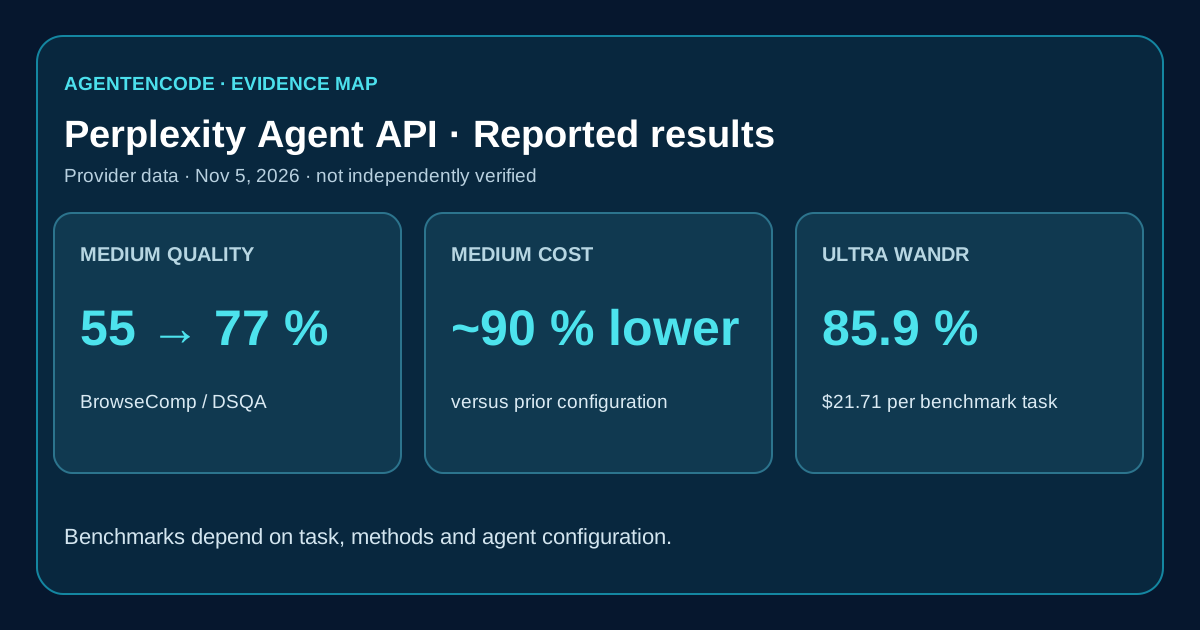
| Medium on BrowseComp/DSQA | 55% → 77% | Specific benchmark tasks; not universal accuracy |
| Medium cost | Almost 90% lower | Relative cost change, not a flat price |
| Xhigh on WANDR | 76.5% | Around a quarter of its August configuration cost |
| Ultra on WANDR | 85.9% | $21.71 per measured benchmark task |
| High with relevant extraction | 88.0% at $0.073 | Compared with 83.5% at $0.094 without extraction |
These are vendor-reported tests. WANDR is Perplexity's own benchmark for difficult, long-form multi-entity research. AgentenCode has not independently reproduced the scores or measured the cost of a real production request.
Ultra is four agents, not one magical model
Ultra assigns the full task to three independent research agents. A fourth agent merges, deduplicates and drafts the result. Independent searches can uncover different sources, contradictions and missing evidence. But the architecture also repeats work and consumes more tool calls, context and time.
This makes ultra a candidate for rare high-value analysis rather than a sensible default for routine lookups. The stated $21.71 WANDR cost illustrates that the top score has a price and should not be interpreted as a rate card for arbitrary user requests.
Better budgets matter more than unlimited loops
Perplexity describes five recurring cost drivers: weak budgets, overloaded context, poor workflow choice, unsuitable model selection and unnecessary parallelism. It therefore limits both steps and tool calls, since a single model step can invoke multiple tools.
In one disclosed experiment, increasing a step budget from one to fifteen improved benchmark accuracy from 41% to 80%, but the query cost rose from $0.0017 to $0.0152. More agent work can improve quality, but only if additional search and verification are worth the spending.
Another example reduced a 5,561-token fetched page to 293 task-relevant tokens with extraction. In the vendor's tests, extraction reduced context overhead and improved both score and spend. Operators must still preserve traceable original sources and citations.
Skills and checkpoints are practical infrastructure
The updated harness loads skills progressively, introducing the full workflow instructions only when needed. This avoids repeatedly paying for irrelevant instructions in a growing context window.
A documented WANDR workflow processed 188 profiles, successfully completed 160 and initially missed 28. A checkpoint preserved the completed records so the retry processed only the remaining 28. This pattern is immediately valuable for real systems: save source versions, decisions and completed subtasks outside the model, then resume precisely where work failed.
AgentenCode decision matrix
| Workflow | Suggested starting point | Essential control |
|---|---|---|
| Simple factual lookup | Fast / lower effort | Source check if consequential |
| Recurring product-change watch | Medium | Dedupe and incremental refresh |
| Complex technical research | High / xhigh | Evidence trace, step and tool budgets |
| Rare, high-value due diligence | Evaluate ultra | Independent sources and human review |
| Legally binding or privileged action | No fully autonomous approval | Human sign-off and enforced permissions |
These are editorial operating recommendations, not guaranteed product features or SLAs. Real billing, data handling, region and contract terms require endpoint-specific checks.
A useful evaluation plan
Select twenty representative tasks with known answers, grouped into simple lookups, multi-hop research and broad source comparisons. Run them with identical tool permissions across effort levels. Measure outcome quality, citation fidelity, tool calls, wall-clock time, failures and total spend. Review both median cost and long-tail expensive outliers, then choose the cheapest tier meeting the real quality threshold.
FAQ
Does ultra always cost $21.71? No. That is the provider's cost per WANDR benchmark task in its published evaluation, not a universal subscription or per-request price.
Does the nearly 90% saving apply to all calls? No. It describes the medium configuration in the vendor's published comparison.
Why both step and tool-call limits? One model step may launch several tool calls, so a step cap alone does not constrain spend.
How is ultra different from xhigh? Ultra combines three independent full-task research paths through a fourth synthesis agent; xhigh is a deep research configuration without that fixed four-agent structure.
Can a named effort tier change? Yes. Perplexity updates bundled configurations. Pin versions and re-evaluate when reproducibility matters.
Conclusion
This release is compelling because it treats agent orchestration as an efficiency problem, not just a model-selection problem. Progressive skills, checkpointed work, bounded tools and task-aware evidence handling may save more money than switching to another frontier model.
Ultra is a valuable option for unusually complex research. It is not the right answer for every job. Productive agents should be judged by verified decisions per dollar, not the number of models running in parallel.
Sources & editorial context
Provider statements and editorial evaluation as of November 7, 2026. We did not independently reproduce benchmarks, install the product in production or certify its security.